
Good Proposals Die in the Approval Meeting
I've watched too many automation proposals die in approval meetings: decks stuffed with equipment specs, 3D renderings, and technology comparisons — and the boss asks only three questions: "How much?" "How fast is payback?" "What happens if we don't do it?" Fumble those, and the best proposal is worth zero.
Remember one truth: an approval meeting isn't a technical review — it's an investment decision. The boss thinks like an investor. He doesn't care whether the stacker crane is single- or double-deep; he cares whether the money is well spent, how big the risk is, and when returns show up. The five-step business case translates technical language into investment language.
Step 1: Quantify the Pain — Translate Hurt into Money
Bosses are numb to "low efficiency" and "hard to hire." They respond to numbers. Step one: translate every pain point into "dollars per year":
- Labor cost: headcount in this process × fully loaded annual cost (wages + benefits + overtime) = dollars/year. Include hidden labor: overtime from hiring gaps, temp premiums, training costs.
- Error cost: error rate × annual order volume × cost per error (return freight + reshipment + service + churn). Most warehouses are shocked the first time they compute this.
- Capacity bottleneck: how many orders lost per year for lack of capacity? Or how much overtime/outsourcing spent to protect it?
- Safety & compliance: incidents per year, payouts, regulatory exposure?
| Pain type | Quantification | Data source | |---|---|---| | Labor cost | Headcount × fully loaded cost | HR payroll | | Error cost | Error rate × volume × cost per error | WMS + service records | | Lost capacity | Lost orders × gross margin/order | Sales data | | Safety cost | Incidents × payout + downtime | EHS records |
Goal of this step: make the boss see "the cost of doing nothing" — what the status quo burns per year. That number is automation's "benefit pool."
Step 2: Compare Options — Always a Multiple Choice, Never an Essay Question
Never bring a single option to the meeting. One option gets "yes" or "no"; two or three get a choice — and approval rates differ completely.
Standard structure: conservative (semi-auto) → recommended (automation) → aggressive (full-auto). For each: investment, annual benefit, payback, risk level, timeline. Then state your recommendation and why — "I recommend option two: shortest payback with manageable risk; option one saves a little but can't fix the capacity bottleneck; option three is technically exciting but doubles the investment."
The subtext: you've already done the boss's thinking; he just nods.
Step 3: Financials — ROI and Payback, the Only Two Numbers That Matter
Financials don't need investment-banking complexity. Three numbers tell the story:
- Total investment: equipment + software + implementation + civil works + first-year maintenance. Watch out: civil works, power upgrades, and downtime losses are the classic omissions — every omitted line becomes an "overrun" later.
- Annual net benefit: labor savings + error reduction + capacity gains − annual operating cost (maintenance, power, consumables).
- Payback = total investment / annual net benefit. ROI = annual net benefit / total investment × 100%.
| Metric | Formula | Boss's gut line | |---|---|---| | Payback | Total investment / annual net benefit | < 3 years: easy yes; > 5 years: very hard | | ROI | Annual net benefit / total investment | > 30% is attractive | | NPV (optional) | Discounted benefits − investment | For large projects |
Rule of thumb: payback under 3 years, bosses barely deliberate; 3–5 years needs a burning pain point; over 5 years, don't bother unless it's strategic. Model conservatively: haircut benefits 20%, inflate investment 20% — implementation only ever runs more expensive and slower, never cheaper and faster.
Step 4: Risks and Mitigations — Lead with the Bad News
Decks that show only good news are a red flag. The boss is definitely thinking about risk; if you don't name it, he assumes it's huge. The right move: volunteer the top three risks, each paired with a mitigation.
- Implementation risk (delays, overruns): mitigate with milestone-based payments + acceptance gates + delay penalties in the contract;
- Technology risk (equipment missing promised takt): mitigate with acceptance criteria in the contract + performance holdback (10–15% of payment tied to acceptance);
- Operational risk (worker resistance, new-process ramp): mitigate with change management starting 3 months early + retaining key veterans + dual-track trial operation.
Naming risks doesn't cost points — it earns them. It tells the boss: this person has thought it through, not come to grab budget.
Step 5: Phased Plan — Make the Signature Easy
A tens-of-millions commitment makes hands shake. A phased plan "splits one big signature into small ones":
- Phase 1 (pilot): one zone / one line, 20–30% of investment, 3–6 months to validate;
- Phase 2 (rollout): replicate across the warehouse once phase 1 hits targets;
- Phase 3 (optimize): fine-tune on operating data.
Define each phase's go-criteria: "launch phase 2 if phase 1 payback ≤ 18 months." The boss isn't signing tens of millions — he's signing the first few million plus an option on data. Decision pressure collapses.
Case Study: An AGV Proposal That Passed
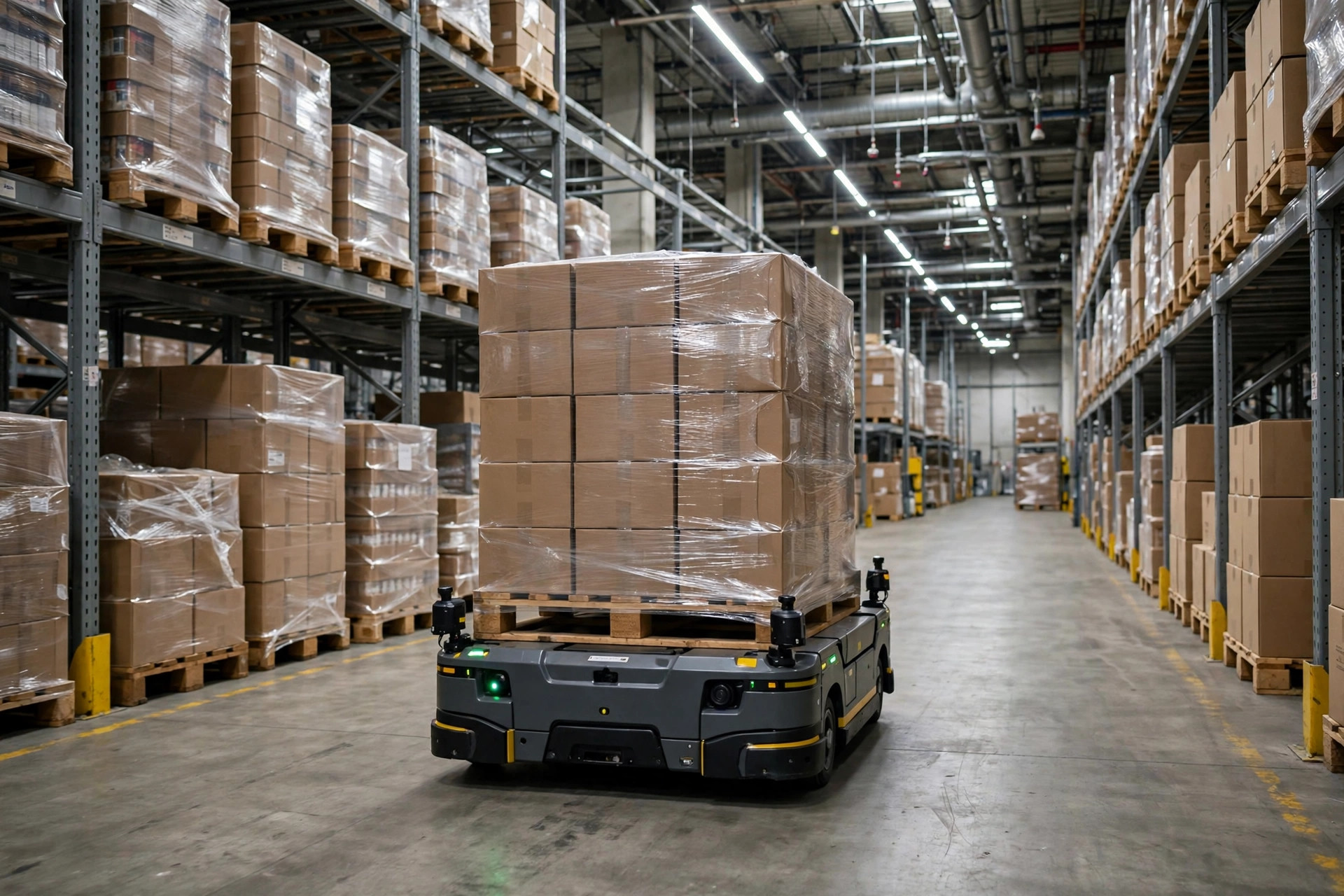
Background: a 3C manufacturing warehouse — 800 pallets/day between raw-material storage and production, 12 forklift operators on two shifts, $250K/year (¥1.8M) in labor, 2 minor pedestrian-forklift injuries.
Five-step summary:
- Pain quantified: $250K labor + $35K (¥250K) injury payouts and downtime + $42K (¥300K) forklift fuel/maintenance = $327K/year (¥2.35M) burned;
- Options: option one — more forklifts ($83K/¥600K, can't fix safety); option two — 8 AGVs + dispatch system ($444K/¥3.2M, recommended); option three — full lights-out incl. AS/RS ($1.7M/¥12M, too much);
- Financials: annual net benefit = $327K − $49K (¥350K) operating = $278K (¥2M); payback 1.6 years, ROI 62.5%;
- Risks: AGV/pedestrian mixing (dedicated lanes), WMS integration delays (phased go-live, fixed routes first);
- Plan: phase 1 — 4 AGVs on one lane ($222K/¥1.6M); add 4 more after 3 months of hitting targets.
Result: approved in one meeting; phase 1 hit targets in 3 months; phase 2 followed. The boss later said what sold him wasn't AGV technology — it was "1.6-year payback" and "let's try $222K first."
Pitfalls
- All tech, no money: more than 3 pages of equipment specs and the boss reaches for his phone. Technical detail goes in the appendix; the body covers money, time, and risk.
- Over-optimistic benefits: modeling labor savings as "fire everyone" when only 70% can actually be redeployed. Haircut benefits 20%, inflate costs 20% — coefficients bought with blood.
- Ignoring change management: equipment arrives, workers resist, new processes sputter — the project still dies. Write training, redeployment, and incentives into the proposal from day one.
- No alternatives: one option forces the boss into true/false. Always offer multiple choice — with your recommendation stated.
Takeaway
The five-step automation business case: quantified pain (cost of doing nothing) → compared options (multiple choice) → financials (payback math) → risks with mitigations (bad news first) → phased plan (easy signatures). Remember: the boss approves certainty of return, not equipment. Nail these five steps and approval goes from "depends on luck" to "highly likely." Before your next approval meeting, run this five-step self-check.