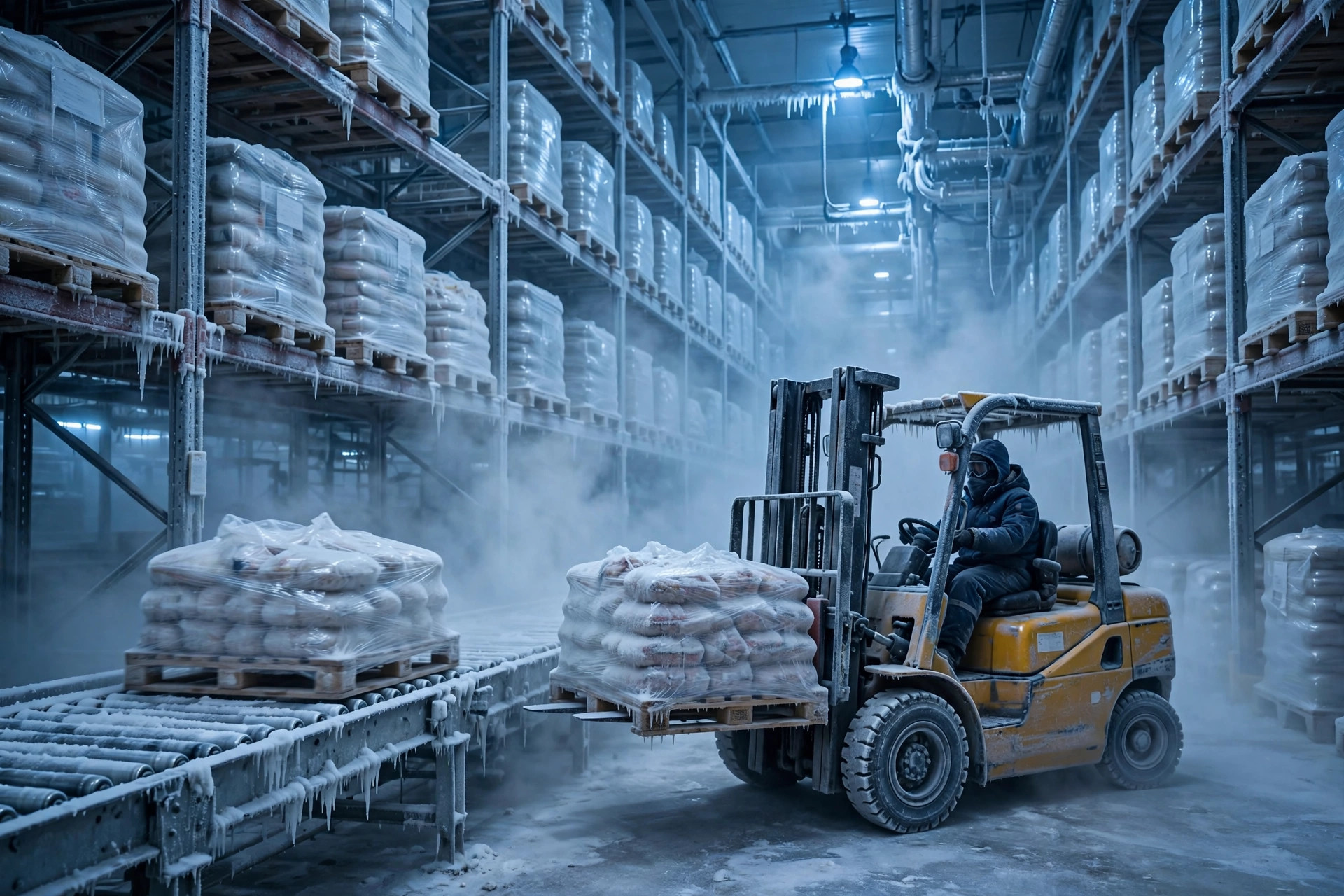
The Least Human-Friendly Warehouse
A -25°C freezer warehouse is where automation pays off most — and where it fails most spectacularly.
Start with the labor math: at -25°C, workers in heavy thermal gear must warm up 10 minutes after every 20–30 minutes of work — effective working time is roughly 60% of ambient. Freezer workers earn 30–50% more, yet turnover is brutal: a South China seafood cold-chain operator reports over 40% annual turnover among freezer forklift drivers; in peak season, "freight with nobody to move it" is routine.
Then the equipment: room-temperature forklifts and conveyors lose half their battery capacity at -25°C, hydraulic oil turns to honey, and a film of frost blinds photoelectric sensors. Cold-storage automation isn't "an ambient solution moved into the freezer" — it's a separate discipline, with steel, batteries, fluids, and software all re-specified.
1. Racking and Storage: Steel Must Survive the Cold First
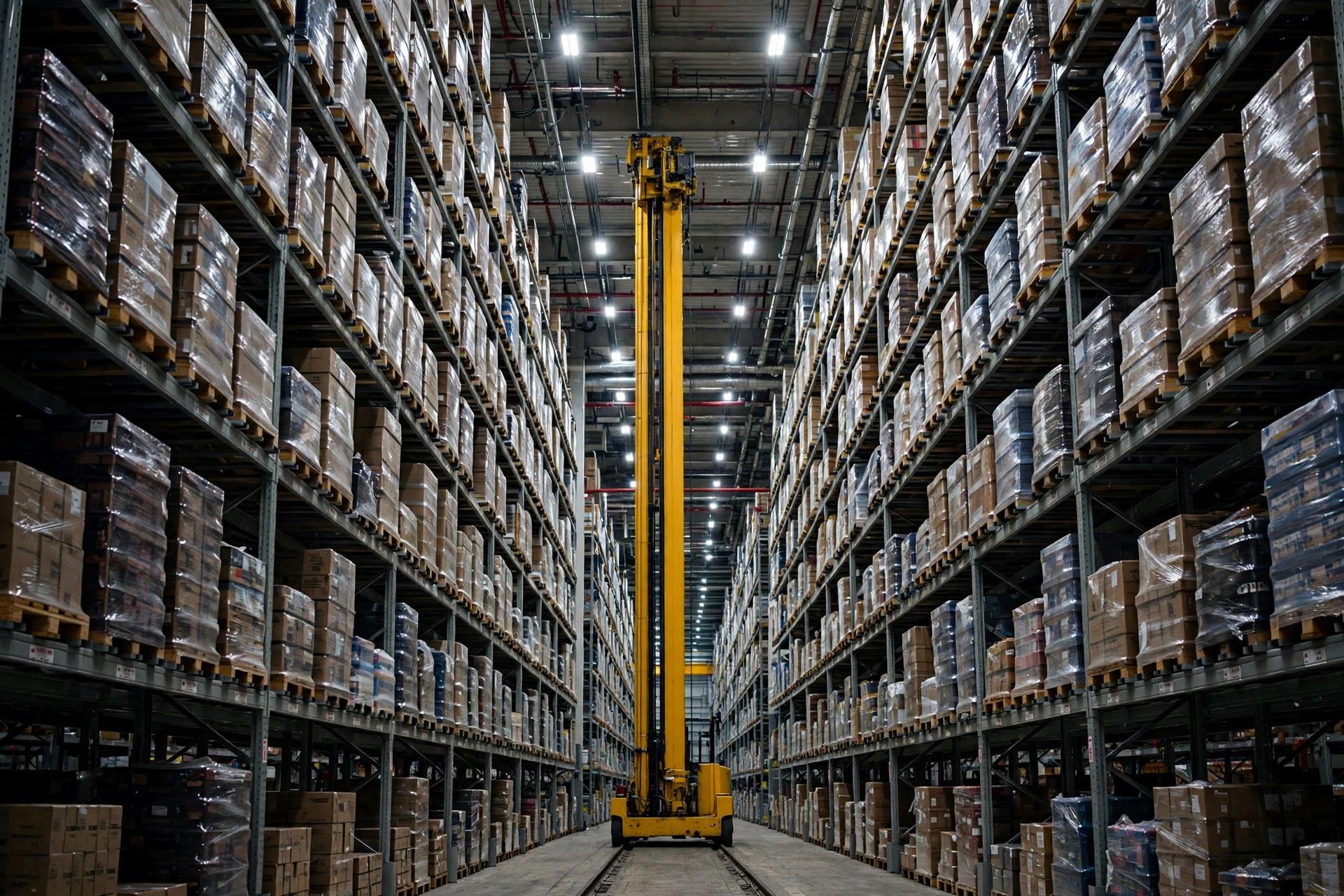
The first hurdle for freezer racking isn't load capacity — it's low-temperature brittleness. Standard Q235 steel loses impact toughness significantly below -20°C, and welds crack more easily. Two specification rules: use Q345 or steel with certified low-temperature impact values, and require full-penetration welds with spot NDT inspection.
On storage formats, freezers naturally favor dense, low-touch systems:
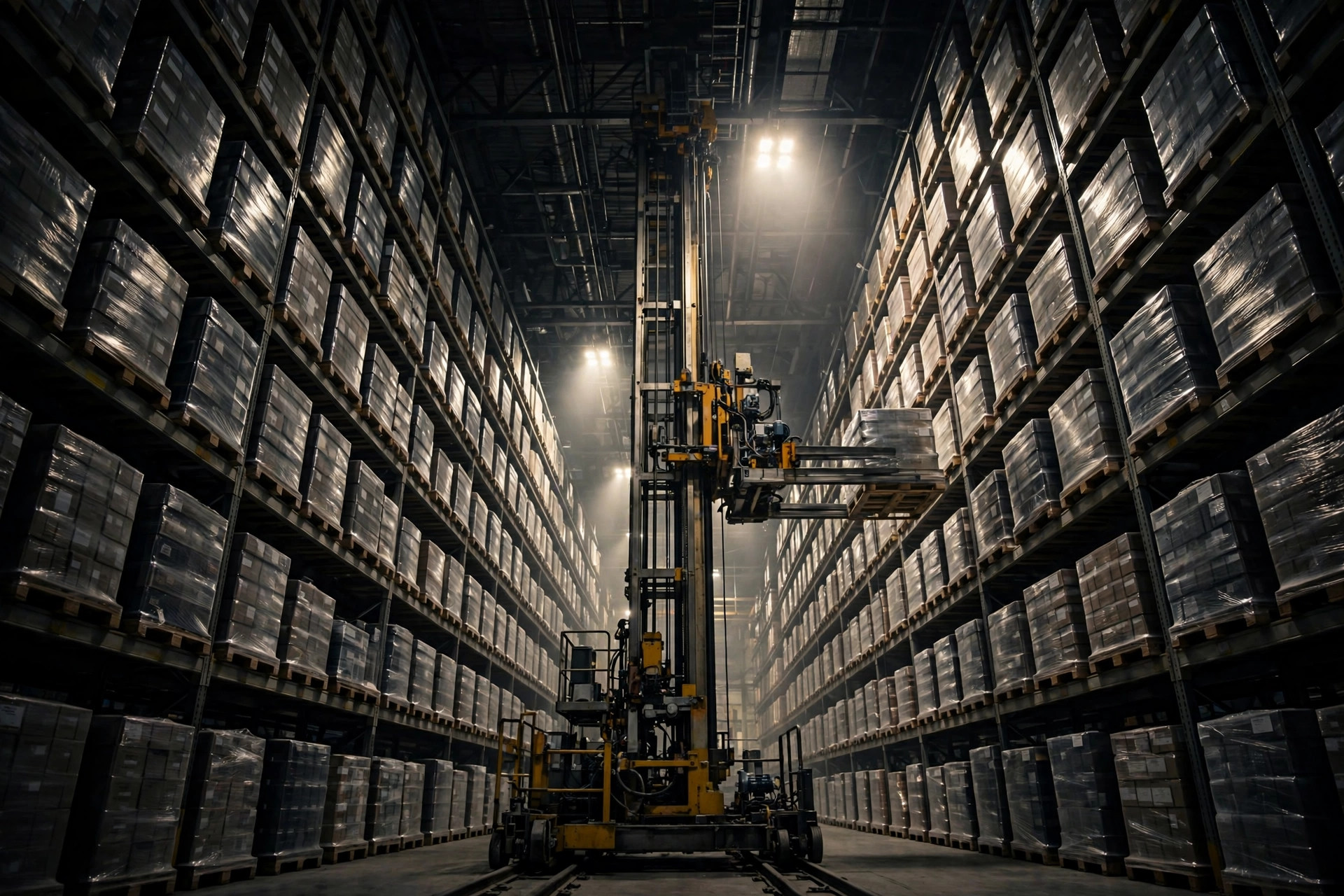
- AS/RS: the -25°C default. Stacker cranes automate aisle storage/retrieval; the freezer runs nearly unmanned with minimal door openings and the most stable temperatures. High capex — best for cold-chain DCs with concentrated SKUs and steady throughput.
- Shuttle + high-density racking: 30–50% cheaper and more flexible — good for broad SKUs and medium batches. Specify low-temperature batteries and controls.
- Drive-in / push-back racking: best value in manual/semi-auto setups, but frequent forklift traffic means more door cycles, bigger temperature swings, higher energy bills.
Rule of thumb: each door opening rebounds nearby temperature 3–5°C, costing 15+ minutes of full-power refrigeration to recover. So "fewer door crossings" is itself a core automation payback.
2. Mobile Equipment: Batteries and Hydraulics Are the Weak Links
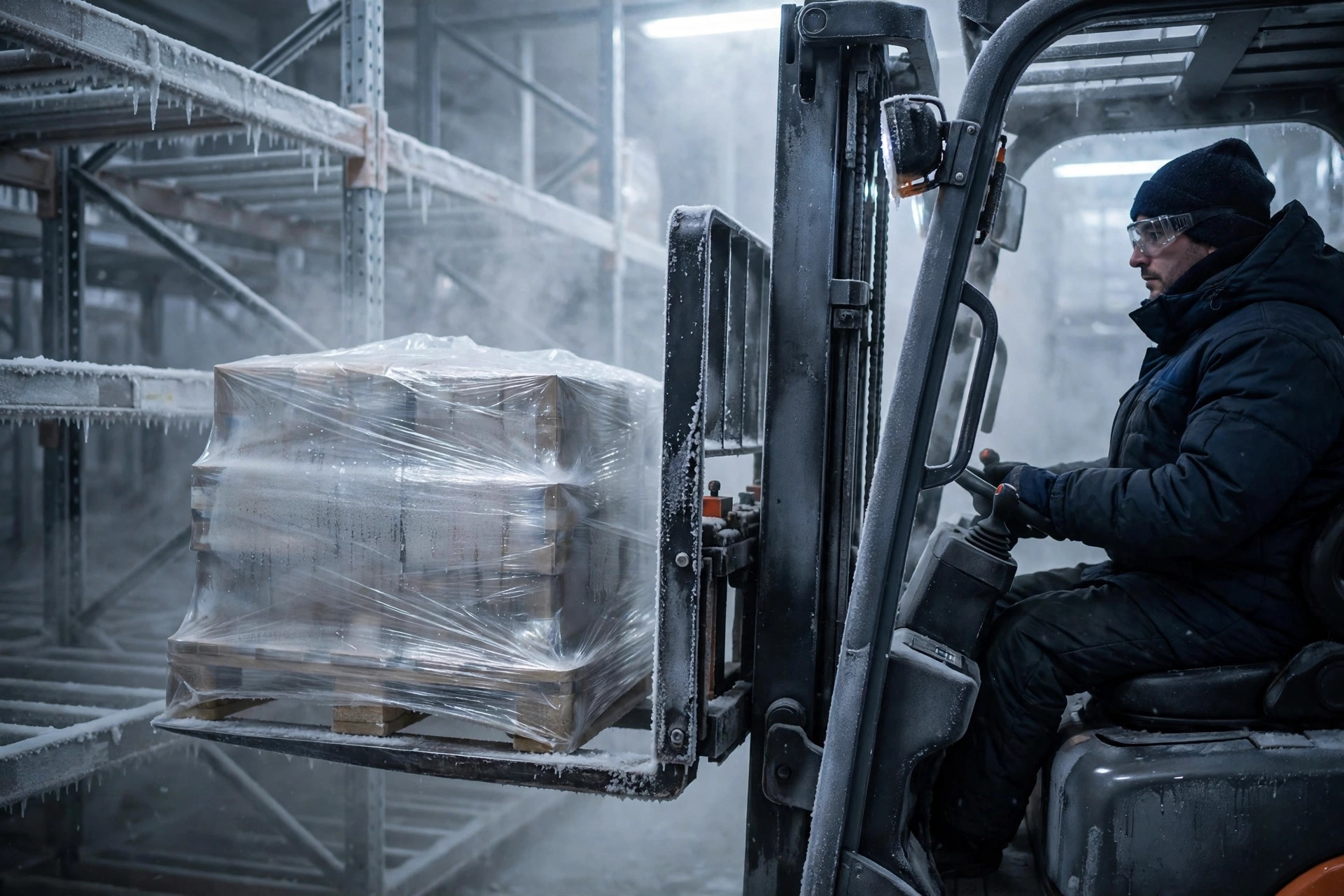
Forklifts, AGVs, and shuttles entering a freezer live or die by two things: batteries and hydraulics.
Batteries: lead-acid delivers only ~50% of rated capacity at -25°C — effectively unusable. Lithium iron phosphate (LFP) holds 70–80%, but needs a heating/insulation system, and charging must happen outside the freezer — charging at -25°C permanently damages cells.
Hydraulic oil: conventional oil has a pour point around -10°C and effectively solidifies at -25°C — cylinders seize. Switch to low-temperature oil (pour point below -40°C) and warm up at no load for 10–15 minutes each shift.
Condensation: the most overlooked killer. Equipment crossing from -25°C to an ambient dock instantly sweats; water in cabinets means short-circuit alarms at best, fried boards at worst. Three countermeasures: IP65+ cabinets, moisture-sealed terminations, and zone-dedicated equipment minimizing temperature-zone crossings.
| Equipment | Ambient spec | Freezer spec | Key difference | |---|---|---|---| | Forklift/AGV batteries | Lead-acid or standard lithium | LFP + heating & insulation | 70%+ capacity at -25°C | | Hydraulics | Standard oil | Pour point below -40°C | No seizing | | Electrical cabinets | IP54 | IP65 + moisture sealing | No condensation shorts | | Sensors | Standard photoelectric | Heated / low-temp rated | No frost false-triggers |
3. Conveying and Sorting: Frost Is the Hidden Killer
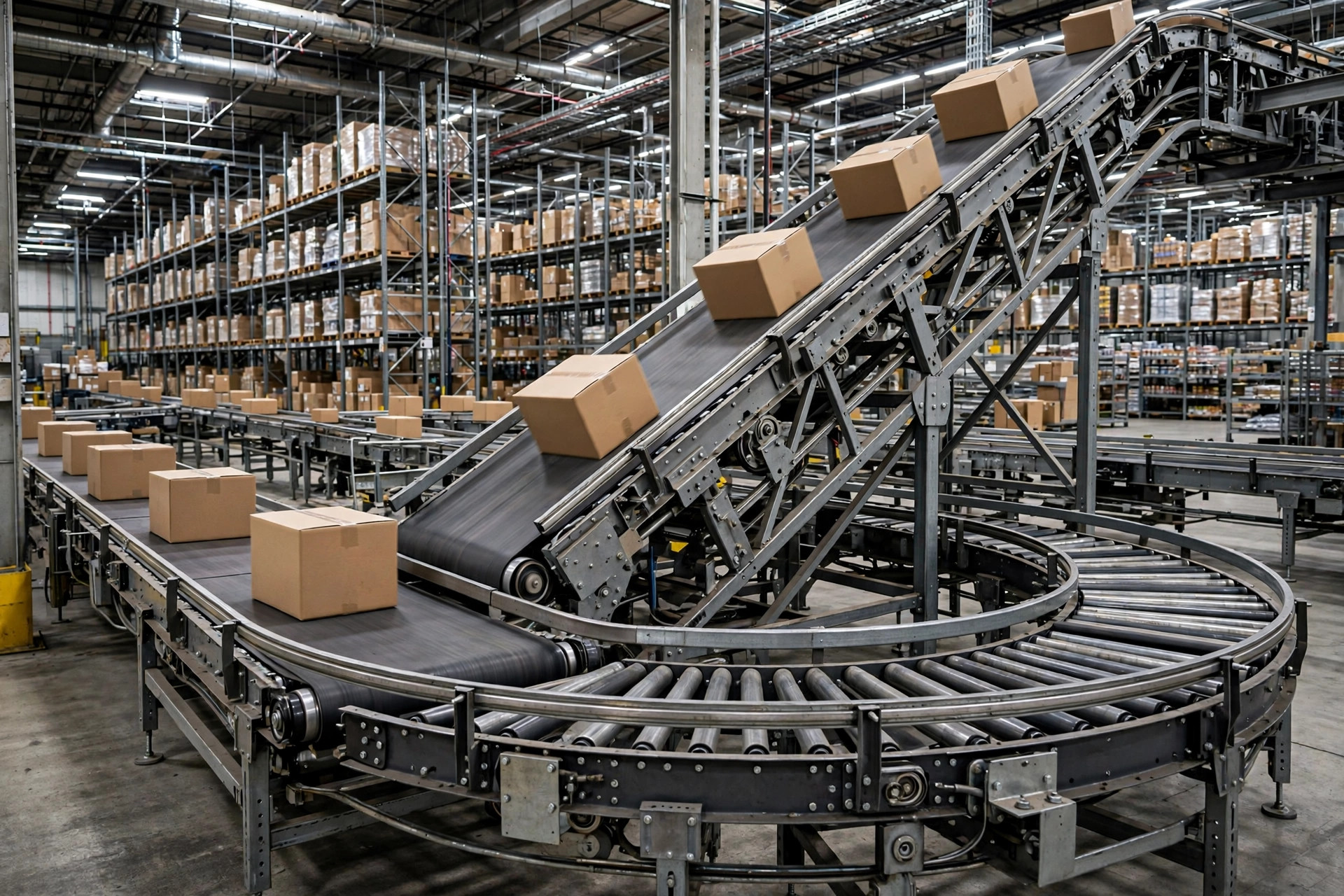
On conveyors and sorters, the enemy isn't the cold itself — it's frost. Humidity swings as people and product move in and out, and moisture frosts over cold metal and sensor lenses:
- Frosted sensors → false product present/absent signals; sort logic falls apart;
- Frost on belts and rollers → slipping, skewed cartons, jams;
- Higher motor starting current in the cold; frequent starts trip thermal protection.
Countermeasures: heated sensors or air-purge defrost hoods; run conveyors continuously instead of stop-start; specify low-temperature motor grease. Pragmatic trick: put the sort zone in a 0–5°C vestibule outside the freezer — equipment never enters deep-freeze, and failure rates drop by half or more.
4. WMS: FEFO Is Iron Law
Cold-storage WMS has one iron law: strict FEFO (first-expired, first-out). Frozen food, seafood, and pharma all carry expiry dates — slotting must be expiry-driven, not nearest-location:
- Capture production and expiry dates at receiving; no putaway without expiry data;
- Recommend pick locations sorted by expiry; auto-alert and prioritize near-expiry SKUs for clearance;
- Full lot traceability — one lot, one code — so recalls can freeze product by batch.
Freezer cycle counting is miserable — people can't stay inside. So inventory accuracy must hit 99.5%+, backed by RFID or dock-door scanning, targeting "no-entry cycle counts."
5. Doors and Vestibules: Guard Every Degree
The best automation is wasted if the doors stand open all day. Doors and vestibule design directly drive refrigeration energy and automation stability:
- High-speed roll-up doors: opening at 1.5 m/s+, with ground-loop or radar sensing so forklifts/AGVs trigger automatic open/close — minimizing cold-air loss;
- Insulated sectional doors: for low-traffic passages where insulation matters more than speed;
- Vestibules: a 0–5°C buffer between deep-freeze and dock. Receiving, sorting, and labeling happen there; the deep-freeze stores only, minimizing entries;
- Air curtains / strip curtains: above dock doors to cut convective exchange when doors open.
| Zone | Temperature | Activities | Automation focus | |---|---|---|---| | Deep-freeze | -25°C | Storage | AS/RS, shuttles, unmanned | | Vestibule | 0–5°C | Receiving, sorting, labeling | Conveyors, PTL, scan verification | | Ambient dock | Ambient | Loading, charging | Charge room, vehicle dispatch |
Case Study: AS/RS Retrofit at a -25°C Frozen-Food DC
Background: a frozen-food DC in East China — 6,000 m² at -25°C, 700 pallets/day. Previously 18 freezer forklifts on two shifts: labor over ¥6M/year, chronic driver turnover, refrigeration bills inflated by constant door cycling.
Solution: a 22 m AS/RS with 6 double-deep stacker cranes, pallet conveyors into the vestibule; forklifts handle docks only, never entering deep-freeze; WMS with FEFO and lot traceability; high-speed roll-up doors plus vestibules throughout.
Results after one year: deep-freeze headcount 36 → 6 (inspection/exceptions only); door cycles down 70%, refrigeration power down ~22%; inventory accuracy 97% → 99.6%; ~¥28M invested against ~¥9M/year savings — payback just over 3 years.
Pitfalls: Four Expensive Lessons
- Don't roll ambient equipment into a freezer. Purchase-price savings come back doubled as winter downtime. Write "-25°C continuous operation" into the spec and demand same-temperature reference sites.
- Don't ignore condensation. Electrical shorts are the #1 failure mode in freezer equipment. IP65, moisture sealing, zone-dedicated use — all three, no exceptions.
- Spares get cold too. Rubber seals and plastic parts embrittle faster in the cold; stock low-temperature versions separately and raise safety stock ~20%.
- Maintenance has to get in. Put service access and the spares crib on the vestibule side — nobody overhauls a stacker crane at -25°C within a 20-minute human work limit.
Takeaway
Cold-storage selection in one sentence: first make equipment survive -25°C, then talk efficiency and payback. Steel by impact value, batteries by heating, fluids by pour point, electrics by moisture protection, software by FEFO, building by vestibule. Get all six right: a three-year-payback investment. Miss one: winter teaches the lesson.