Don't Start with 3D: The One Line That Splits 2D and 3D Camera Selection
Two years ago, a beauty-products distributor wanted vision inspection. The integrator quoted an all-3D camera package — 14 cameras, $380,000. I walked the floor and told him: your job can be done with 2D cameras and two light bars. $80,000, done. He put the $300K he saved into upgrading his conveyor.
My one-line verdict: the dividing line is not price, it is the task. If the job only needs flat, planar information — read the code, read the label, present or missing, straight or crooked — 2D is enough. If it needs spatial information — how tall, how big, where it is, whether it is leaning — that is when 3D earns its keep.
2D cameras: enough for 70% of warehouse vision jobs
2D does flat work. The three most common 2D stations in a warehouse:
First, inbound label verification: before a pallet enters the building, a camera photographs the shipping label, OCR reads the PO number and SKU, and compares them against the ASN. Mismatches get diverted with an alarm. A station like this lands at $5,000–$8,000 and replaces a dedicated checker — payback inside a year.
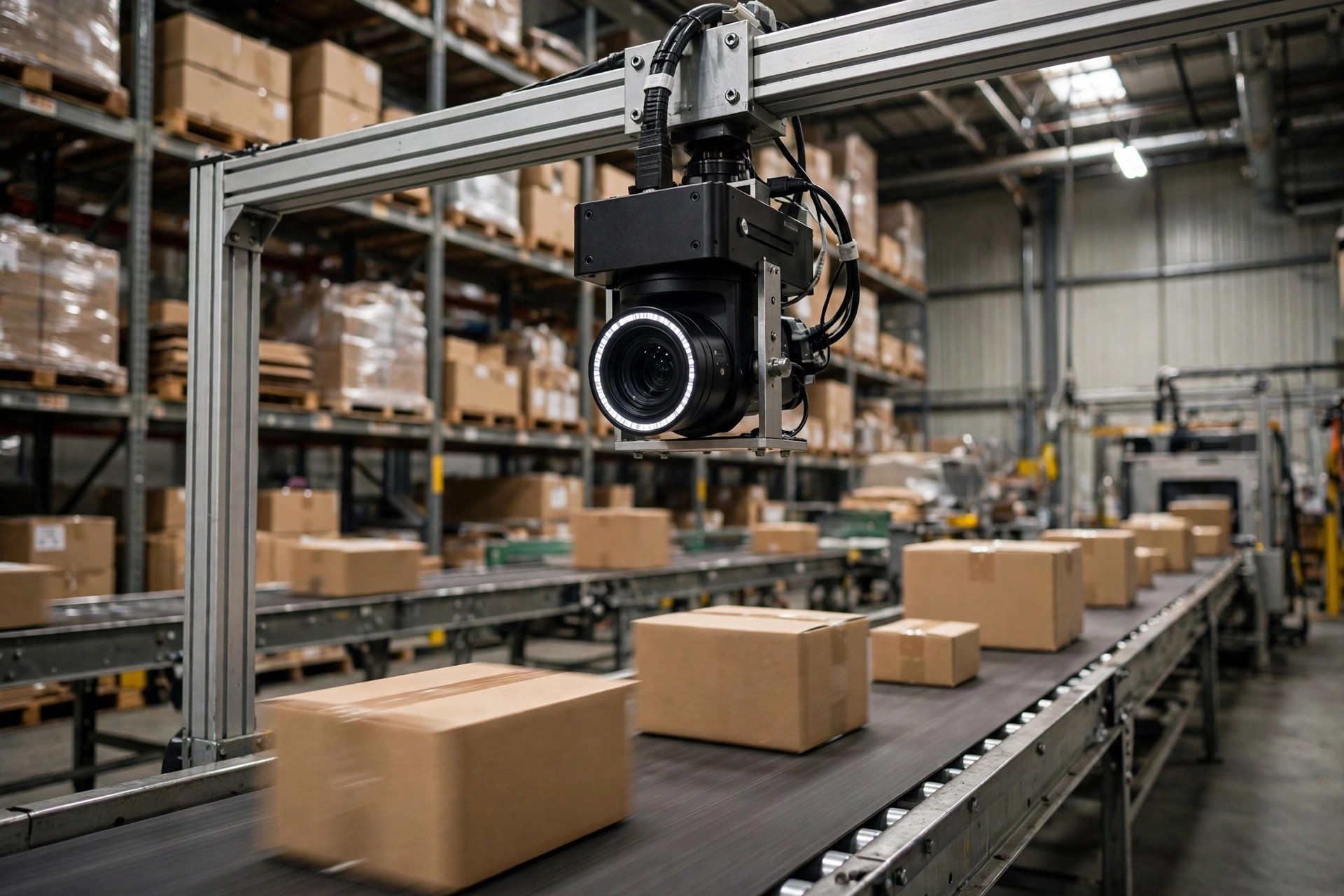
Second, barcode reading on sortation lines: cameras mounted over a parcel sortation line read shipping labels for diverting. The takt is brutal — 60 to 120 parcels a minute — and 2D's frame rate and millisecond response are exactly the right tool. Getting read rates above 99.5% is not about a pricier camera; it is about light angle and mounting position. That sentence is worth money. Write it down.
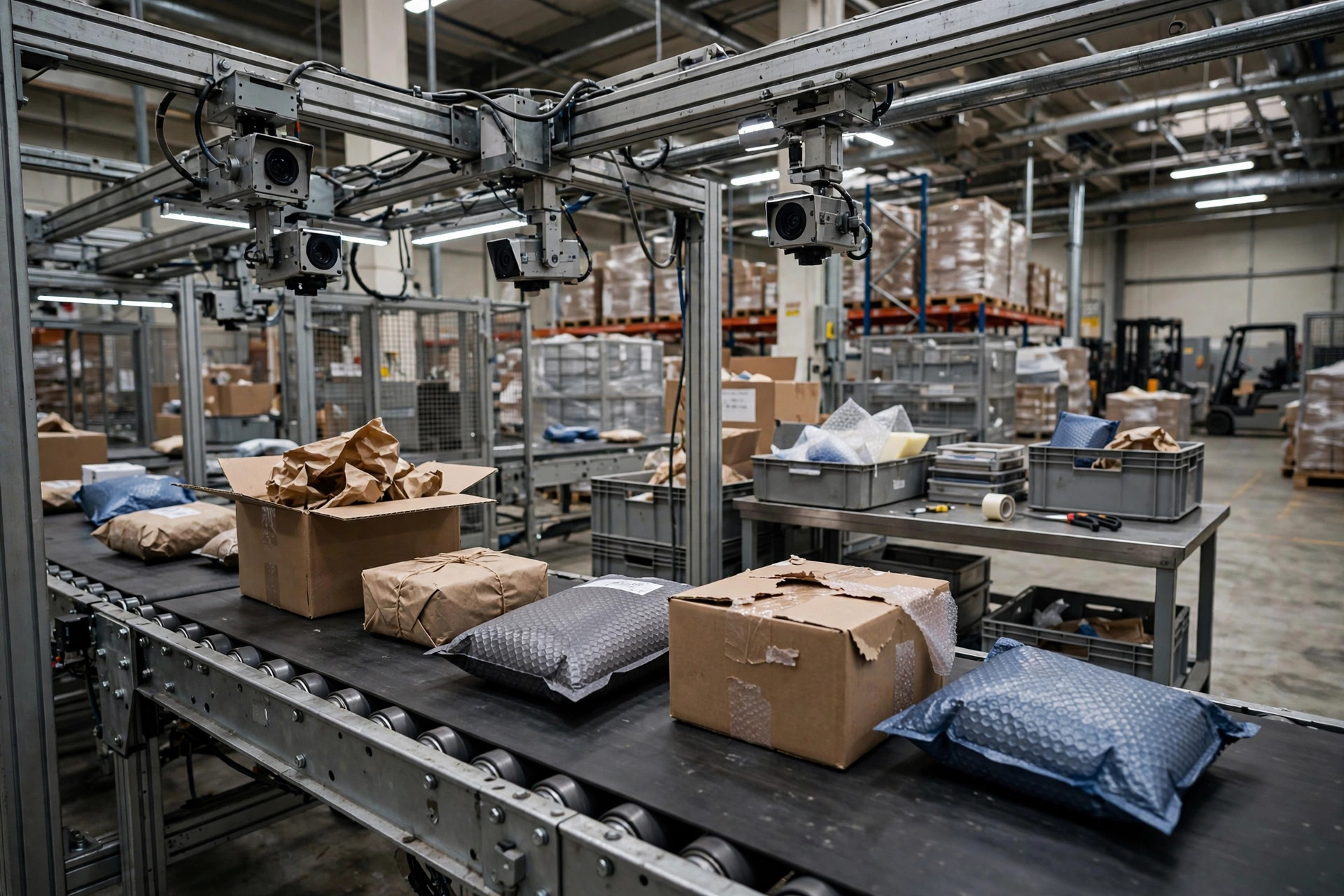
Third, carton seal inspection: cartons pass under a camera that checks the tape is present and straight; missing tape gets kicked to a rework lane. One camera plus one photo-eye, $3,000 all in. Half of all "short shipment" complaints trace back to missed seals at this step — this station has one of the highest ROIs in the building.
Rule of thumb from the field: seven or eight out of ten warehouse vision tasks are "recognize it, read it" — 2D handles them fine, at $500–$2,000 per camera and $3,000–$8,000 per station.
When 3D is mandatory
Three categories where no amount of 2D tuning will save you.
First, measuring: length, width, and height of cartons and pallets — dimensioning for freight audit. That is 3D data, period. One auto-parts client of mine recovered over $400K a year in freight differentials with a 3D dimensioning station — carriers bill on dimensional weight, and if you declare small, you eat the difference.
Second, guiding robots: depalletizing and picking arms need to know where the thing is and what pose it is in — no depth data, no motion. This is 3D's home turf; 2D does not even get a ticket.
Third, judging deformation: crushed cartons, damaged goods, over-height pallets — "is it leaning, is it caved in" is fundamentally a spatial question. Catching an over-height pallet at receiving is far cheaper than rescuing one wedged inside a rack aisle.
3D cameras run $3,000 to $15,000 each; with software and integration, a station starts at $30K–$80K.
The technology map: not all 3D is the same
Cameras all called "3D" differ enormously. Pick the wrong flavor and the money is wasted:
| Technology | Accuracy | Speed | Hates | Price band | Typical use |
|---|---|---|---|---|---|
| Structured light | ±1mm class | Medium | Ambient light, reflective surfaces | High | Precision measurement, robot guidance |
| Laser line scanning | ±1mm class | Slow (must scan) | Vibration | Mid-high | Pallet profiling, dimensioning |
| Time-of-flight (ToF) | ±5–10mm | Fast | Harsh light, transparent objects | Mid | Tote positioning, AGV obstacle sensing |
| Stereo vision | ±10mm class | Fast | Low-texture surfaces | Low | Coarse positioning, wide-area monitoring |
The short version: need accuracy, pick structured light or laser; need speed, pick ToF or stereo; structured light outdoors or under harsh ambient light is asking for trouble. And do not spec from a three-year-old datasheet — confirm against vendors' latest specs.
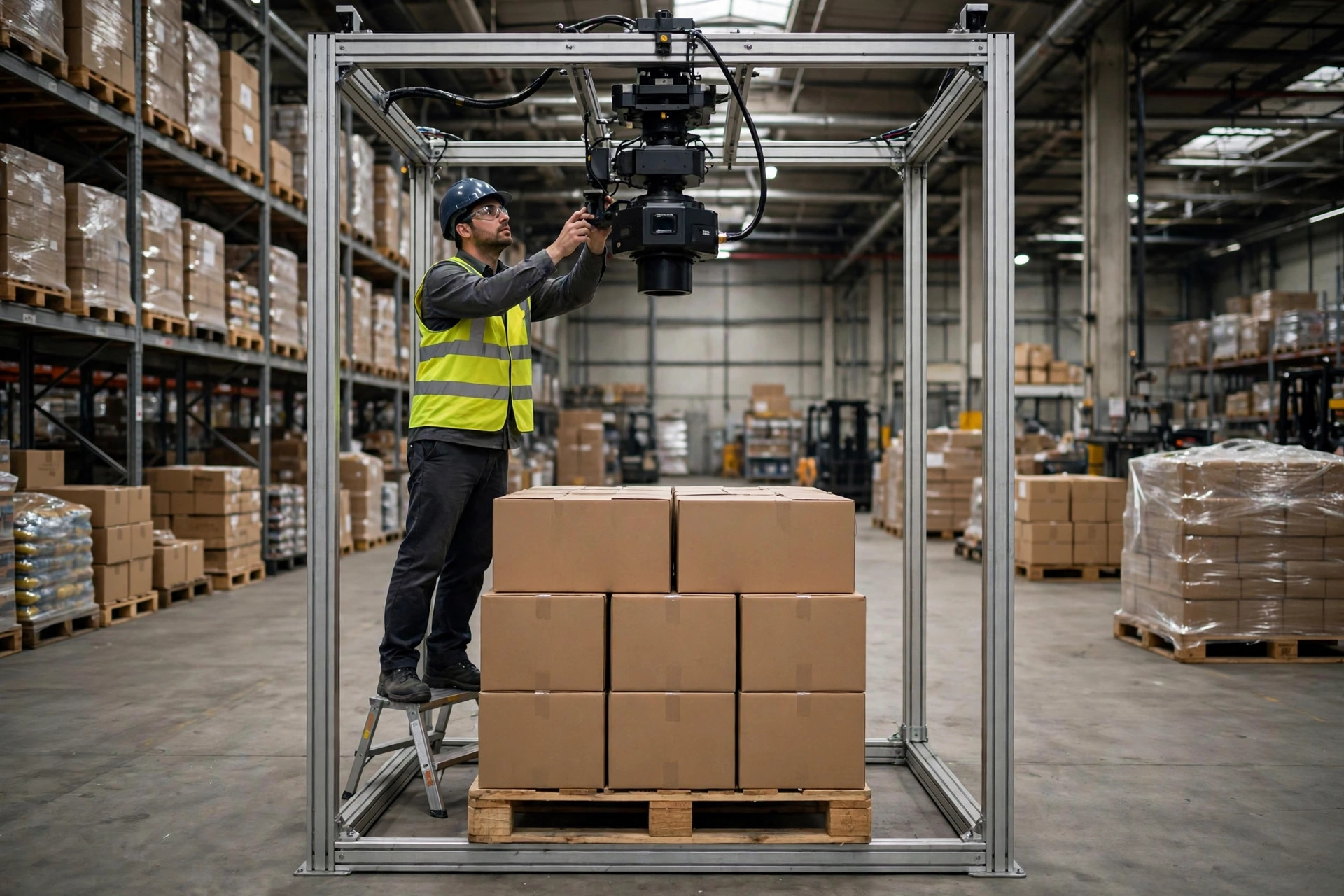
Two stations, side by side: where the money goes
Compare two real stations and the spending becomes obvious:
| Outbound verification (2D) | Pallet dimensioning (3D) | |
|---|---|---|
| Job | Read labels, verify SKUs | Measure pallet L×W×H |
| Cameras | 2D industrial ×2, about $3K | 3D ToF ×4, about $20K |
| Lighting and mounting | Bar lights + brackets, about $2K | Gantry + light shrouds, about $8K |
| Software and integration | Read-and-compare logic, about $15K | Point-cloud processing + cubing, about $30K |
| Station total | about $20K | about $60K |
| Annual return | Fewer mis-ships; about $80K in complaints and returns avoided | About $400K in freight differentials recovered |
See the pattern? The 2D station is cheap and answers "right or wrong." The 3D station is expensive and answers "how much money." The selection criterion is always task value, never how cool the technology looks.
Four traps
Trap one: reading barcodes with a 3D camera. A sledgehammer to crack a nut — and slower, too. 3D frame rates and processing latency lose to 2D on millisecond read tasks, at five times the price.
Trap two: shrink-wrap glare. A wrapped pallet is a mirror. Specular reflection throws 3D ranging off and blinds 2D reads alike. The fix is polarized lighting and polarizing filters, or a different light angle — it is an optics problem, not a "buy a more expensive camera" problem. For every 3D project, the first POC test should use real shrink-wrapped pallets.
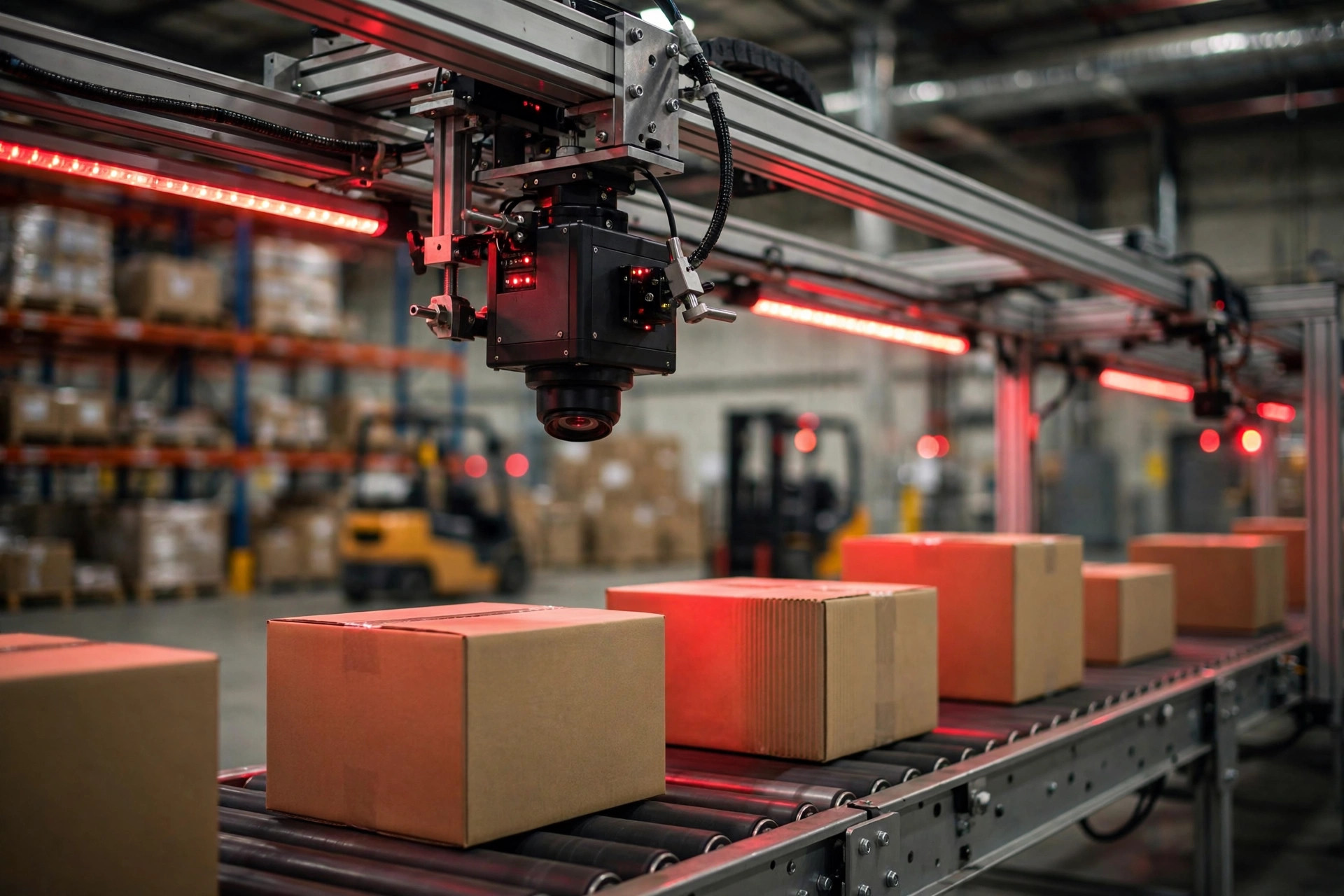
Trap three: the lighting budget nobody counted. In vision projects, light sources, mounting, and commissioning labor routinely eat 30% of total cost. Compare camera sticker prices without system totals and your budget will blow up. Lighting has its own craft: bar lights for edge-lit side views, ring lights for even top illumination, coaxial lights for reflective surfaces, backlights for silhouette checks — wrong light, and the priciest camera in the world will not save you.
Trap four: forcing 2D to measure volume. Perspective error is physics. Volume numbers "estimated from a photo" used for freight audit are a trap you are digging for yourself. If you need the data, buy real 3D. If you do not, stop pretending.
The six-step selection checklist
- Write the job in one sentence: "I need to measure / recognize / judge ___." Cannot write it? Do not buy the camera yet. The more specific the sentence, the cheaper the selection.
- Check the planar-or-spatial box: planar goes 2D, spatial goes 3D. One line divides them — do not cross it.
- Set the takt: how many units per minute? Can the 3D processing latency keep up with line speed? If not, accuracy is irrelevant.
- Set the accuracy: ±1mm or ±10mm? Get this wrong and the whole technology choice is wrong, and the budget off by multiples.
- Survey the environment: ambient light, dust, shrink wrap — three variables that dictate the lighting design, and the POC must use real freight.
- Ask about maintenance: who tunes the parameters after the integrator leaves? Vision systems die from "nobody here knows how to adjust it." Put training, spares, and remote support in the contract.
Use this tomorrow: list every vision task you want, check the planar-or-spatial column. You will find most of them land on 2D. Spend the savings on lighting and installation instead — read rates respond to that far more than to a pricier camera. Remember: in a vision project, lighting is 70% and the camera is 30%. That sentence will steer you clear of half the traps.