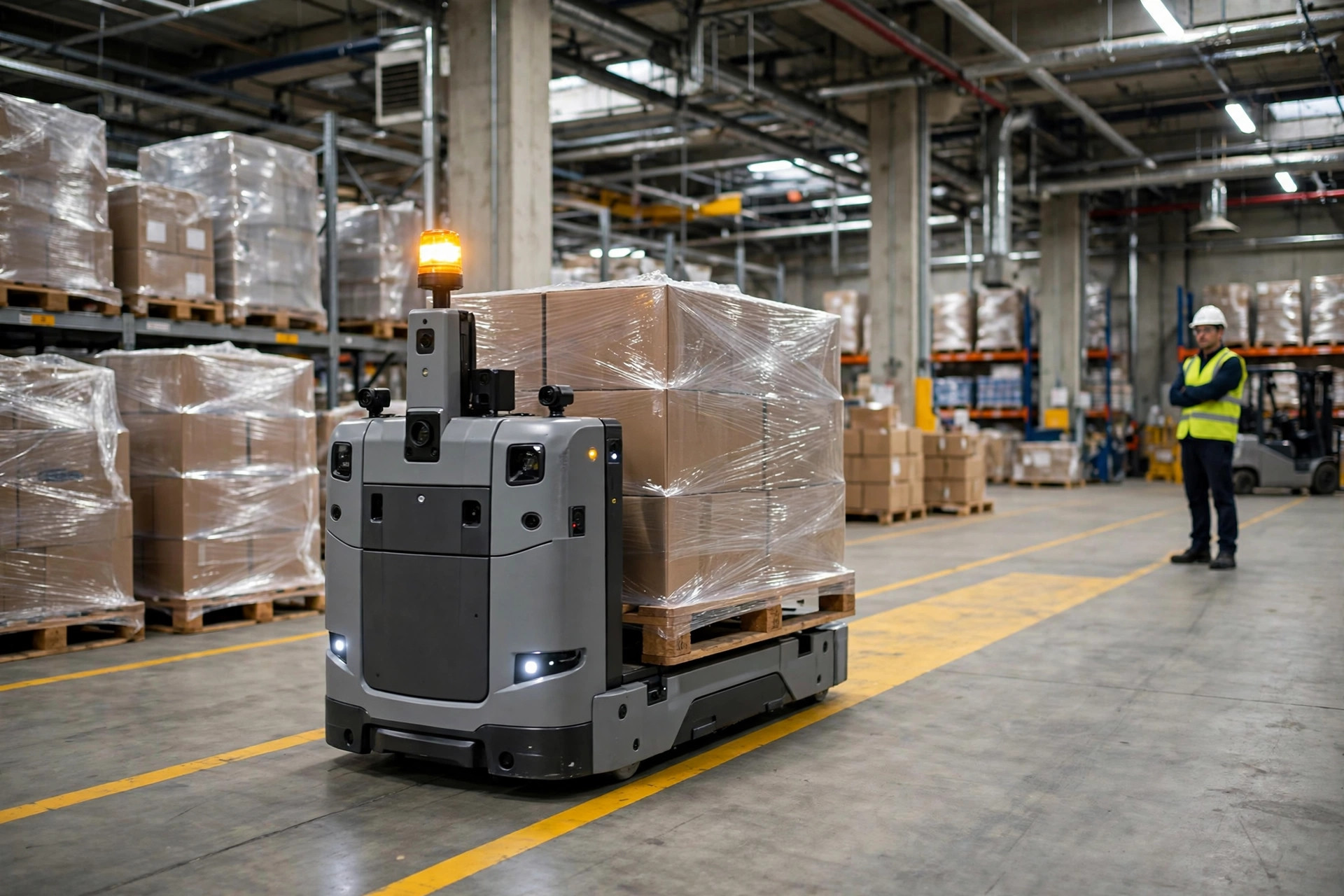
One Accident Wiped Out Three Years of Automation Gains
In 2019, at a US warehouse, a loaded AGV struck an inventory associate at a turn — fractured pelvis. The investigation: the AGV's laser scanner was blocked by racking, creating a blind spot; the cart ran 1.5 m/s with insufficient braking distance. The company paid $800K, the project shut down for 4 months — three years of automation returns wiped out, plus extra.
Mixed human-robot traffic is the biggest risk exposure in any AGV/AMR project. Two mainstream standards govern it internationally — ANSI/RIA R15.08 (US) and ISO 3691-4 (international) — with one shared philosophy: divide safety responsibility between vehicle and people clearly, and engineer collision probability to the floor. From 20 years of field work, I've distilled five red lines.
Five Red Lines — None Negotiable
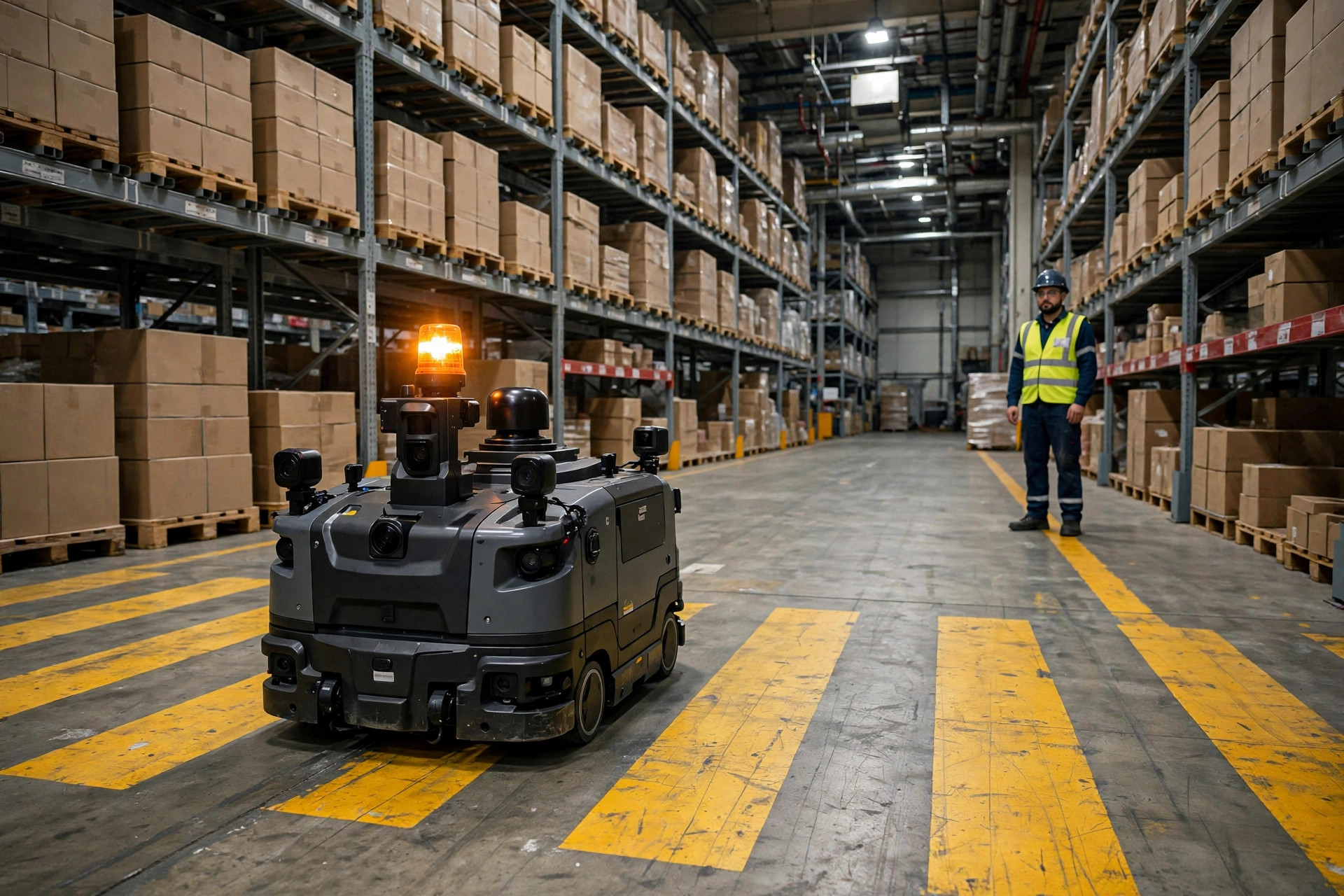
Red Line 1: Zoned Speeds — The More People, the Slower the Cart
Speed is safety's first variable. Standards require zoned limits; my field-tested tiers:
| Zone | Speed Limit | Notes | |---|---|---| | Unmanned (fenced) | ≤2.0 m/s | Physically isolated, no entry | | Low foot traffic (aisles) | ≤1.0 m/s | Occasional passersby | | Mixed traffic | ≤0.6 m/s | Matches walking pace | | Intersections / turns / ramps | ≤0.5 m/s | Blind spots — slow early |
Unlimited cornering speed is killer #1. A cart doing 1.5 m/s on the straight that doesn't slow for the bend — centrifugal force plus blind spots equals accidents. The dispatch system must enforce "curve speed points." Non-negotiable at acceptance.
Red Line 2: Safety Distances — Scanners Aren't Decoration
AGV/AMR laser scanners need two protection zones:
- Slow-down zone: 3–4 m — person detected, cart crawls.
- Stop zone: 1–1.5 m — person detected, immediate stop.
Critical detail: zone geometry must scale with speed. Faster carts need bigger stop zones (stopping distance = reaction distance + braking distance). At 1.5 m/s, a loaded AGV needs ~0.8–1.2 m to brake — a 1 m stop zone is insufficient; make it 1.5 m minimum. Verify with a test dummy at acceptance, not paper specs.
Red Line 3: Audible & Visual Alarms — Seen by the Deaf, Heard by the Blind
- In motion: blue warning light (projects a blue spot 3 m ahead on the floor) plus low-frequency tone; tone changes for turns and reversing.
- E-stop / fault: red strobe plus high-frequency alarm.
- Night / low light: reflective vehicle strips — AGVs are "invisible" in dim warehouses.
The blue spot is the most underrated safety device in the industry: a person at a blind corner sees the blue light on the floor first and knows a cart is coming. Costs tens of dollars; outperforms thousands in sensors.
Red Line 4: E-Stop & Manual Mode — Humans Take Over When Things Go Wrong
- Every vehicle needs a prominent red e-stop button — press it and the vehicle power-cuts and brakes.
- Remote/manual mode: during maintenance and exception handling, carts must switch to human remote control, capped at 0.3 m/s.
- Test e-stops monthly: many e-stop buttons sit untouched for three years — oxidized contacts fail exactly when needed.
Red Line 5: People & Zones — Manage Humans Before Machines
No equipment outsmarts human unpredictability. The most neglected of the five:
- Onboarding training: AGV zones, what blue light means, how to yield on alarm — tested before floor access.
- Visitor control: escorted entry to AGV zones, reflective vests mandatory.
- Zone marking: floor lines (yellow solid for AGV lanes, green for walkways), convex mirrors at intersections.
- Drills: quarterly — simulate a runaway AGV. You're training muscle memory.
Real Case: From Monthly Incidents to Three Years Clean
A Texas 3PL, 30 AGVs, mixed traffic — averaging one "close encounter" a month (mercifully no serious injuries). Our safety retrofit:
- Zoned speeds site-wide; mixed zones cut from 1.2 to 0.6 m/s (throughput impact under 5% — mixed zones were only 20% of travel).
- Scanner protection zones resized to measured braking distances, verified with a test dummy.
- Blue-spot projectors + convex mirrors at 12 intersections.
- Full workforce training + visitor escort policy.
Three straight years with zero collisions since; OSHA inspection passed first try. The GM did the math: $150K for the retrofit versus $500K+ for a single serious injury, direct plus indirect. You don't need a spreadsheet to see the value.
One more detail: we piped AGV telemetry into a safety dashboard — e-stop counts, slow-zone triggers, overspeed alarms, reviewed weekly. Data showed 80% of slow-zone triggers at 3 intersections; rerouting one walkway cut triggers 70%. Safety data is the best retrofit compass — don't just log accidents; the everyday near-miss alarms hide the big risks.
Pitfalls: Four Traps
- "Our carts have obstacle avoidance, we're safe": sensors get dirty, fail, and have blind spots. Safety is layered defense (speed + scanners + alarms + training), never a single sensor.
- No re-validation after modifications: heavier loads or higher speeds change braking distances — every change needs a safety re-assessment through a formal change process.
- Unprotected charging areas: chargers mean cables and foot traffic — AGVs need exclusion zones or crawl speeds nearby.
- Treating standards as decoration: ANSI R15.08 and ISO 3691-4 are minimums, not ceilings. If your foot traffic exceeds the standards' assumptions, go stricter.
Summary
The five red lines of mixed traffic — zoned speeds, safety distances, audible/visual alarms, e-stop override, people management — reduce to one sentence: always assume sensors fail and humans err; layer your defenses. Safety spending is the highest-ROI money in any automation project: a $150K retrofit preventing a single $500K+ accident. Carts can run a little slower — but they must never hit a person. Iron law.