Pickers Spend 70% of Their Time Walking, Not Picking
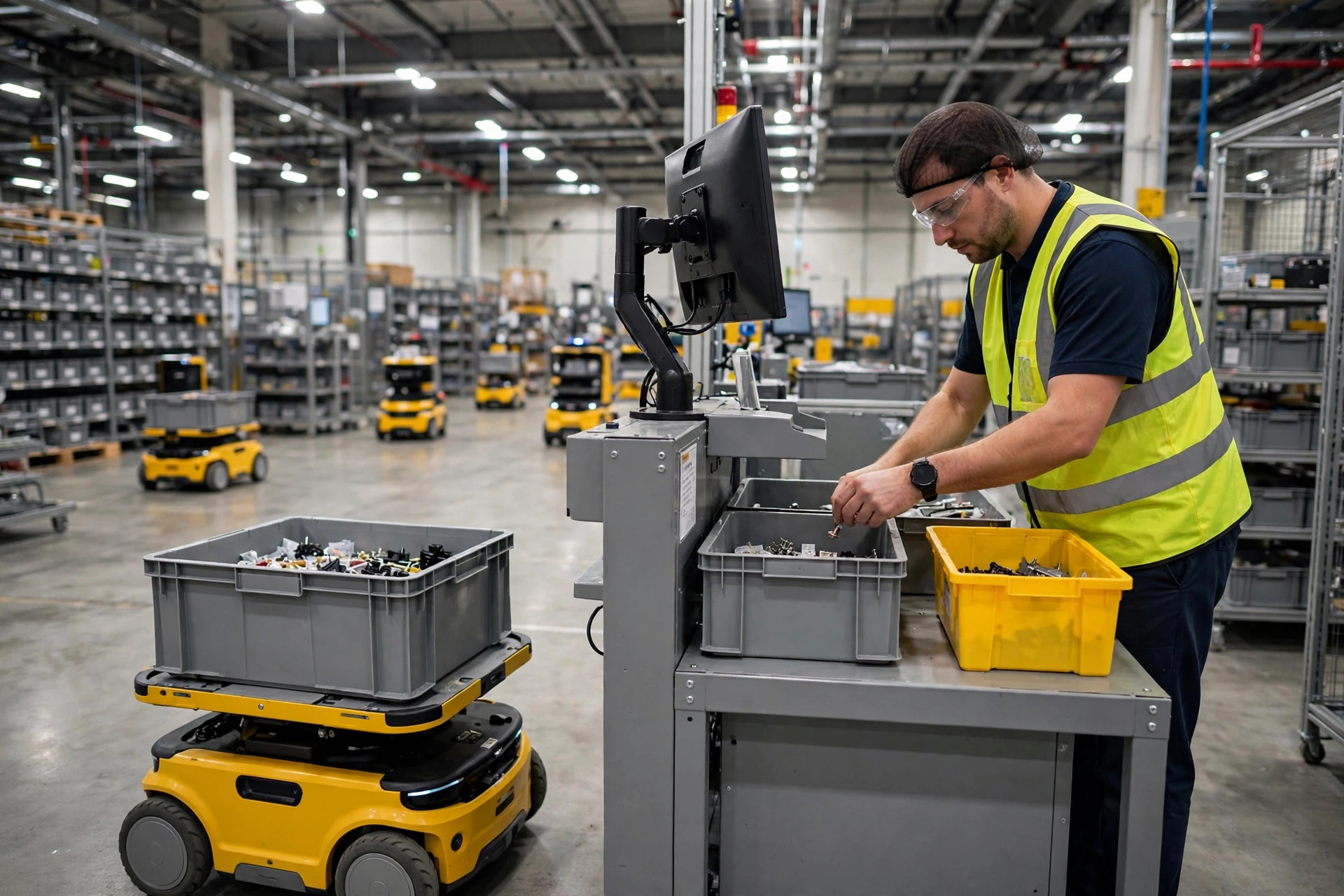
Time studies in traditional warehouses tell a consistent story: in an 8-hour shift, a picker spends under 30% actually picking — 60–70% goes to pushing a cart up and down the aisles. You're paying for 8 hours and getting 2.5 hours of effective work. Bin-to-person (goods-to-person) robotics attacks exactly this waste: people stay put, goods move — robots deliver totes of product to pick stations, and humans just "grab."
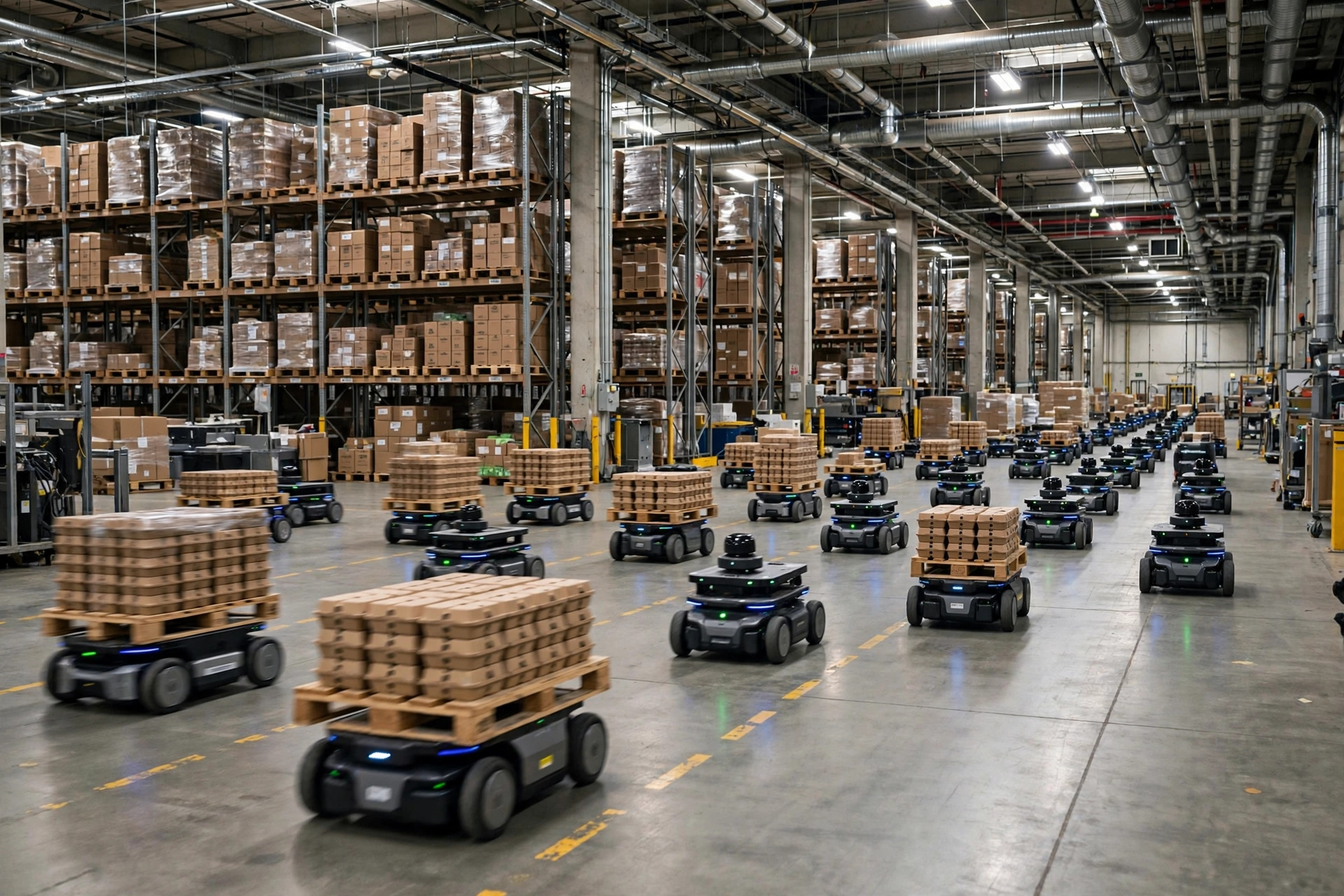
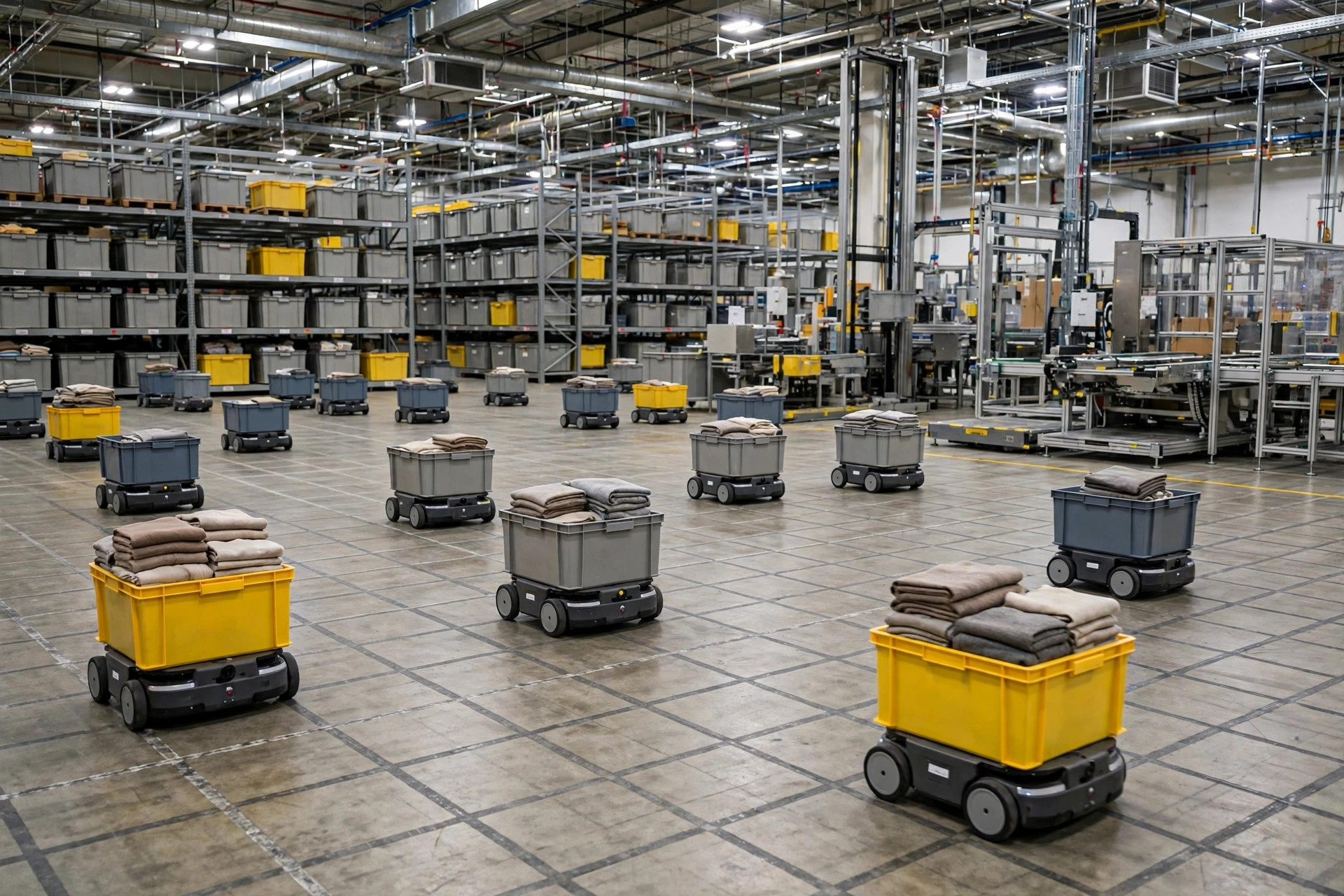
Known in China as bin robots, with vendors like HAI Robotics, Geek+, and Quicktron, the concept is consistent: dense tall shelving filled with standard bins; dozens of small robots shuttle underneath, lifting target bins and delivering them to workstations; operators take the required quantities while lights guide them; robots return the bins.
Four Dimensions of the Revolution
1. Throughput: From 100 to 400 Picks/Hour
Traditional person-to-goods picking: a skilled worker manages 80–120 picks/hour including travel. In goods-to-person, the workstation is the bottleneck — measured results:
- Per station: 300–450 picks/hour (small parts, with light guidance and put walls).
- One station pairs with 8–12 robots; robot utilization above 70% is healthy.
- Peak season? Just add robots — capacity is bought by the unit, no recruiting and retraining cycle like temp labor.
2. Density: 1.5–2x the Storage in the Same Footprint
Traditional racking needs 2.5–3 m personnel aisles; bin-robot grids pack shelving into a matrix with ~1 m robot-only aisles, and shelving reaches 4–6 m. Same floor area holds 1.5–2x the storage locations of conventional shelf racking. At US warehouse rents of $8–12/m²/year, the rent avoided is serious money on its own.
3. Accuracy: Light Guidance Plus Weight Checks
Stations use pick-to-light: which bin lights up, how many to take — all on screen. Add check-weighing (weigh after the pick, alarm on mismatch) and pick accuracy reaches 99.9%+, versus 97–98% for manual picking. Return and complaint costs get cut by more than half.
4. Labor: Not Fewer Jobs — Different Jobs
| | Traditional Person-to-Goods | Bin-Robot Goods-to-Person | |---|---|---| | Pick rate | 80–120/hour/person | 300–450/hour/station | | Storage density | Baseline | 1.5–2x | | Accuracy | 97–98% | 99.9%+ | | Staffing | Many pickers, high turnover | Fewer station operators + maintenance | | Investment | Low | $2M–$5M (mid-size DC) | | SKU fit | All categories | Small parts (<5 kg) |
Pickers don't disappear — they become station operators. The work is easier (no walking, no climbing), which paradoxically makes hiring easier. Across projects I've touched, staff turnover fell from 40% to 15% — real savings in a US warehouse.
5. Station Design: The Last Mile of Throughput
Robots can deliver bins all day, but if the human at the station can't keep up, it's wasted. Three numbers matter in station design:
- Ergonomic height: bins presented at 75–110 cm — no bending, no overhead reaching across an 8-hour shift. Wrong height costs 15% throughput and doubles injury risk.
- Lights + display: pick-to-light strips plus a screen showing quantities and order info — operators memorize zero SKUs; new hires are productive after 2 hours of training.
- Dual positions: two bin slots per station so the robot pre-stages the next bin — zero operator waiting. Dual-position stations measure 25–30% faster than single.
Stations are the cheapest part of the system (tens of thousands each) yet set the throughput ceiling. I've seen too many projects pour everything into robots and slap two tables together for stations — then the bottleneck sits in human hands. Backwards priorities. Robots deliver fast; stations must grab fast — both ends matter equally.
Real Case: 22-Month Payback at a 3C Accessories DC
A California 3C-accessories e-commerce DC: 12,000 SKUs, all under 500 g, 30,000 orders/day. Previously 45 pickers plus 20 peak-season temps, 2% misship rate.
The solution: a HAI-style bin system — 2,000 m² of grid, 60 robots, 6 stations, $3.2M invested. After go-live: pickers cut from 45 to 12 (station operators), per-station rate of 380 picks/hour versus 100 before, 99.92% accuracy.
The math: ~$1.3M/year in labor savings (33 people × $40K), ~$80K in rent avoided (density gains freed 800 m²), ~$250K/year in avoided error losses. 22-month payback. The CEO's take: "Peak season used to terrify me — hiring. Now it's the thing I worry about least."
Pitfalls: Four Traps
- Forcing oversized SKUs into bins: standard bins run ~600×400×300 mm; bigger SKUs stay in conventional zones. Do the SKU dimension analysis upfront — below 70% bin-compatible SKUs, think twice.
- Robot-to-station imbalance: too many robots, too few stations, and robots queue waiting to present — money wasted. Rule of thumb: 8–12 robots per station, sized by simulation.
- Fire code as an afterthought: dense grids plus robots may trigger tougher sprinkler or smoke-detection requirements — talk to the fire marshal in month one, or rework later.
- Counting labor savings but not rent: many ROI models miss the density dividend — in the US it routinely represents 20–30% of total benefit.
Summary
The bin-robot revolution boils down to one thing: eliminating the warehouse's most expensive waste — human walking time. Throughput up 3–5x, density doubled, 99.9% accuracy, at the cost of a $2–5M investment and 70%+ bin-compatible SKUs. For small-parts-dominant operations above ~20,000 orders/day struggling to hire, the math deserves a serious look. Goods-to-person isn't the future — it's the present, already happening.