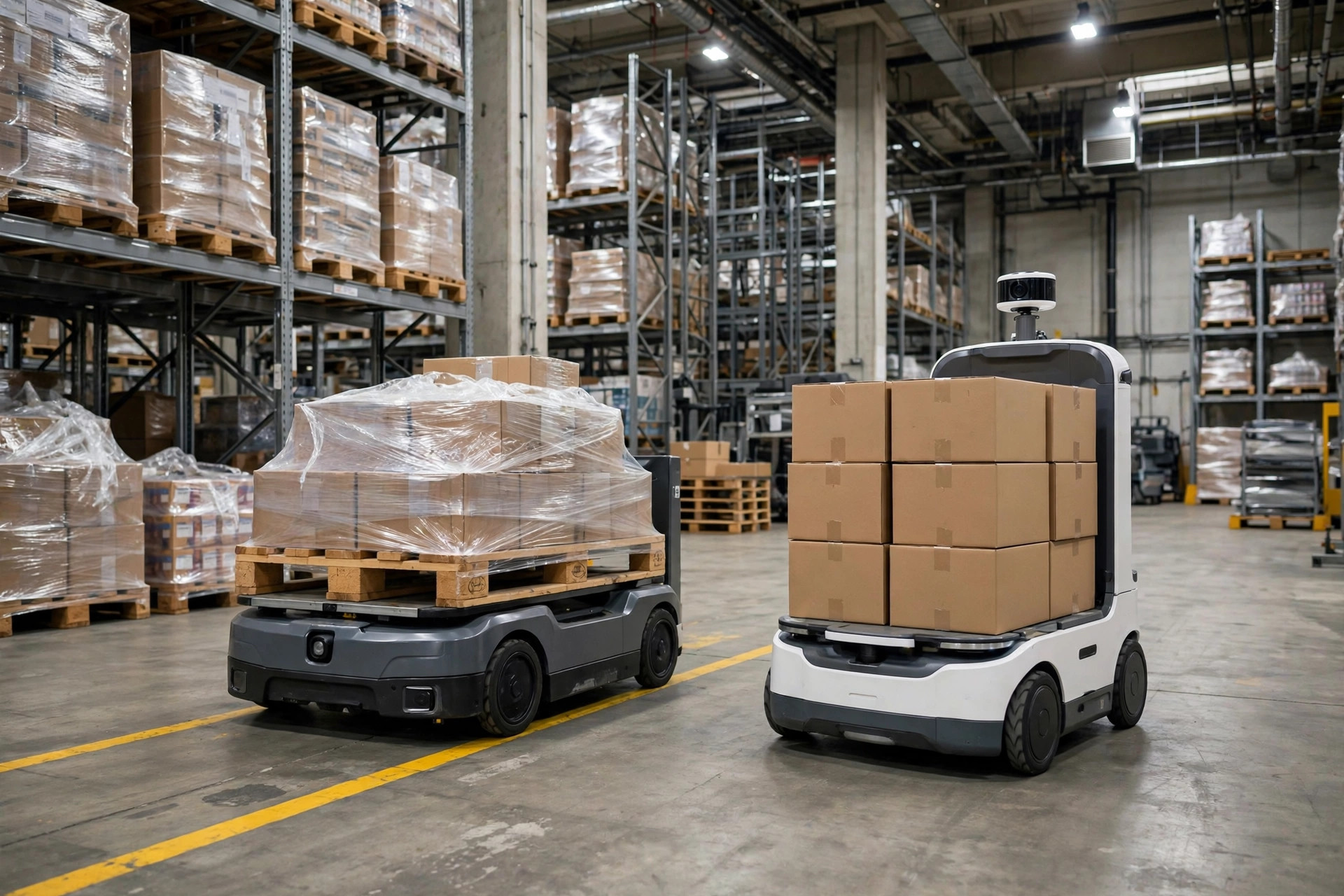
One Letter Apart — Two Ways of Life in the Warehouse
Last month a client with a 20,000 m² warehouse wanted 20 "little carts" for raw-material delivery and brought me two quotes: AGVs at $30K each, AMRs at $60K each. "Lao Mi, they're both self-driving carts — why double the price?" I took him to two sites: the AGV warehouse had magnetic tape and QR codes all over the floor, carts running like trains on tracks; the AMR warehouse had clean floors, carts navigating on their own, detouring around people. He got it instantly: one is a tram, the other is a self-driving taxi.
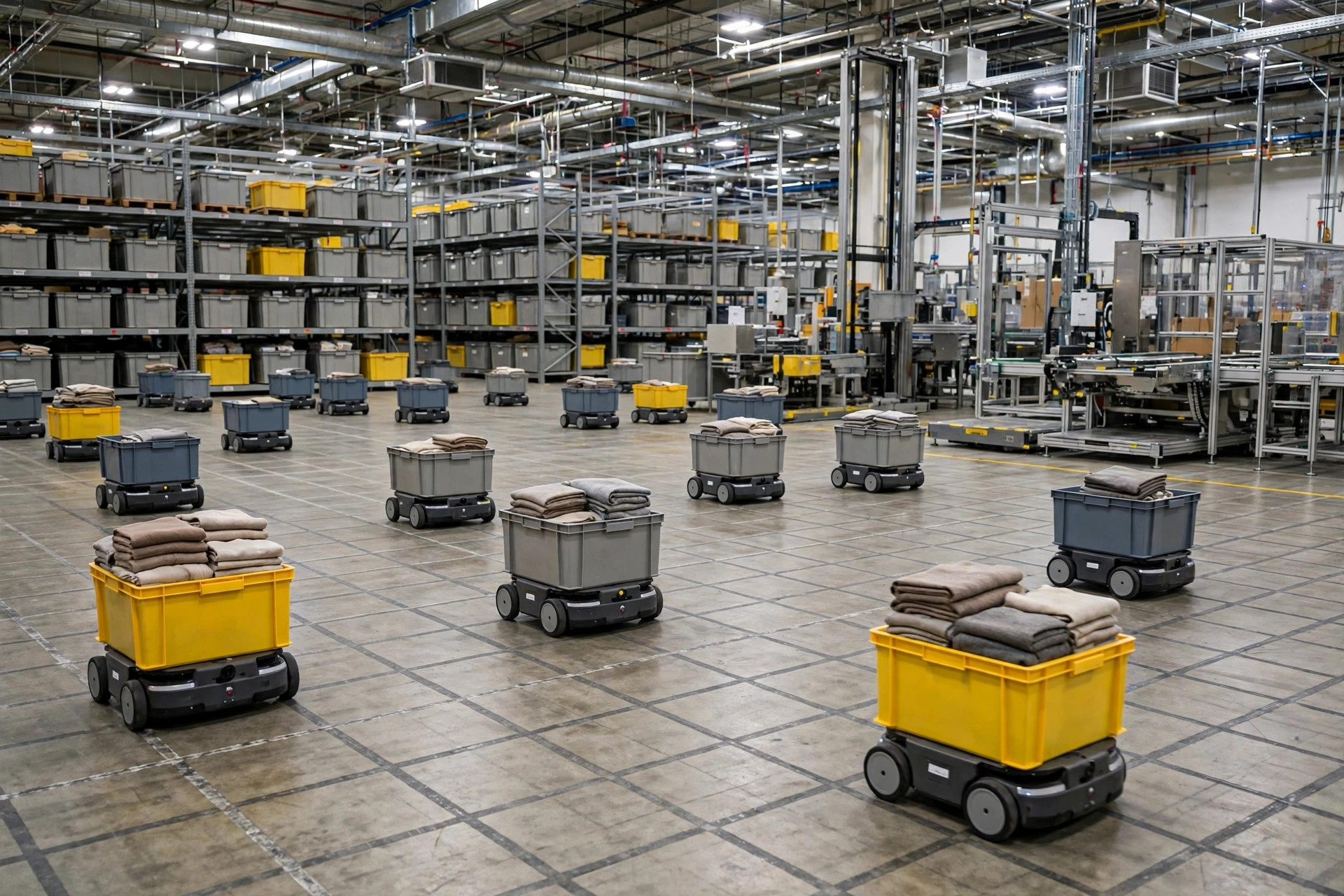
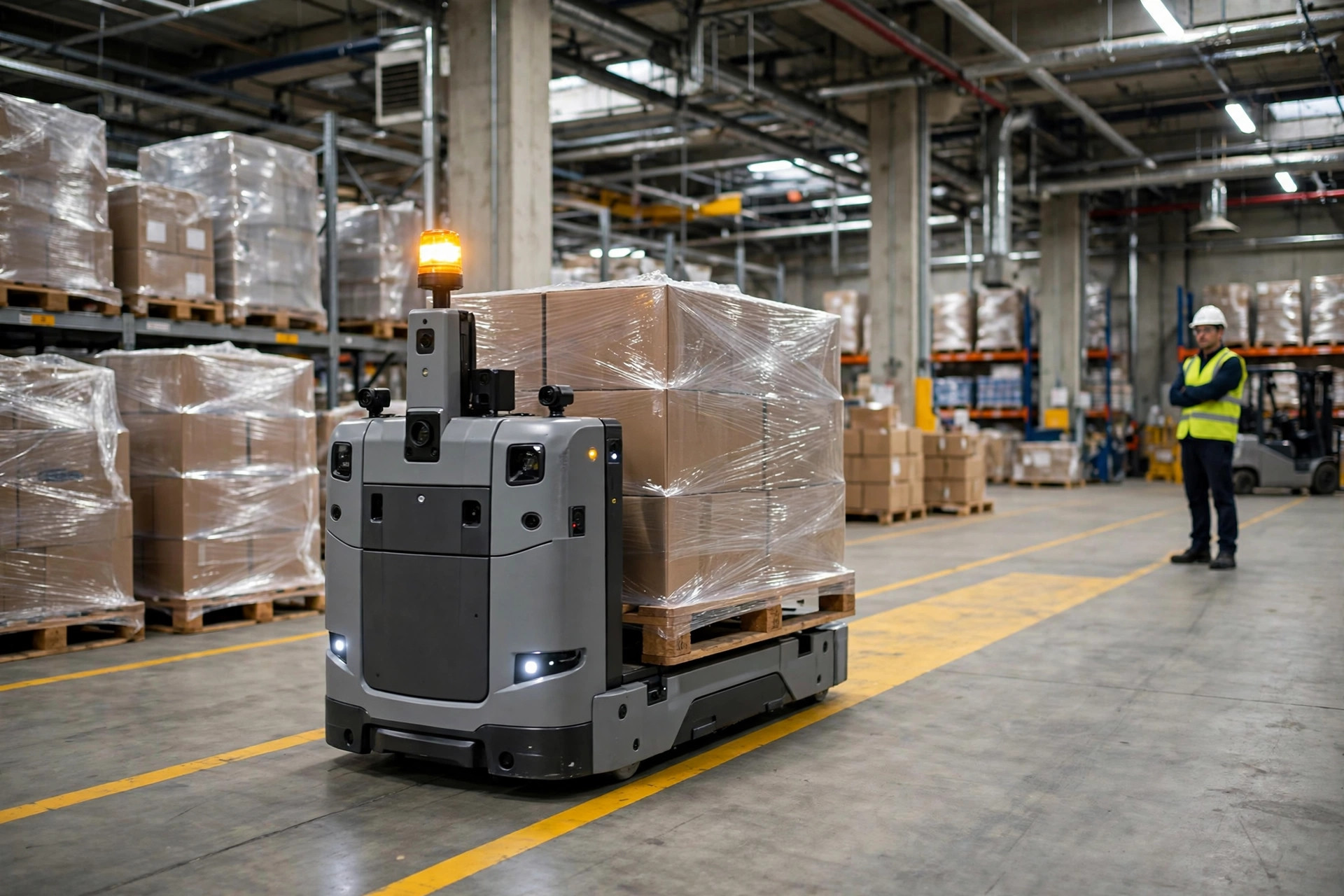
AGV (Automated Guided Vehicle) vs. AMR (Autonomous Mobile Robot) — one letter apart, and the essential difference is one sentence: AGVs follow external guidance (magnetic tape, pucks, QR codes, laser reflectors) along fixed routes; AMRs build maps with onboard sensors (LiDAR SLAM, vision) and plan their own paths.
Five Dimensions That Reveal the Real Difference
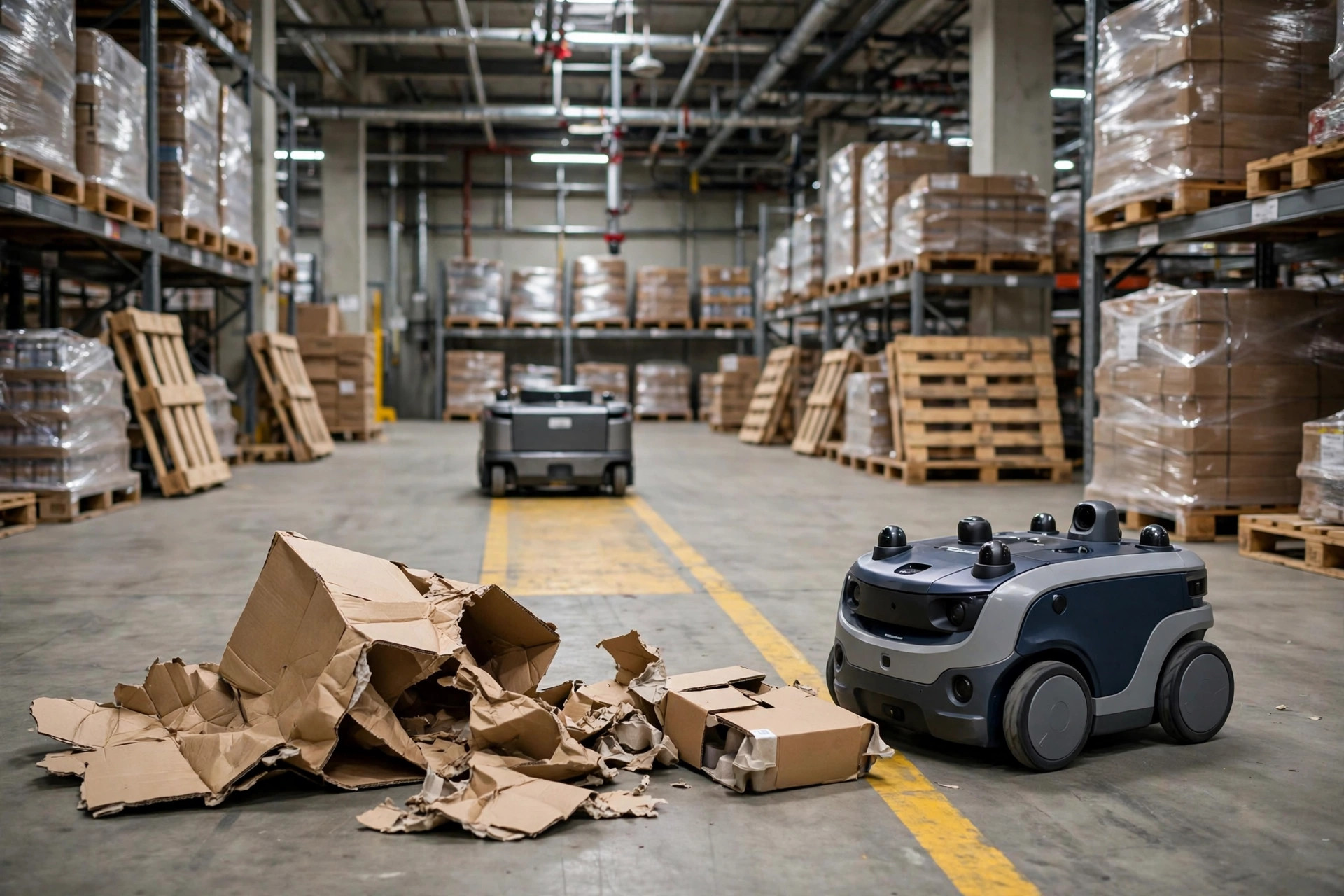
1. Navigation: Fixed Tracks vs. Free Roaming
- AGV: routes are "drawn" into the environment. Changing a route means re-laying tape, drilling pucks, or sticking QR codes — half a day minimum each time. The upside: routes are absolutely deterministic, ideal for processes that never change.
- AMR: on day one it "scans" the warehouse to build a map; after that, point and go. Adding a delivery point takes two clicks in software — live in 5 minutes. If your layout changes often, AMR isn't a luxury, it's a requirement.
2. Obstacle Handling: Stop and Wait vs. Detour
- AGV: person or pallet ahead — slow down, stop, alarm, wait for the obstacle to clear. Safe but stubborn; efficiency suffers in high-foot-traffic zones.
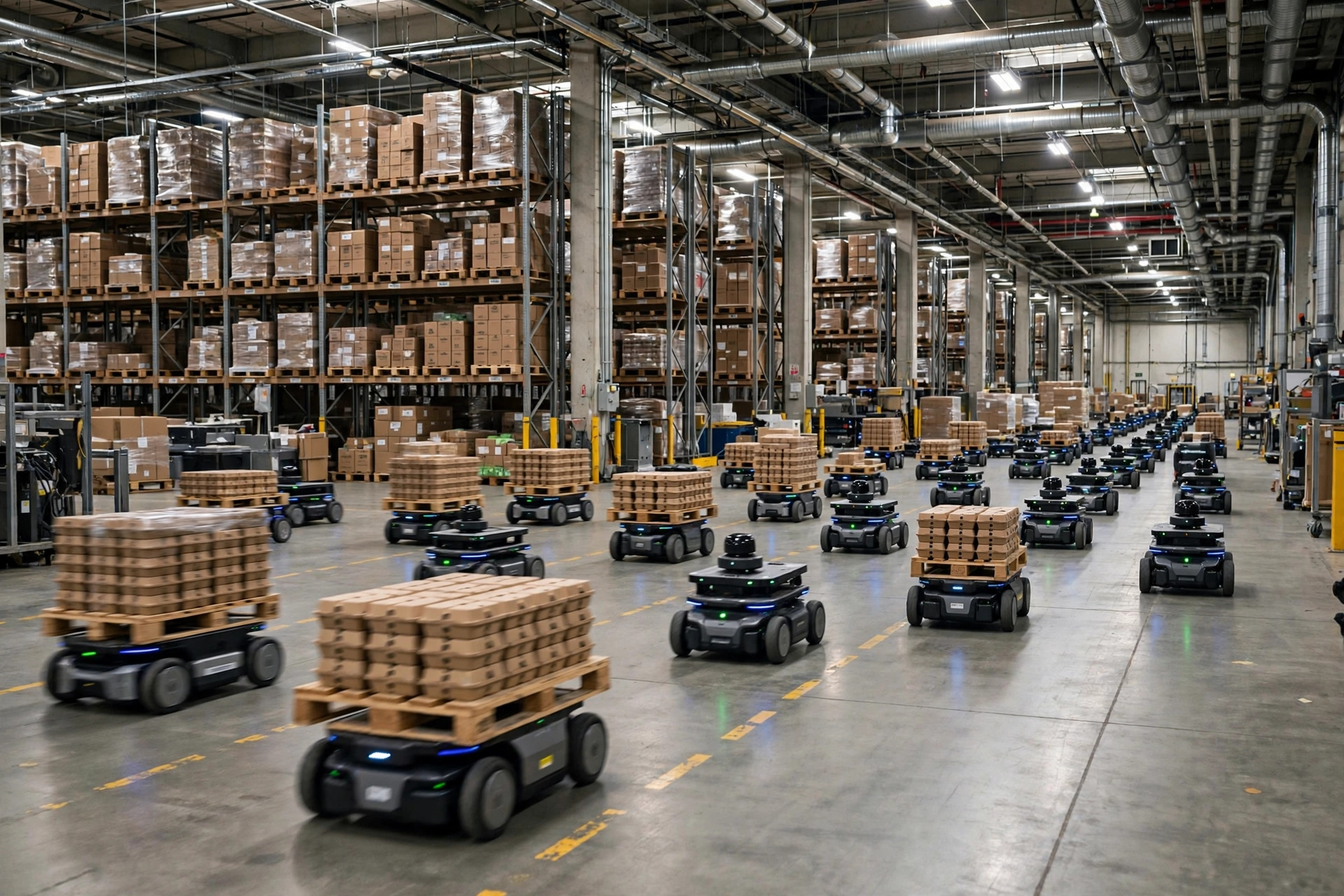
- AMR: 360° LiDAR perception plans detours in advance — at home in mixed human-robot zones. This is a big part of why AMRs cost more: sensors and compute aren't free.
3. Deployment: Measured in Months vs. Weeks
| | AGV | AMR | |---|---|---| | Navigation | Magnetic tape / QR / laser reflectors | LiDAR SLAM / visual navigation | | Route changes | Floor rework: half a day to days | Software config: minutes | | Obstacle handling | Stop and wait | Autonomous detour | | Deployment | 2–4 months (incl. floor work) | 2–4 weeks | | Unit price | $20K–$50K | $40K–$80K | | Fleet size | 5–20 units, fixed routes | 10–100+ units, dynamic dispatch | | Typical use | Auto plants, fixed production lines | E-commerce DCs, 3PLs, flexible manufacturing |
4. Cost Structure: Don't Stare at Unit Price
AGVs are cheaper per unit, but add floor installation (magnetic tape runs tens of dollars per meter — a full site adds up), route-change costs, and dedicated chargers. AMRs cost more per unit but skip the floor work, with fleet software usually bundled. At 20 units over 3 years, the total gap is often under 30% — don't let unit quotes fool you.
5. Decision Tree: Three Questions
- How often do routes change per year? Rarely → AGV. Often → AMR.
- Mixed traffic with people? Yes → AMR. Segregated zones → AGV works.
- Scaling past 50 units someday? Yes → AMR fleet software scales far better.
6. Hybrid: Many Warehouses Need Both
In practice, either/or is the exception — hybrid deployment is the norm. An 80,000 m² e-commerce DC I worked on is typical: AGVs run the fixed trunk loops (receiving → storage → sortation) — cheap and steady; AMRs handle flexible delivery inside sortation, dispatched dynamically to order waves. Both systems talk to the WMS through a unified task interface: AGVs are the arteries, AMRs the capillaries.
The key to hybrid: crisp task boundaries — fixed, high-frequency, bulk moves go AGV; variable, multi-point, small-batch moves go AMR. Blurry boundaries mean the two systems fight over jobs and both underperform. One money-saving trick: AGVs run fixed replenishment on night shifts (no people around), AMRs run flexible delivery on day shifts — both fleets at full utilization.
Start small either way: pilot 5–10 units to prove the process and ROI, then scale. I've seen 50-unit day-one purchases where untested processes grounded the whole fleet — painful lesson. Small steps aren't timid; they buy room to learn, and a proven phase-one ROI makes phase-two budget far easier to win.
Real Cases: AGVs for Auto Parts, AMRs for E-Commerce
Case A (AGV): An auto-parts supplier, 300 m fixed route from warehouse to production line, 200 trips/day, route unchanged in three years. Eight magnetic-tape AGVs, $400K total, three years with zero route changes — steady as a Swiss watch. AMRs here would be money wasted.
Case B (AMR): A 3PL e-commerce DC, 50,000 m², 2,000 SKUs, pick-zone layout reconfigured quarterly. Thirty AMRs for goods-to-person picking with dynamic dispatch. Add carts in peak, park them in troughs; layout changes live in 5 minutes. Over three years, avoided rework costs and downtime long covered the unit-price premium.
Pitfalls: Four Common Misconceptions
- "AMR is newer, so it's better": for never-changing routes, AGV is cheaper, steadier, and simpler to maintain. Newer ≠ better fit.
- Buying AGVs before checking the floor: magnetic-tape AGVs demand flat floors — more than 5 mm deviation per 3 m and they lose signal. Survey the floor before ordering.
- Running AMRs like AGVs: paying AMR money to run fixed routes wastes every dollar of sensor value. Know whether you need dynamic dispatch before buying.
- Ignoring the network: AMRs depend on Wi-Fi and the fleet server — a 5-second Wi-Fi drop leaves carts "lost" and spinning. Full-site Wi-Fi roaming tests (signal ≥ −65 dBm) are a prerequisite for any AMR project.
Summary
AGV vs. AMR isn't an upgrade relationship — it's a division of labor: fixed routes, stability, low cost → AGV; changing layouts, mixed traffic, flexibility → AMR. Remember the metaphor: AGV is the tram, AMR the self-driving taxi. Whether your warehouse needs railways or city-wide cabs — the answer is in how often your business changes.