The Overlooked Labor Sink
Walk into any e-commerce DC or factory pack zone and you'll see it: two or three workers beside a mountain of flat cartons, repeating three motions all day — pick up a blank, fold it into a box, tape the bottom. Simple motions, but one person erects only 3–5 cases a minute; backs ache by day's end and throughput never climbs.
Case erecting and sealing is the most overlooked labor sink: too low-tech to attract investment, yet a 5,000-order/day warehouse typically staffs 4–6 people just for it. The automatic case erector/sealer ends that sink: one machine erects and bottom-seals 10–20 cases a minute — replacing 2–3 people who never call in sick or get injured.
1. How It Works: Erect, Fold, Seal in Three Steps
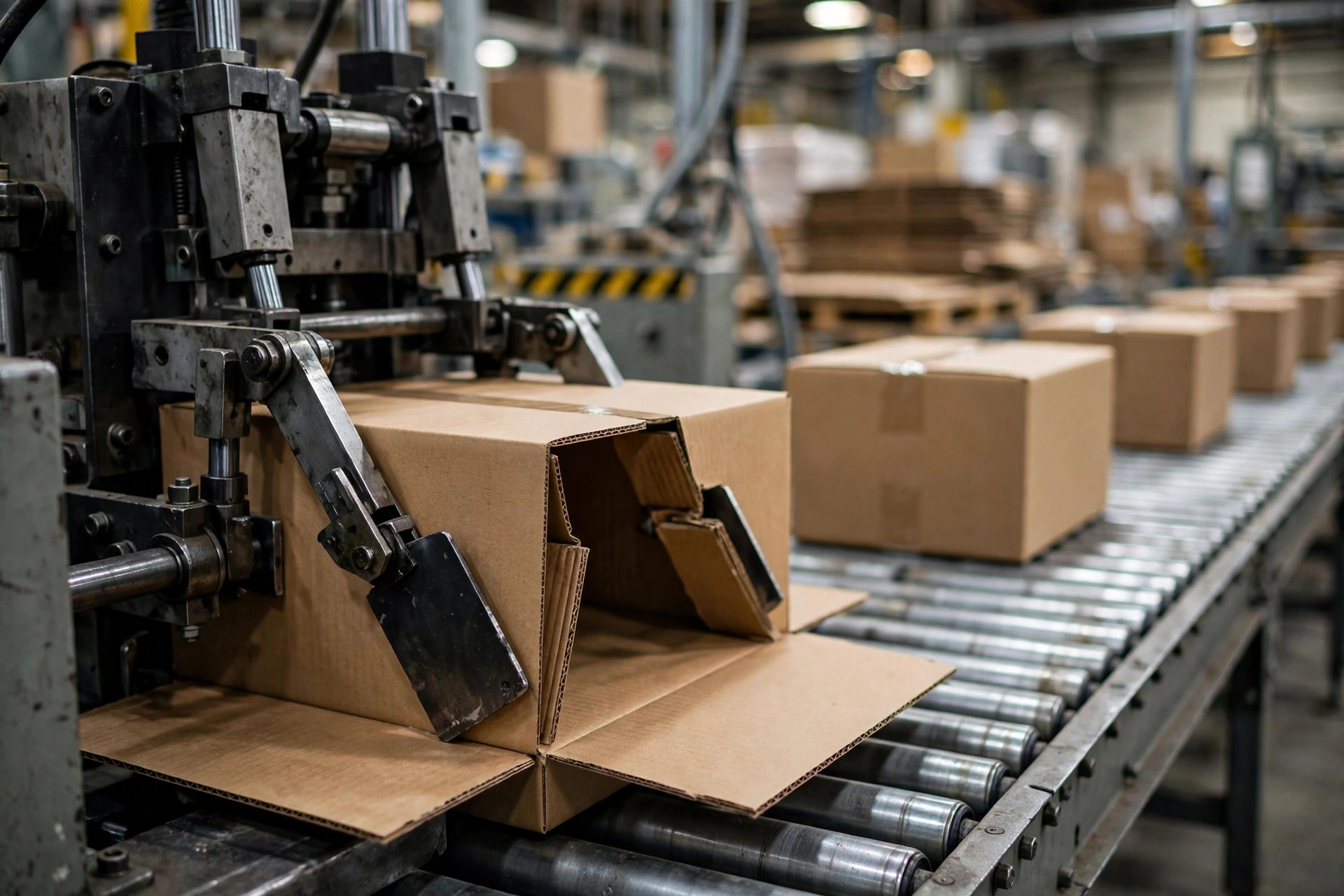
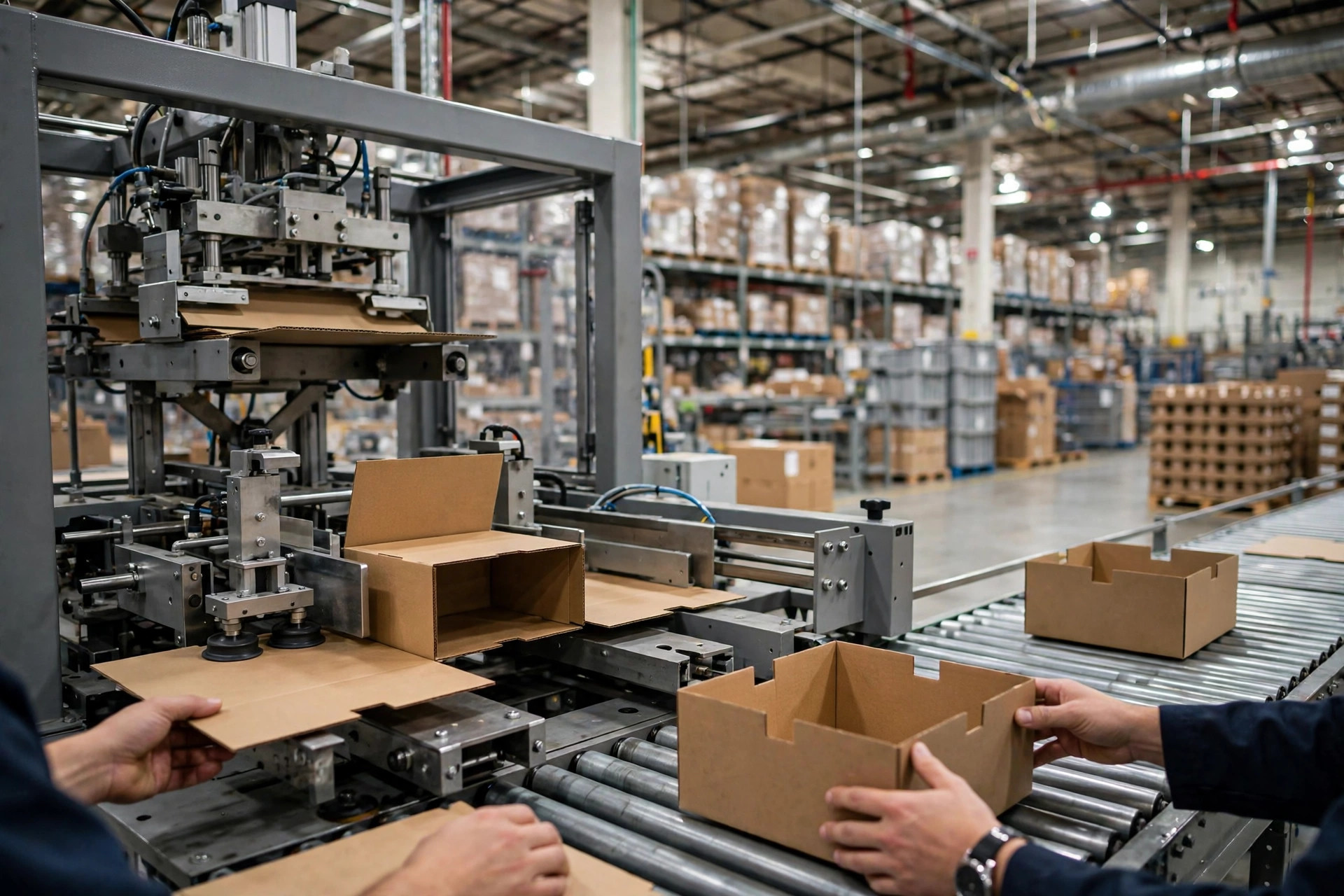
An automatic case erector works in three steps:
- Pick: vacuum cups or a mechanical hand pull a flat blank from the magazine. A typical magazine holds 100–200 blanks — one load lasts 1–2 hours.
- Form: the blank is squared into a box, front and back flaps folded, bottom tabs locked — this is the technical core; fold quality decides whether the box comes out square.
- Bottom seal: tape (single-strip) or hot melt applied to the bottom, then the conveyor carries it away.
Top case sealers work similarly: packed cartons pass through, top flaps are plowed flat, tape seals the top. Premium lines add automatic height detection — folding and sealing to the actual fill height, cutting void space — which matters for e-commerce DCs reducing dunnage and parcel freight.
2. Choosing a Model: Speed, Case Sizes, Changeover
| Selection factor | Slower models | Faster models | How to choose | |---|---|---|---| | Speed | 6–10 cases/min | 15–25 cases/min | Size to peak × 1.2 | | Size changeover | Manual (15–30 min) | One-touch/auto (1–3 min) | Multi-size operations need auto | | Size range | Fixed presets | Wide auto-adjust | Depends on case-size spread across SKUs | | Price | $11K–21K | $28K–55K | Don't pay for speed you'll never use |
Three selection questions: first, peak throughput in cases/min? Second, how many case sizes and how often do you change over? Third, is blank quality consistent? Multi-size with frequent changeovers → automatic-adjust models; manual-adjust machines stop the line 20 minutes per changeover — three changeovers a day costs an hour of capacity.
3. Matching Line Takt: Don't Let the Erector Become the Bottleneck
Erector takt must be ≥ downstream packing/sealing takt. Classic trap: buying a 10-case/min erector ahead of a manual pack station doing 12/min — the erector becomes the line bottleneck and workers wait for boxes.
Matching formula: erector rate ≥ peak order-box demand × 1.2. A 5,000-order/day e-commerce DC peaking at 800 orders/hour needs ~14 cases/min — choose 18+/min. Magazine capacity counts too: a 200-blank magazine at 14/min lasts 15 minutes, chaining an operator to refills — choose 500+ blanks or automatic magazine replenishment.
4. Tape vs. Hot Melt: Choosing the Seal
| Factor | Tape sealing | Hot-melt sealing | |---|---|---| | Consumable cost/case | Low (tape is cheap) | Medium (guns + adhesive) | | Seal strength | Medium | High (continuous bead) | | Appearance | Visible tape lines | Clean, seamless | | Equipment cost | Low | 30–50% higher | | Best for | E-commerce, general | Food, pharma, premium brands |
Tape is enough for e-commerce; food and pharma with hygiene and appearance demands suit hot melt. One detail: 48 mm tape is the universal standard; 72 mm seals heavier cases more securely.
5. Payback Math: One Machine, How Many People?
The math for a 5,000-order/day e-commerce DC:
- Today: 2 people erecting + 2 sealing at ~$830/month (¥6,000) → ~$80K/year (¥576K) fully loaded;
- Investment: erector + sealer line ~$35K–48K (¥250–350K);
- After: 1 operator for loading/inspection → ~$20K/year (¥144K);
- Annual savings ≈ $60K (¥430K) → payback 7–10 months.
That excludes hidden gains: squarer cases lift auto-label scan rates; workers move from repetitive labor to higher-value verification and exception handling.
Case Study: Case Line Retrofit at an E-Commerce DC
Background: an e-commerce DC in South China — 6,000 orders/day, 4 standard case sizes. Previously 5 people hand-erecting and sealing (8 at peak, still overwhelmed); hand-erected boxes came out unsquare and the downstream auto-labeler often failed to scan.
Solution: 1 auto-adjust erector (one-touch changeover across 4 sizes, 18/min) + 1 auto top sealer + height-detection fold-down, 500-blank magazine, conveyor tied straight into the pack zone.
Results: erect/seal headcount from 5 to 1 (loading/inspection); steady 16 cases/min, no peak-season choking; label scan first-pass rate from 92% to 99% on squarer boxes; project investment ~$44K (¥320K), payback 9 months.
Pitfalls
- Blank quality is the foundation: unclear score lines and uneven board caliper make the erector fold crooked and jam constantly. Lock quality standards with your carton supplier — edge-crush strength and score depth in the purchase agreement.
- Too many case sizes: beyond ~6 sizes, even auto-adjust machines struggle. Standardize first — converge 80% of orders onto 3–4 case sizes — then automate.
- Clean the dust: erecting generates heavy paper dust; vacuum cups and sensors need weekly cleaning or suction fades and false alarms multiply.
- Keep a manual bypass: when the machine faults, a manual erecting station keeps the line moving. Rehearse the failover switchover before peak season.
Takeaway
The automatic case erector/sealer is where carton automation starts: small investment (tens of thousands of dollars), fast payback (under a year), low risk (mature process). Selection in three lines: size takt to peak × 1.2, standardize case sizes before automating, blank quality is the foundation. Don't underestimate this "box-folding machine" — it's the first domino of pack-line automation; topple it, and auto case-packing, weighing, and labeling follow.