The Last Manual Stronghold
In many warehouses the front end is already automated — conveyors, scanning, sorting all flowing — and then at the end of the line, two or three workers are still hand-stacking cartons. Palletizing is "the last manual stronghold": repetitive bending and lifting, tons per day, chronic back injuries — and young workers simply won't do it.
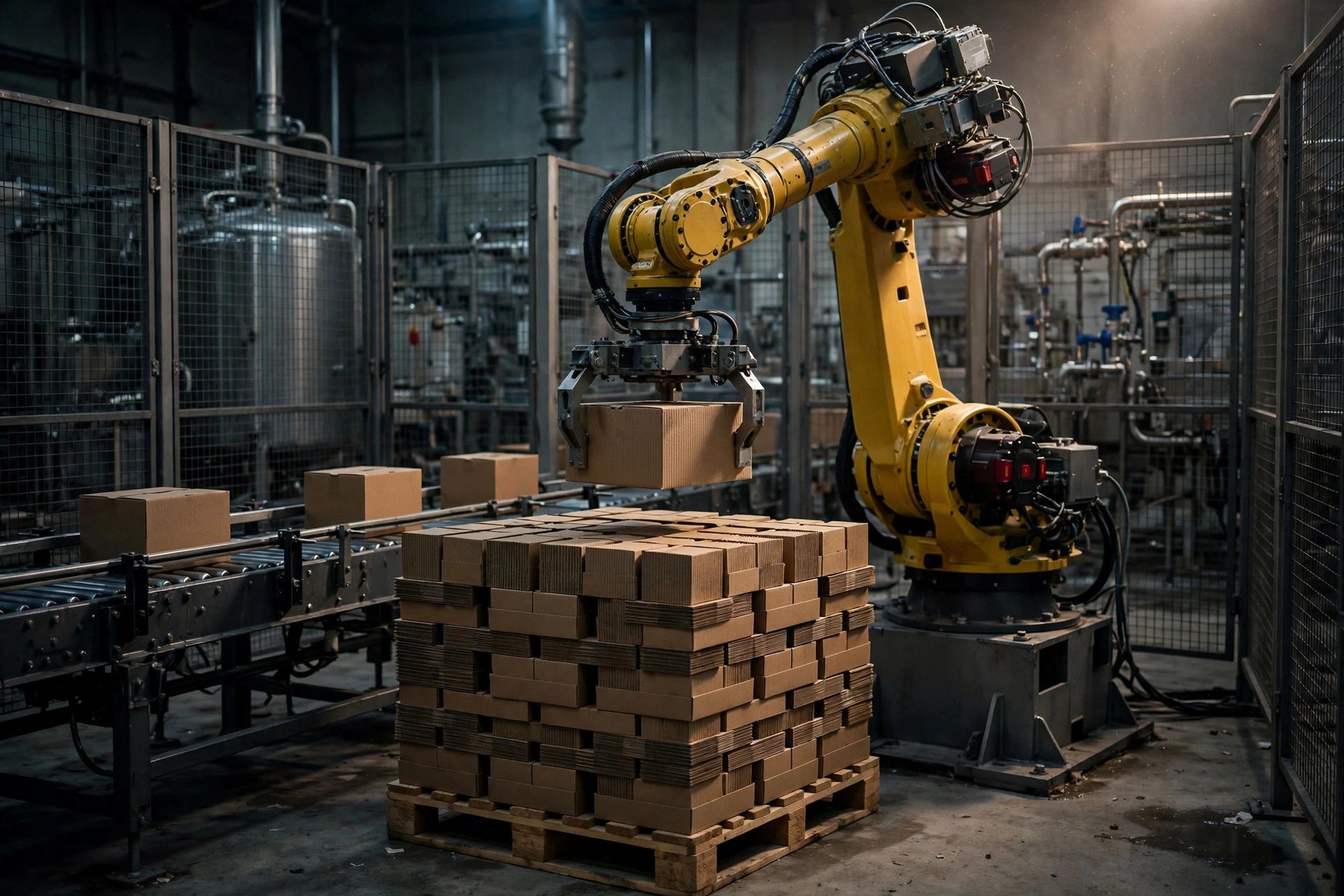
Robotic palletizing exists to take this stronghold: one robot running 24/7, perfectly uniform pallets, topple rates near zero. But plenty of palletizing robots end up "not fitting in," and the cause is almost always one of two things: a poorly tuned pallet pattern (the pallet wobbles), or the wrong gripper (cartons drop).
1. Robot Types: Articulated, Gantry, or Collaborative
| Type | Traits | Payload / speed | Best for | |---|---|---|---| | Articulated (6-/4-axis) | Flexible, compact footprint | 10–200 kg, medium-high speed | Multi-SKU, small batches, changing patterns | | Gantry / Cartesian palletizer | Simple, rigid | 50–500 kg, high speed | Single/few SKUs, high volume, fast lines | | Collaborative robot | No fencing, shared space | 5–20 kg, low speed | Light loads, tight spaces, flexible fill-in |
First three questions: how heavy are the cases, how many per minute, how many SKUs? Single-SKU high speed (e.g., a beverage plant at 15+ cases/min) → gantry palletizer, fast and cheap. Multi-SKU with frequent pattern changes → articulated robot, just switch programs. No room for fencing and light cases → collaborative robot as a fill-in.
2. Pallet Patterns: Stability Beats Speed
The pallet pattern is the soul of palletizing. A good algorithm satisfies four goals at once:
- Stability: interlocked layers with staggered joints, centered gravity — like bricklaying; staggered joints are rule #1 against toppling;
- Cube utilization: 90%+ pallet footprint utilization — don't waste pallet area;
- Labels out: barcodes/shipping marks facing outward for dock scanning, eliminating re-stacking;
- Computability: the algorithm auto-generates patterns from case and pallet dimensions — a new case size gets a new pattern within 10 minutes.
Common patterns:
- Interlocked (brick-laid): each layer rotated 90° or offset half a case — most stable, the default choice;
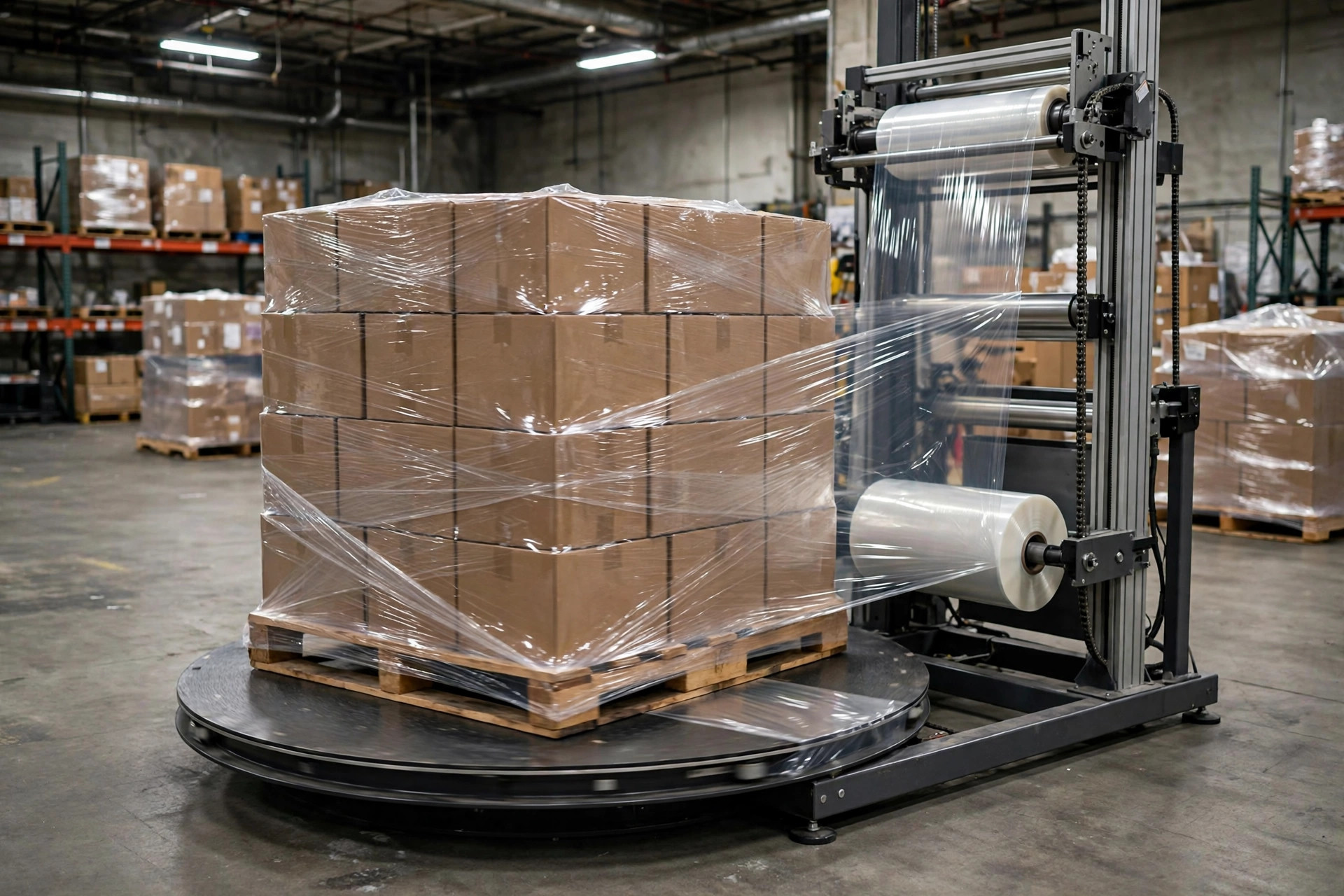
- Column: layers perfectly aligned — fast to build but unstable; only for light cases plus stretch-wrap reinforcement;
- Hybrid: interlocked base layers, flexible top layers for remaining space — balancing utilization and stability.
One hard metric: on a finished 1.8 m pallet, push the top-layer cartons by hand — more than 5 cm of shift means the pattern or place accuracy needs tuning.
3. Gripper Selection: Clamp, Vacuum, Fork, or Cradle
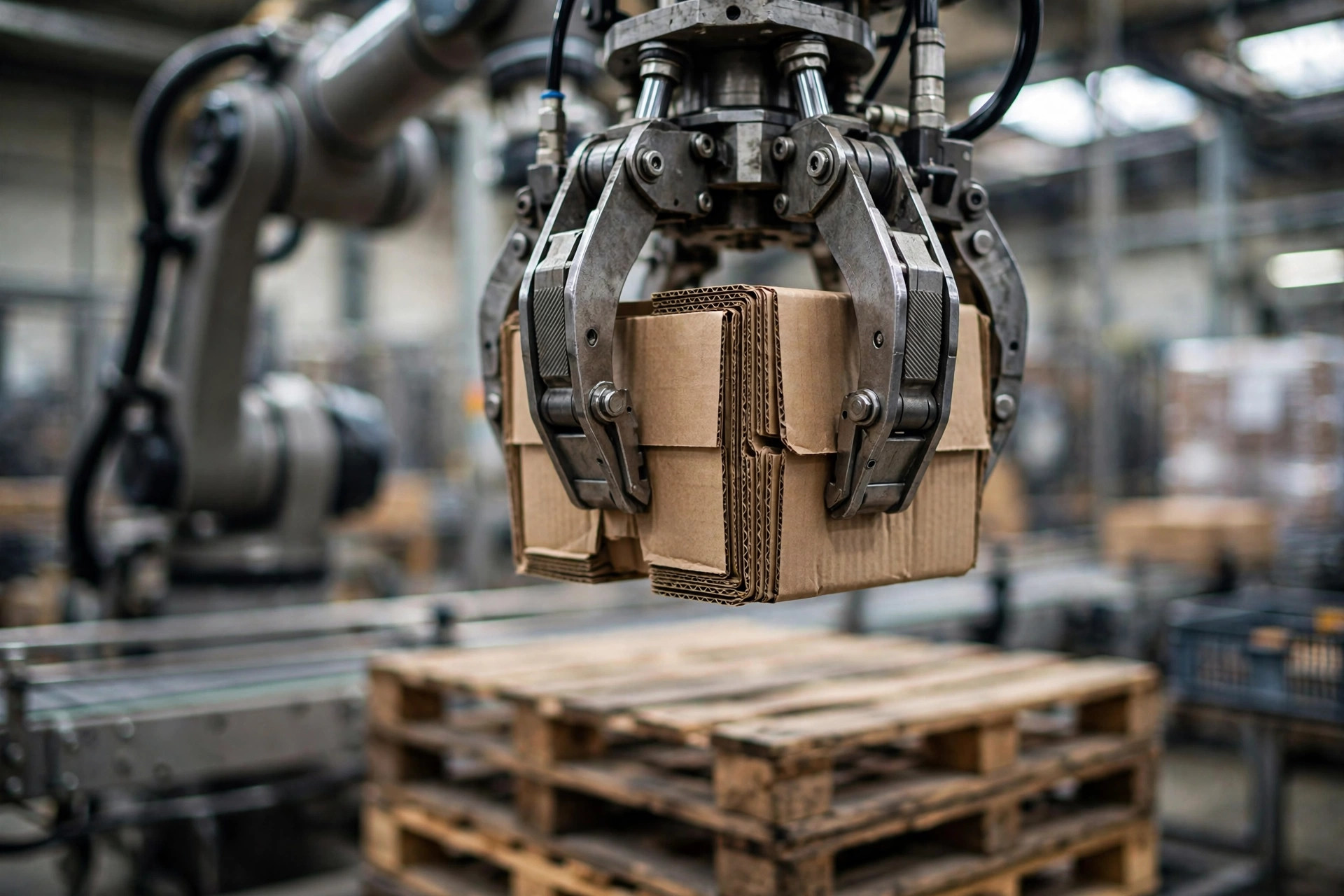
The gripper is the robot's only contact with the carton. Get it wrong and the best algorithm is worthless:
- Clamp/squeeze: side plates hug the carton. Most universal — good for standard corrugated cases, gripping by friction. Clamp force must be adjustable: too much crushes, too little drops.
- Vacuum: top cups suck the carton. Great for flat, well-sealed tops and fast. But tape wrinkles or vent holes on the surface kill suction.
- Fork/under-grip: tines support from below. Best for heavy cases and soft packs (rice bags, pet food) — no deformation risk.
- Combo: clamp + vacuum, hug + support — for mixed cases and multi-SKU. Pricier, but most flexible.
Selection mantra: look at the carton first, then the gripper. Bring your heaviest, lightest, largest, smallest, and softest cases to the vendor for live testing; film it and write the results into the contract — verbal "it handles everything" doesn't count.
4. Cycle-Time Math: Don't Buy a Bottleneck
The robot's takt must match the line. Simple formula:
Required rate (cases/min) = line peak throughput (cases/min) × 1.2 (margin factor)
Example: a line peaking at 10 cases/min needs a robot rated at 12+. One full pick-and-place cycle = move to pick position → grip → transfer → place → return. Articulated robots typically cycle in 8–12 s, gantry machines in 5–8 s — but those are ideal no-load figures; with vision positioning, pattern computation, and exception handling, derate to 80%.
Dual-station design is the key speedup: while the robot builds pallet A, a forklift removes full pallet B and stages an empty — no stopping for pallet exchange. Single-station setups lose 1–2 minutes per exchange — hundreds of cases a day.
5. Integration with Lines and WMS: No Islands
A palletizing robot must talk to the upstream line and downstream WMS:
- Upstream: conveyor infeed signals and case identification (scan or vision); the robot auto-switches pattern programs;
- Downstream: on pallet completion, the WMS auto-generates the pallet label (SKU, quantity, lot, pattern), prints and applies it, and a forklift/AGV collects per dispatch instruction;
- Exceptions: skewed, empty, or damaged inbound cases get vision-rejected or alarmed — don't let the robot grab a crushed carton.
| Integration point | Signal / data | Exception handling | |---|---|---| | Conveyor → robot | In-position signal, case code | Skewed-case reject, empty-case alarm | | Robot → WMS | Pallet complete, layer count | Pattern anomaly pause | | WMS → print & apply | Pallet label data | Missing-label reprint | | WMS → forklift/AGV | Transport task | Full-pallet wait queue |
Case Study: Palletizing Line Retrofit at a Beverage Plant
Background: a beverage plant in East China — 12,000 bottles/hour line, i.e., 12 cases/min. Previously 6 people hand-palletizing across two shifts; patterns depended on craftsmanship, with 3–5 toppled pallets a month; peak season hiring was impossible.
Solution: 2 four-axis articulated robots + dual-station pallet magazines, clamp grippers with adjustable force control, vision-guided case positioning, WMS-driven automatic pattern changeover (3 case sizes); auto labeling on completion with AGV call-off.
Results: 14 cases/min per robot — the line never starves; headcount from 12 to 2 (inspection); toppled pallets: zero; project investment ~$250K (¥1.8M) including AGV integration, ~$165K/year (¥1.2M) in labor savings — payback 18 months.
Pitfalls
- Carton strength first: a robot stacking 5 layers to 1.8 m puts far more load on bottom cartons than hand stacking. If edge-crush strength is insufficient, the best pattern still collapses. Test the carton before buying the robot.
- Inbound consistency: case dimensions varying more than 1 cm defeat even the best algorithm. Demand dimensional stability from upstream casing/sealing.
- Don't skimp on safety fencing: articulated robots need fencing + safety gates + e-stops inside their motion envelope (collaborative robots excepted). The money saved on fencing won't cover one injury.
- Bank your patterns: before a new case size goes live, generate and physically test its pattern in simulation — don't make the line wait while you tune programs.
Takeaway
Robotic palletizing selection in two mantras: patterns are about "stability," grippers are about "the carton." Stable patterns end toppled pallets; the right gripper ends dropped cases. Add correct takt math and solid systems integration, and one robot replaces 4–6 people with a two-year payback — the most mature automation play at the end of the pack line. But remember: robots can't fix bad cartons and chaotic infeed — upstream quality is the foundation palletizing automation stands on.