A "Simple Belt" That Sank Three Projects
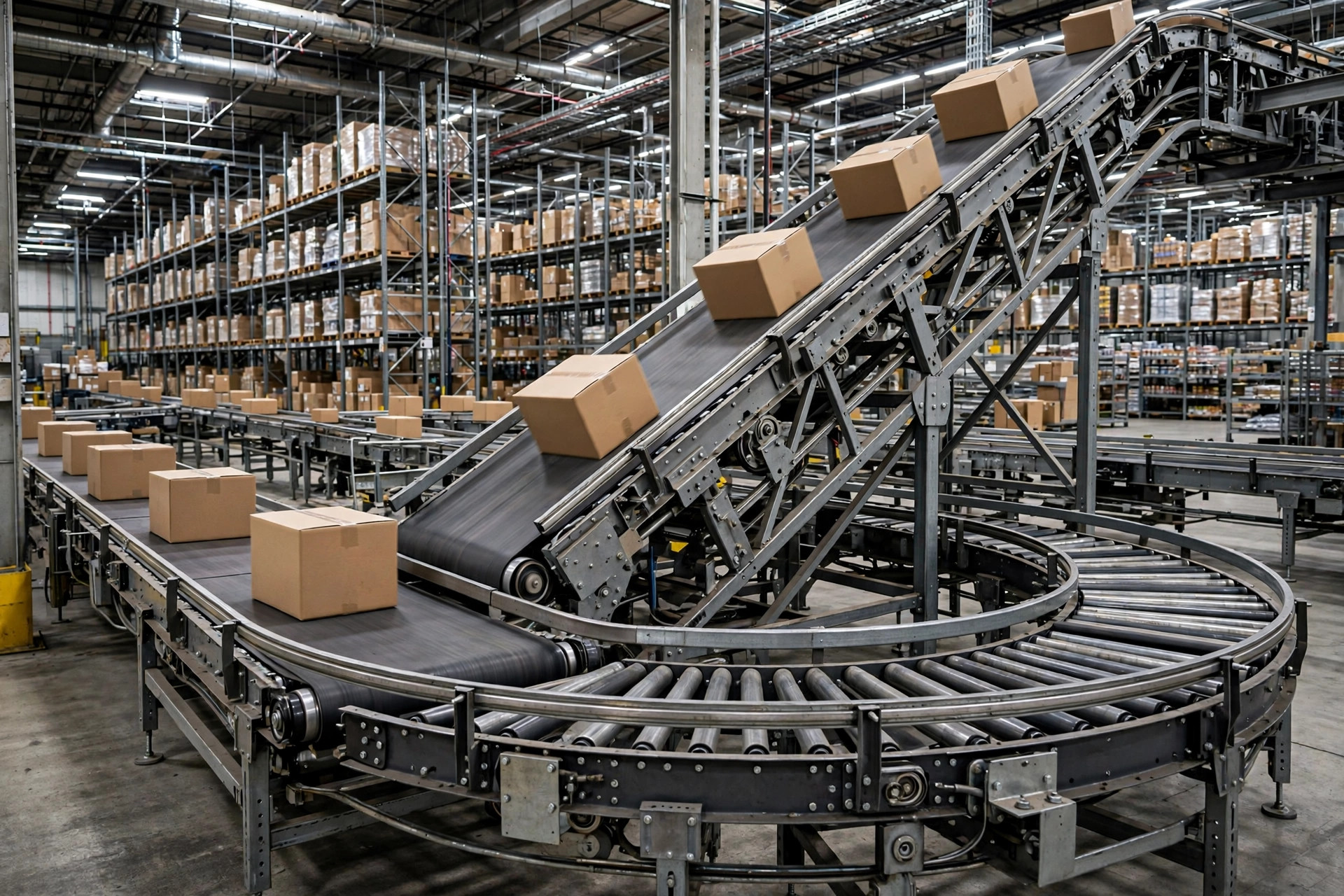
The most expensive conveyor lesson I've seen: a client's new DC had a 12-meter climb from sortation to packing. To save money, the design used a standard flat-belt conveyor at a 22-degree incline. On day one, cartons slid back down one after another and jammed the whole section. The rework — switching to a cleated belt with a top hold-down — cost an extra $90K and a month of delay.
Conveyors are the arteries of an automated warehouse. They look simple, but one wrong parameter drags down the entire line's throughput and reliability. Speed, incline, and curves are the three places designs most often go wrong.
Three Engineering Essentials, Dissected
1. Speed: Faster Isn't Better — 1.2–2.0 m/s Is the Sweet Spot
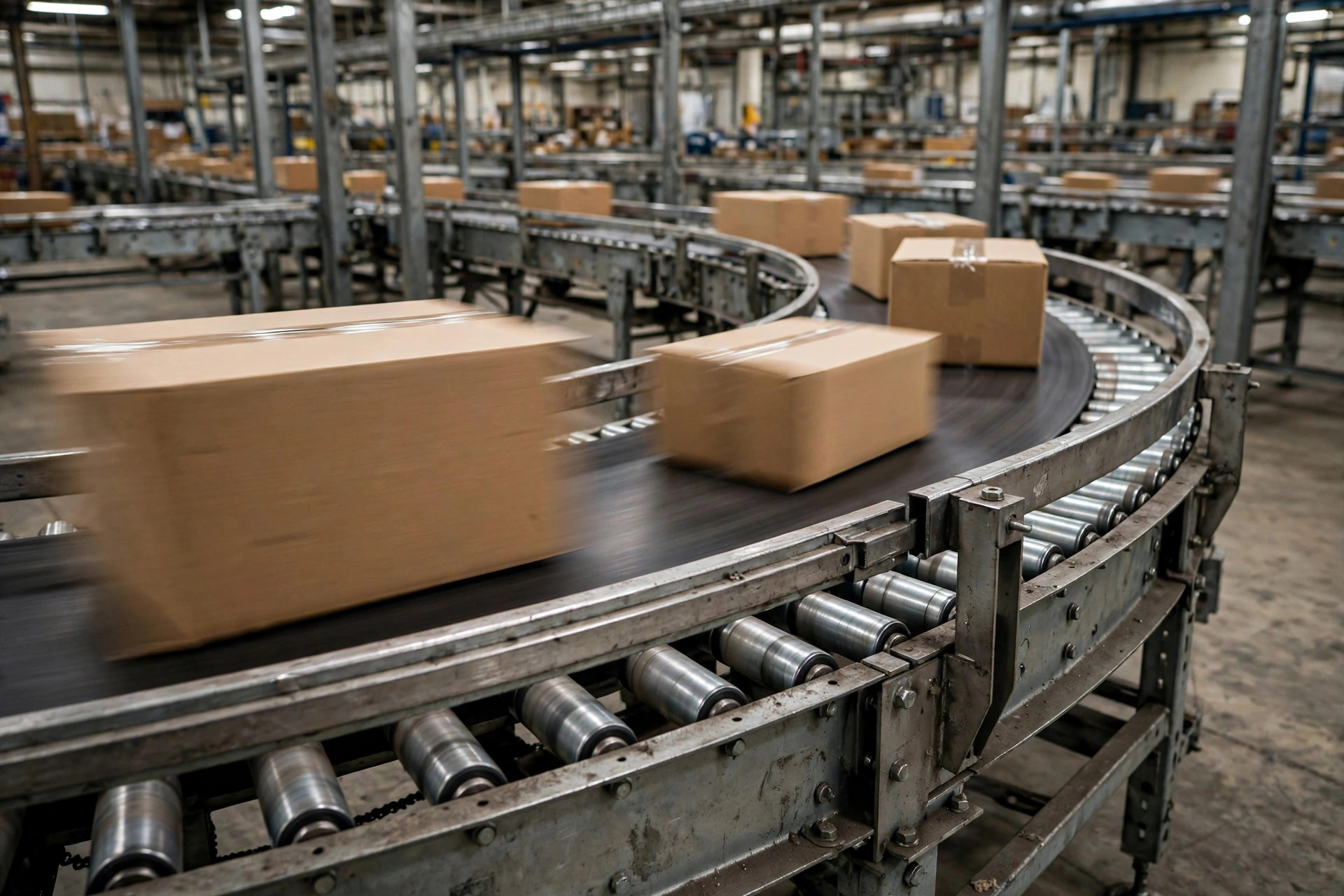
Line speed directly sets hourly throughput: throughput = 3,600 × speed ÷ item spacing. A line at 1.5 m/s with 0.6 m spacing theoretically moves 9,000 items/hour.
But speed brings costs:
- Sort accuracy drops: photoeyes need response time, diverter mechanisms need actuation time — above 2.0 m/s, wheel-diverter accuracy falls from 99.5% to below 98%.
- Noise and wear: every extra 0.5 m/s increases roller and belt wear by roughly 40%.
- Longer e-stop distances: safety standards mandate stopping distances — faster lines need safety light curtains set further back, eating floor space.
My selection rule: trunk lines at 1.5–2.0 m/s, sortation sections at 1.2–1.5 m/s, manual work zones (induction, QC) at 0.8–1.2 m/s. Zoned speeds beat one-speed-fits-all on both energy and stability.
2. Incline: Beyond 15 Degrees, Change the Equipment
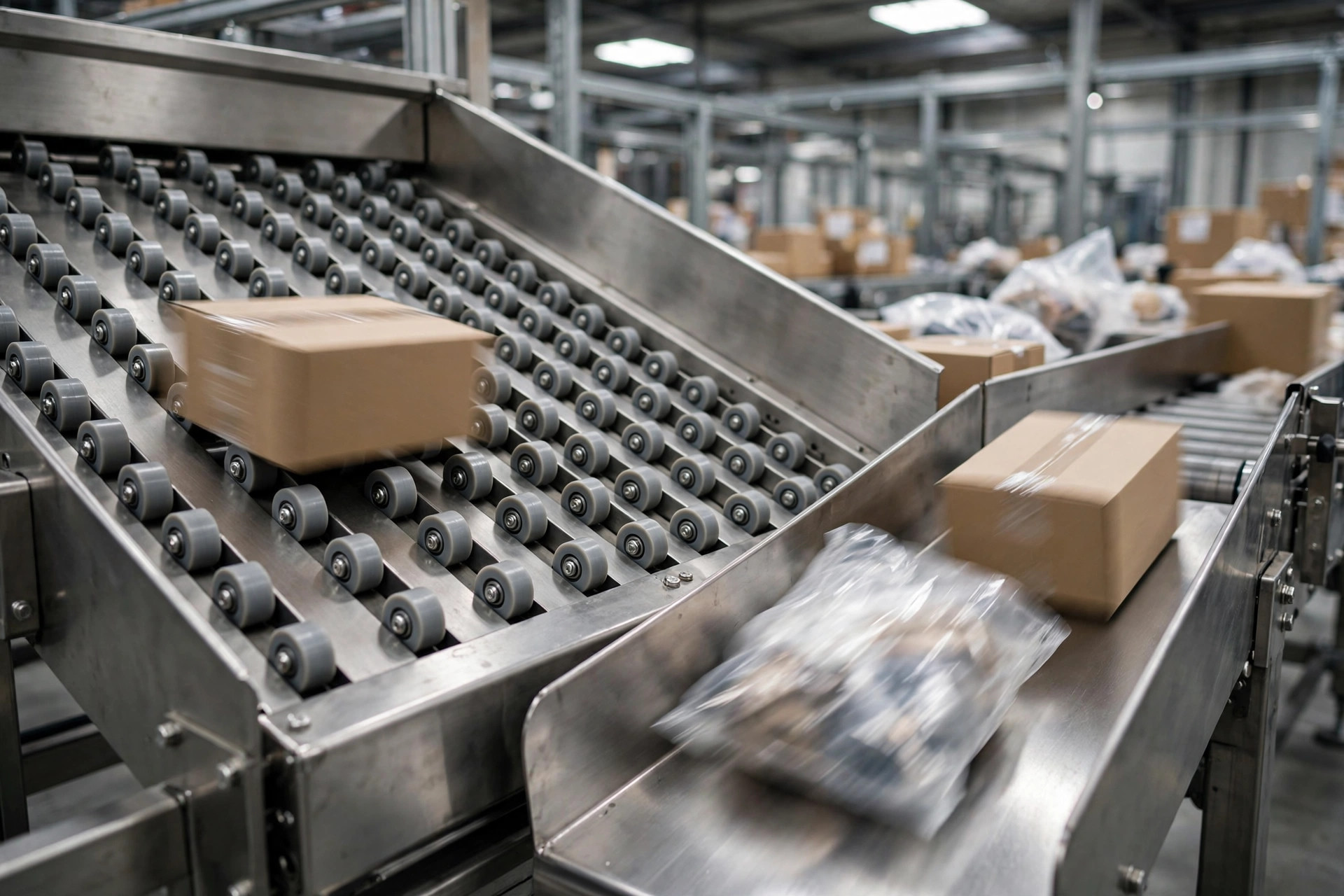
Climbing ability varies enormously by conveyor type — this is iron law for selection:
| Type | Safe Incline Limit | Notes | |---|---|---| | Standard flat belt | 12–15° | Slips beyond this, especially with slick carton bottoms | | Cleated/patterned belt | 25–30° | Side skirts stop spillage; good for small items | | Powered roller | 5–8° | Friction-driven; slips fast on inclines | | Chain conveyor | 30°+ | Pallet duty; chain dogs do the work | | Spiral lift | Vertical | Small footprint; ideal for mezzanine transfers |
The painful lesson: a carton's friction coefficient on belt is ~0.4 dry, but only ~0.25 when damp or film-wrapped. At 0.25, arctan(0.25) ≈ 14° — that's where the 15-degree ceiling comes from. In humid climates or cold-chain rooms with condensation, be 2–3 degrees more conservative.
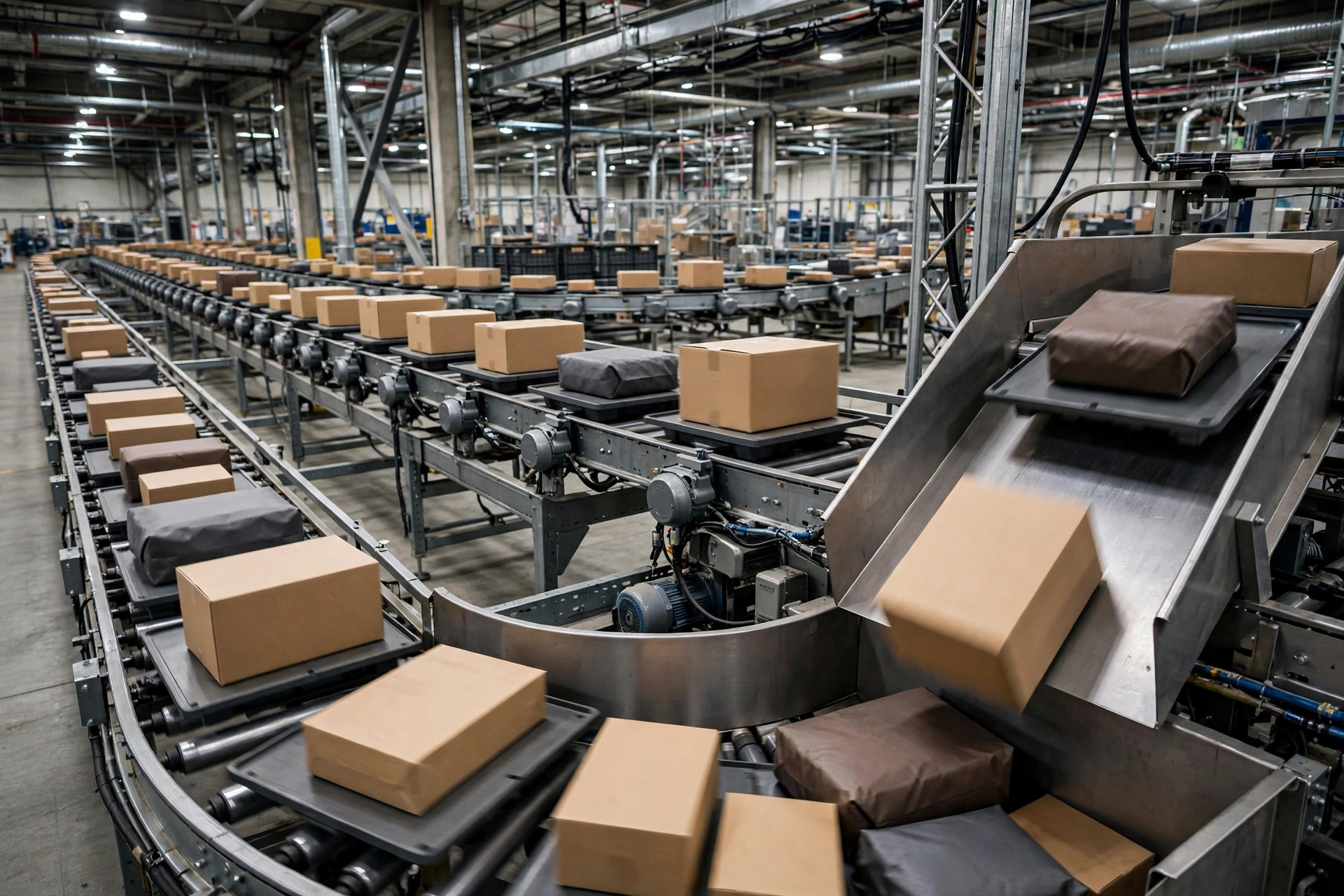
For climbs beyond 15 degrees, three options: switch to cleated belt, add a top hold-down belt that "sandwiches" product uphill, or use a lift. Don't believe "just upsize the motor" — motors solve power, not slippage.
3. Curves: The Most Expensive 10% of Your Line
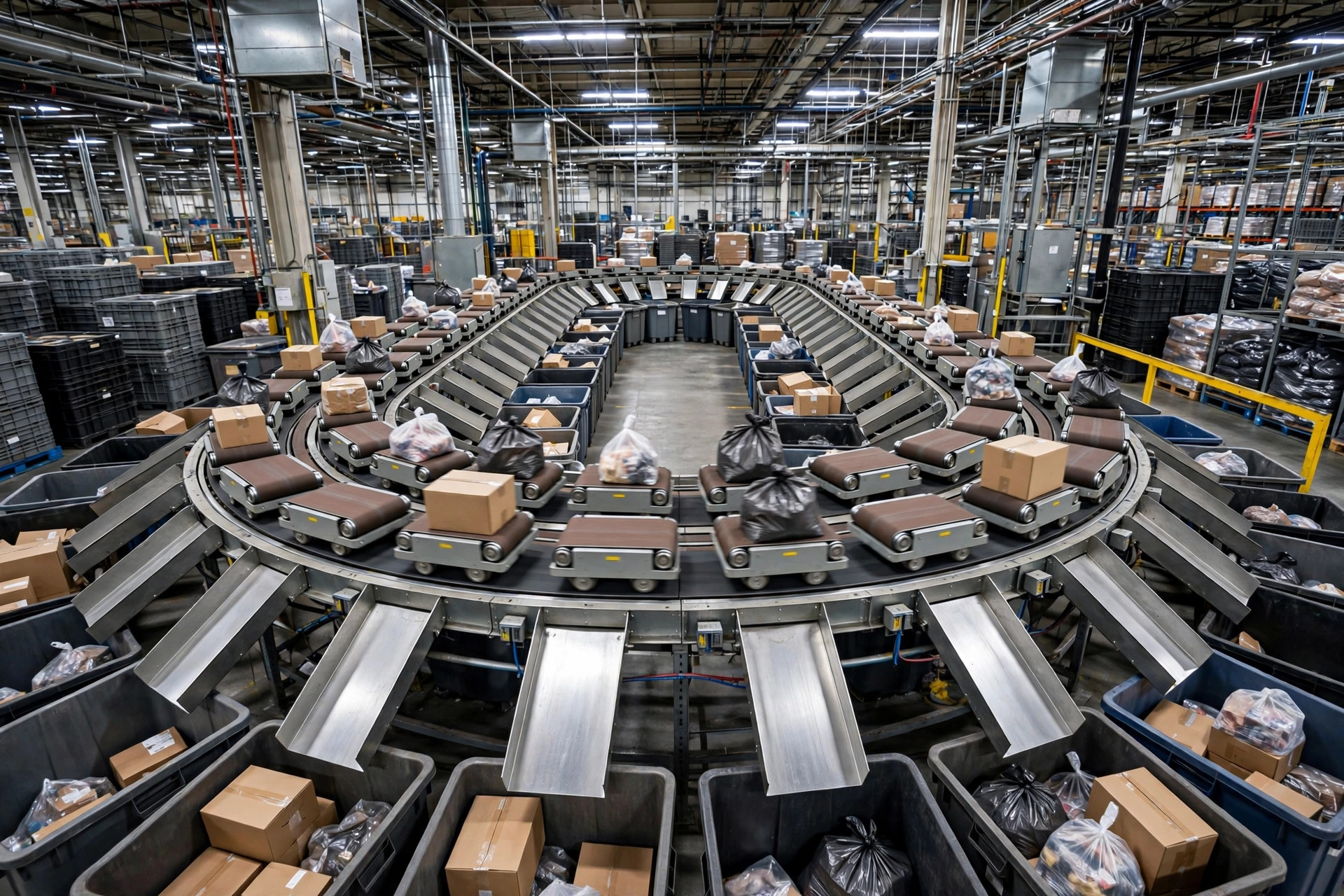
Straight sections are cheap; curves are expensive. On a typical line, 80% of faults and 50% of commissioning time come from the curves.
- Belt curves: tapered rollers handle the turn, radius typically 600–1,000 mm, good for small parcels — keep speed under 1.5 m/s or centrifugal force throws product off.
- Roller curves: tapered-roller differential, larger radius, more floor space, but heavier load capacity.
- Lift-and-transfer: the right-angle specialist — lifts, rotates 90°, sets down, ~8–12 seconds per cycle. Note it's a bottleneck: line throughput equals its cycle rate; string no more than 2–3 in series.
Three iron rules for curve planning: curve radius ≥ 1.5x the longest product dimension; keep 2 m of straight conveyor before and after each curve for flow stabilization; guard both sides of every curve at no less than two-thirds of product height.
When you can climb instead of turning, do it. In U- or L-shaped layouts, one 90° belt curve costs as much as 8–10 m of straight belt. If ceiling height allows, two cleated-belt climbs with an elevated straight run replace ground-level curves — you add lift height but eliminate the fault-prone curves, and long-term maintenance costs less.
Bonus: Don't Let Electrical Lag Mechanical
Conveyors are electromechanical — once mechanics are set, electrical must keep up: one VFD per line (don't share one drive across multiple motors to save money — start/stop shock stretches belts); use through-beam photoeyes, not diffuse-reflective (in dusty warehouses, diffuse sensors false-trigger within months); leave 20% spare I/O in control cabinets so future additions don't need a new cabinet. Each detail costs little — under 5% of total — but decides whether you commission in one pass or debug for three months.
Real Case: One Curve Decision Saved $400K
A Texas 3PL with a U-shaped layout needed its sort line to make a 180° turn. The original design used four 90° belt curves at $520K. I walked the site, saw 12 m ceilings, and proposed "climb + elevated straight + descend": two 18 m cleated-belt climbs to 6 m elevation, 40 m of aerial straight run, then back down. Total: $380K — $140K saved, and more importantly four fault points eliminated; two years running with zero curve-section downtime. Sometimes the best curve is no curve at all — go up.
Pitfalls: Four High-Frequency Failures
- Photoeyes in the curve: product attitude shifts in curves cause false triggers. Mount photoeyes only on straight sections, 2+ m from any curve.
- Motor sized for flat running: incline motors must cover lift work plus friction — keep 30% margin or summer heat derating trips overloads.
- No expansion joints: straight runs over 30 m buckle their supports from thermal expansion — leave 5 cm expansion gaps every 20–30 m.
- One button for the whole line: upstream keeps feeding when downstream jams. Zone control with accumulation sensing is mandatory — jams must auto-stop upstream.
Summary
Conveyor planning comes down to three numbers: speed zoned at 1.2–2.0 m/s, 15° as the incline red line, curve radius at 1.5x product length. Plus one mindset: minimize curves wherever possible — and when the ceiling allows, go over instead of around. Conveyors run 24/7; spending 10% more care at design time saves 50% of your midnight emergency calls after go-live.