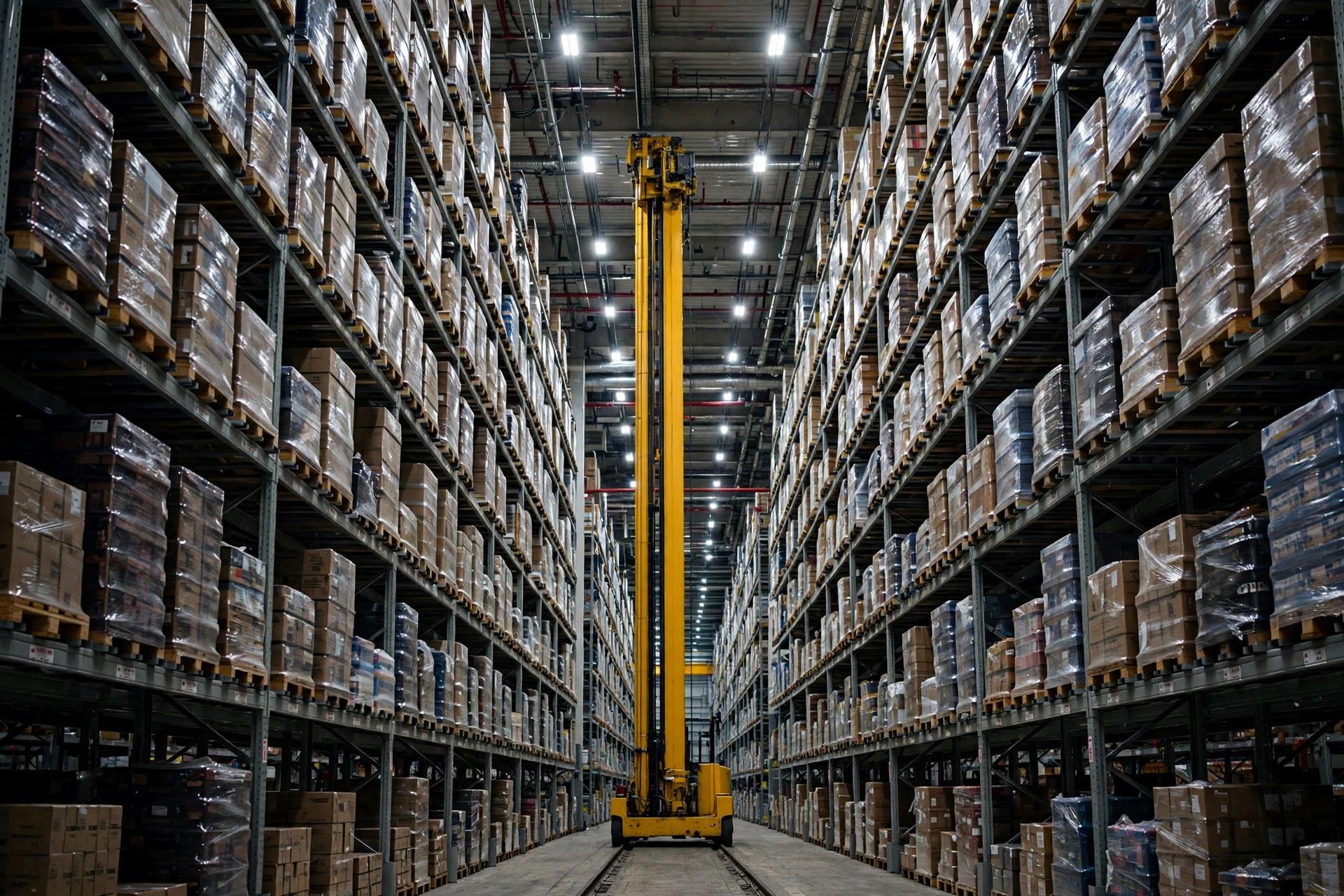
Same "AS/RS" Name — One's an Elevator, One's a Taxi Fleet
Last year I ran two AS/RS projects side by side — a perfect contrast. A tire warehouse, heavy bulky goods, 24 m tall: stacker cranes. A pharma distribution DC, 8,000 SKUs, fragmented orders: four-way shuttles. The tire client asked: "Why not shuttles for me too — aren't they more advanced?" I told him: a shuttle can move a 500 kg tire, but your wallet and its service life won't survive it.
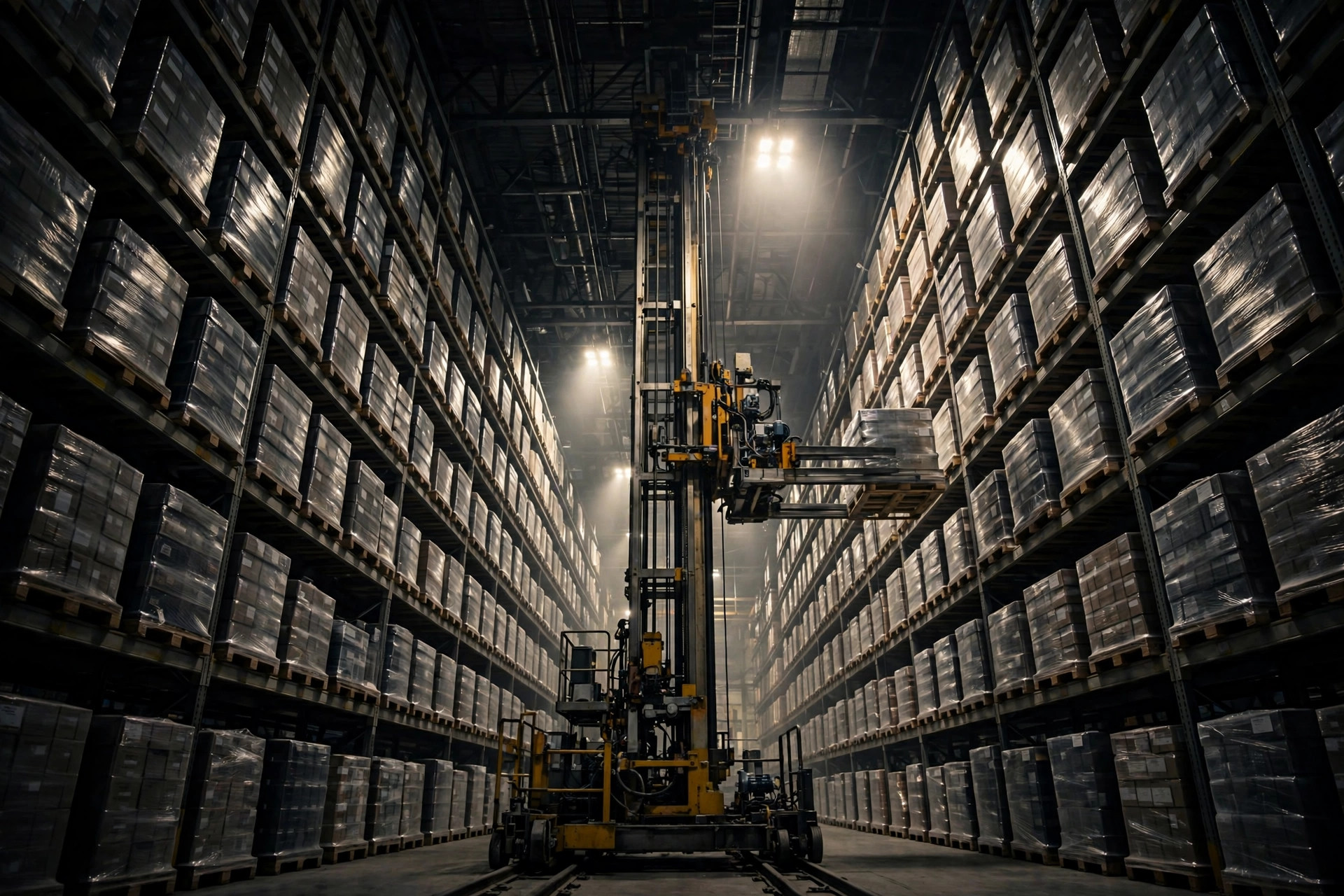
Automated storage (AS/RS) has two mainstream architectures: stacker-crane systems (one tall crane per aisle, storing and retrieving like an elevator) and shuttle systems (small carts running on every level, changing levels via lifts). Pick the wrong architecture and you've poured the wrong foundation — everything after is remediation.
Know the DNA Before Choosing
Stacker Cranes: Tall, Heavy, Steady — Afraid of Single-Point Failure
- Height: 24–40 m with ease — 2–3x shuttle systems; extreme land utilization.
- Load: 500–1,500 kg per pallet — the heavy-goods choice.
- Throughput: 40–80 pallets/hour per crane (single-deep); more aisles = more parallelism.
- DNA flaw: one crane per aisle — when it fails, the whole aisle is down. Single-point failure is the stacker crane's Achilles' heel.
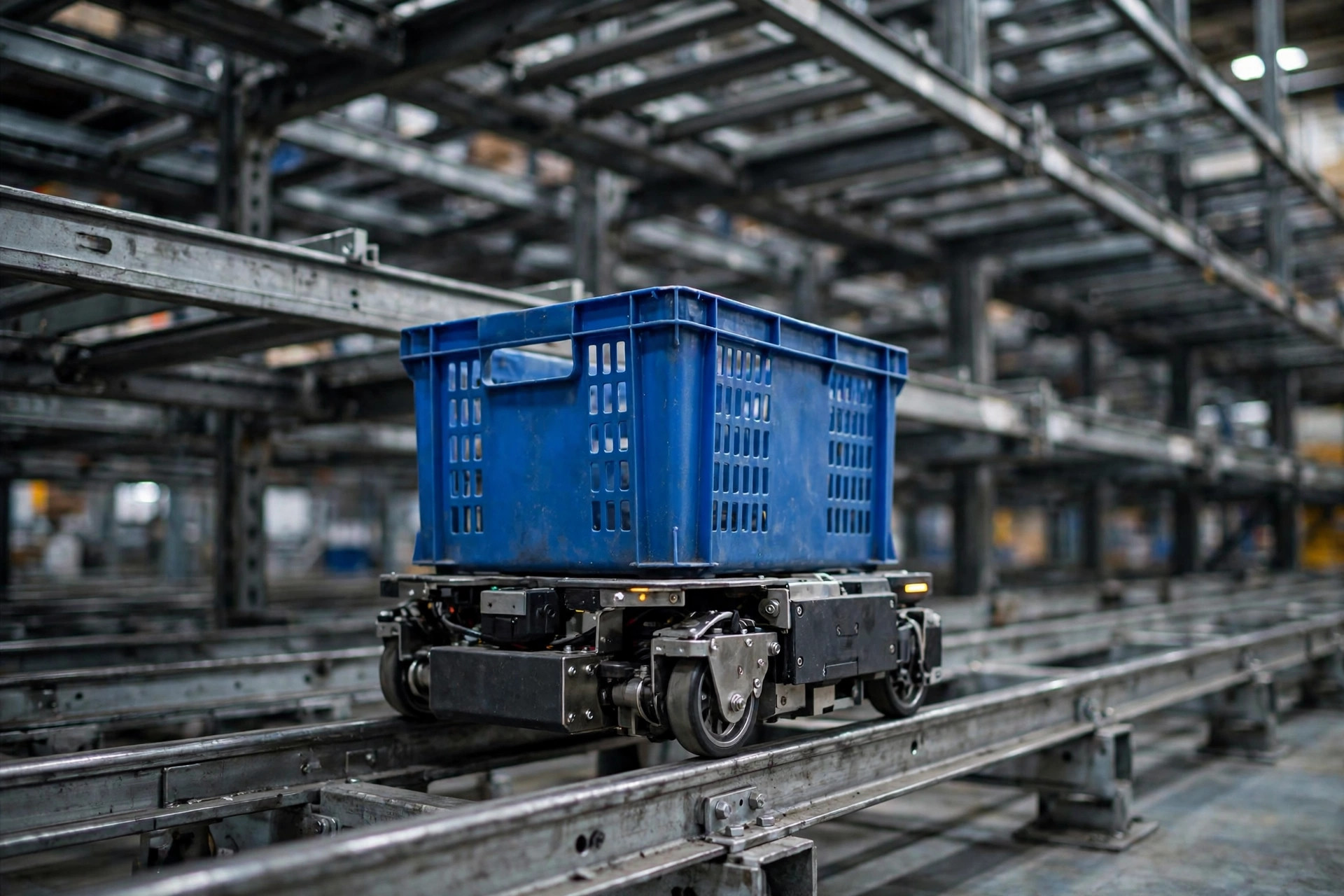
Shuttles: Flexible, Fast, Pricey — Winning on Expandability
- Height: typically 8–18 m, limited by lifts and fire code.
- Load: 30–50 kg bin-level; 500–1,000 kg pallet-level (heavy-duty shuttles).
- Throughput: many carts in parallel — system throughput scales linearly with added carts. Add carts in peak, park them in troughs.
- DNA advantage: one cart fails, the rest keep working; growth means adding carts and levels without shutdowns.
Head-to-Head
| | Stacker-Crane AS/RS | Shuttle AS/RS (4-way) | |---|---|---| | Height | 12–40 m | 8–18 m | | Load per pallet | 500–1,500 kg | 50–1,000 kg (bin vs. pallet class) | | Throughput | 40–80 pallets/hr per crane | 200–1,000+ bins/hr system (parallel carts) | | SKU count | Good under 5,000 | Good for 5,000–50,000+ | | Single-point failure | Yes — one crane per aisle | No — multi-cart redundancy | | Expandability | Expansion = new aisles, civil work | Add carts/levels while running | | Investment (10K-pallet class) | $8M–$15M | $6M–$12M | | Typical industries | Tires, food & beverage, heavy manufacturing | Pharma, e-commerce, 3C, apparel |
Four Scenario Questions
Q1: How heavy? Pallets routinely over 800 kg → stacker crane. Sub-50 kg bins → shuttle.
Q2: How many SKUs? 5,000+, many order lines → shuttles' parallel carts were built for you. Few SKUs, full-pallet moves → stacker cranes, simple and direct.
Q3: How expensive is land? Tight land, must stack past 24 m → stacker crane. Under 18 m suffices → shuttle.
Q4: What's the cost of downtime? 24/7 production where an hour down costs six figures → shuttle redundancy is your insurance. Planned-maintenance windows acceptable → stacker cranes are fine.
The Hybrid: "I'll Take Both"
More projects now go hybrid: stacker cranes for bulk pallet storage, shuttle bin systems for piece picking, linked by conveyor. Cranes handle high-volume pallet storage — cheap and dense; shuttles handle high-frequency small-item picking — flexible and fast.
A food-distribution DC I designed last year works exactly this way: 20,000-pallet stacker-crane storage (24 m) for bulk, plus a 5,000 m² four-way shuttle bin zone for broken-case picking, with automatic full-pallet replenishment feeding the shuttle zone. Investment ran 15% below two independent systems, and "bulk" and "piece" operations never interfere. This "each does what it's best at" approach is becoming the large-DC mainstream. One watch-out in planning: size the inter-zone conveyor for peak replenishment with 30% headroom — starve the pick zone and it's the hybrid's only coordination risk.
Real Cases: Two Projects, Two Answers
Case A (stacker crane): Midwest tire DC, 400–600 kg per pallet, 800 SKUs, mostly full-pallet moves. Six aisles, 24 m stacker-crane AS/RS, 12,000 pallet positions, $11M invested. Five years in: under 100 hours of crane downtime total (with spares on hand and 48-hour service SLA). For heavy goods, the crane's simplicity and ruggedness won.
Case B (shuttle): East-coast pharma DC, 12,000 SKUs, average 8 order lines, 20,000 lines/day. Four-way shuttle bin system, 16 m, 80 carts, $9M. During peak they temporarily added 20 carts, lifting throughput from 600 to 900 bins/hour — capacity following the business, which no stacker crane can do.
Pitfalls: Four Traps
- "Shuttles are advanced, so shuttles": advanced ≠ suitable. Heavy, super-tall, full-pallet scenarios favor stacker cranes — cheaper and tougher.
- No spares for stacker cranes: single-point failure is mitigated with spares and service response. Stock critical spares (motors, encoders, wheel assemblies); write response times into the SLA.
- Fire code as an afterthought for shuttles: dense multi-level carts trigger tough sprinkler and smoke-exhaust demands — engage the fire marshal at project kickoff.
- Comparing capex, ignoring 10-year TCO: shuttle carts are consumables, batch-replaced every 5–8 years; crane steelwork lasts 20. Run the 10-year total cost — conclusions can flip.
Summary
Stacker cranes vs. shuttles: one is an elevator (tall, steady, fears single-point failure), the other a taxi fleet (flexible, fast, wins on numbers). Heavy, super-tall, few SKUs, full-pallet moves → stacker crane. Small items, many SKUs, fragmented orders, growth ahead → shuttle. Four scenario questions, and the answer mostly writes itself. An AS/RS is a 20-year asset — one extra month of analysis at selection saves ten years of headaches after go-live. Time well spent, by any accounting.