Same "High-Speed" Label, Completely Different Personalities
Last year two clients asked me about sorter selection in the same week. One runs books — 150,000 orders/day, all books and cartons. The other runs baby products — 80,000 orders/day, a mix of formula cans, glass bottles, and diaper packs. I recommended a shoe sorter for the book warehouse and a tilt-tray for the baby warehouse. The book client protested: "Why does he get tilt-tray and I get shoe? Isn't shoe faster?" I told him: faster, yes — but let a shoe sorter shove glass baby bottles for three months and your customer complaints will teach you the lesson.
Shoe sorters and tilt-tray sorters are both trunk-line high-speed sortation, both breaking 10,000 items/hour — but their working principles and "personalities" couldn't be more different. Choose wrong and it's a disaster.
Understand the Principles First, Then Choose
Shoe Sorter: Brute Force Done Right
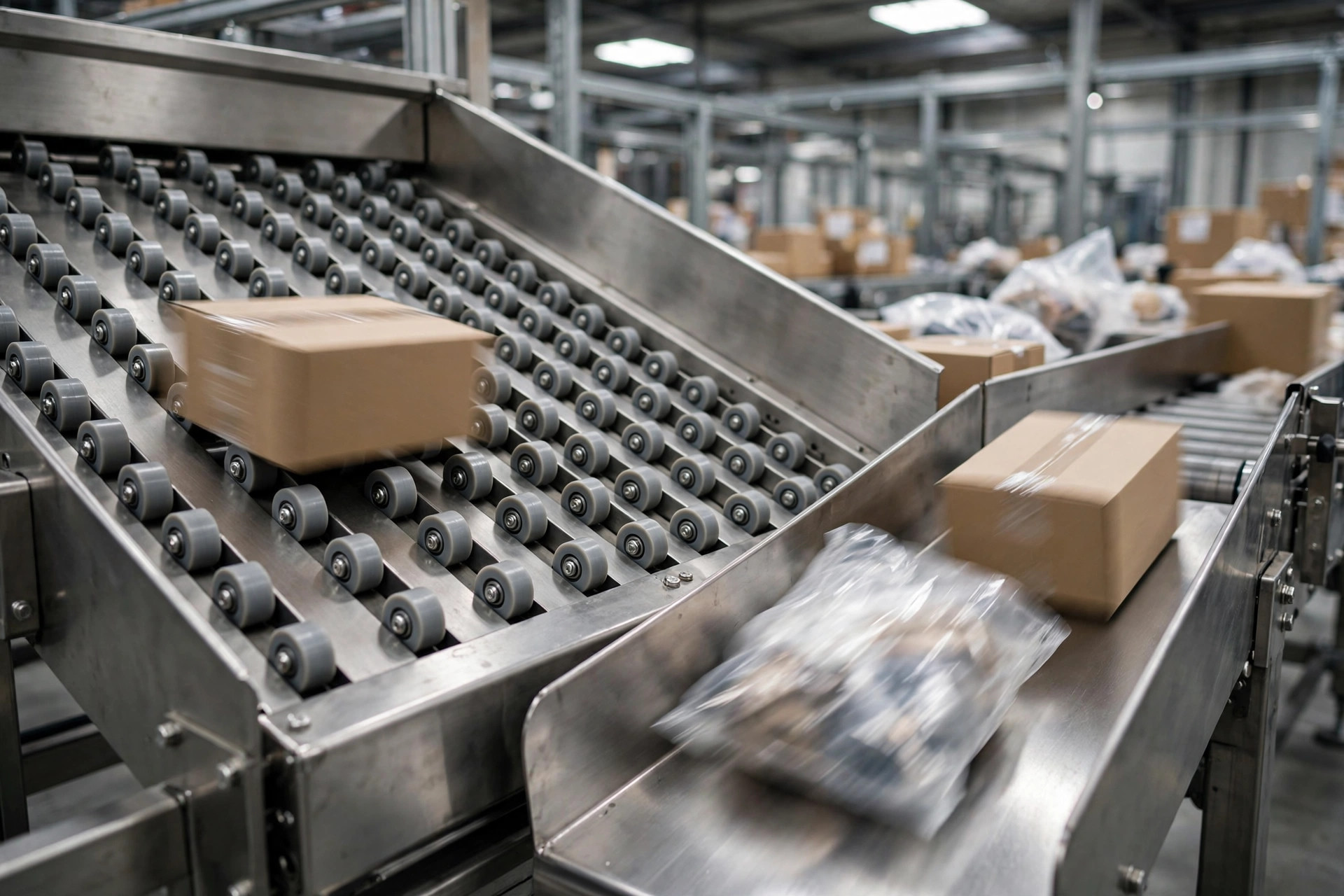
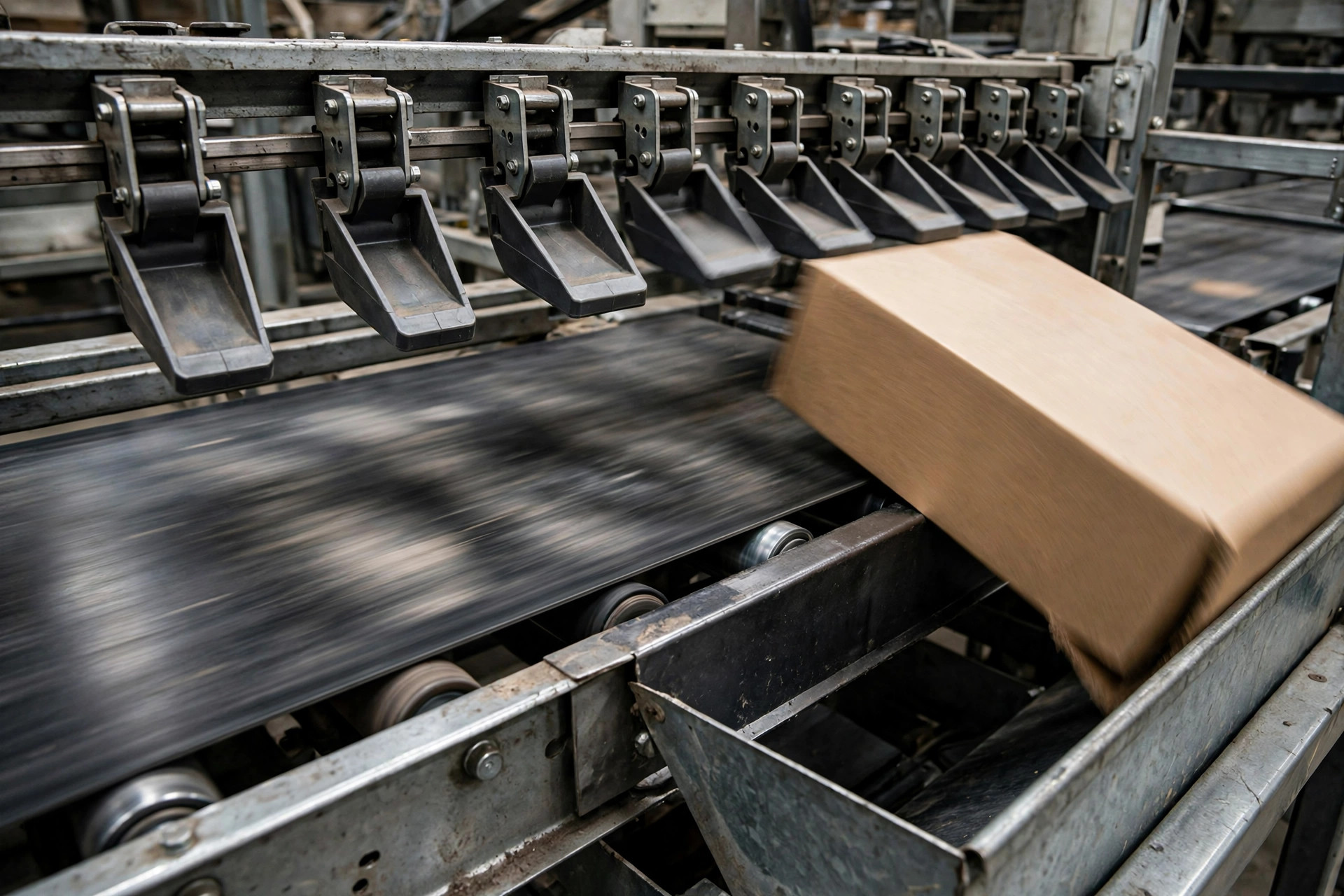
Principle: between two high-speed chains (or belts) sit rows of sliding "shoes." At the divert point, shoes travel diagonally along a guide track and shove product into the chute. Crisp, decisive, extremely fast.
- Throughput: 12,000–15,000 items/hour — double a wheel diverter.
- Product fit: 0.5–30 kg; happiest with flat-bottomed regular cartons and totes.
- Personality: powerful push — unfriendly to irregular, fragile, or slick-surfaced goods.
Tilt-Tray Sorter: The Gentleman's Tip
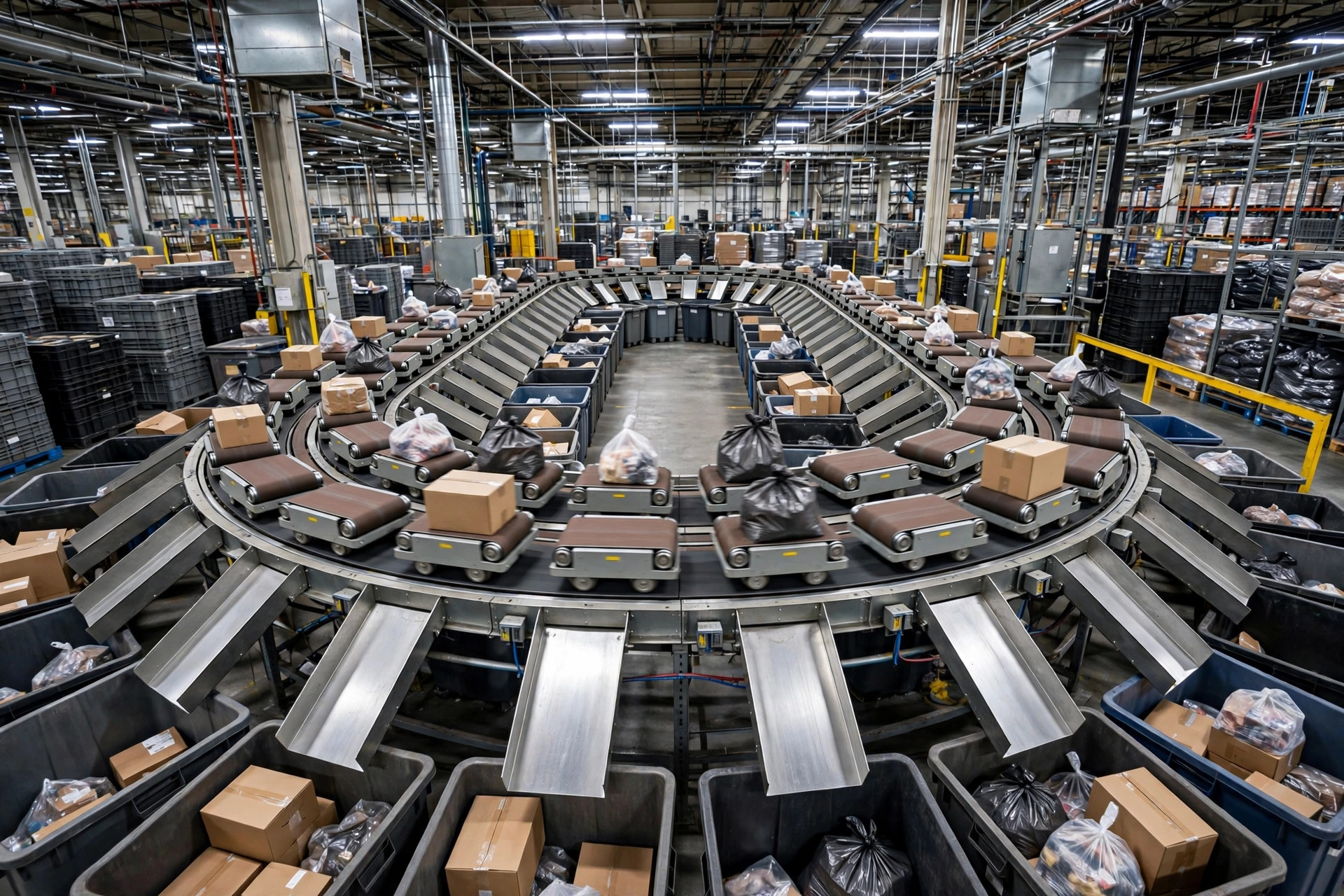
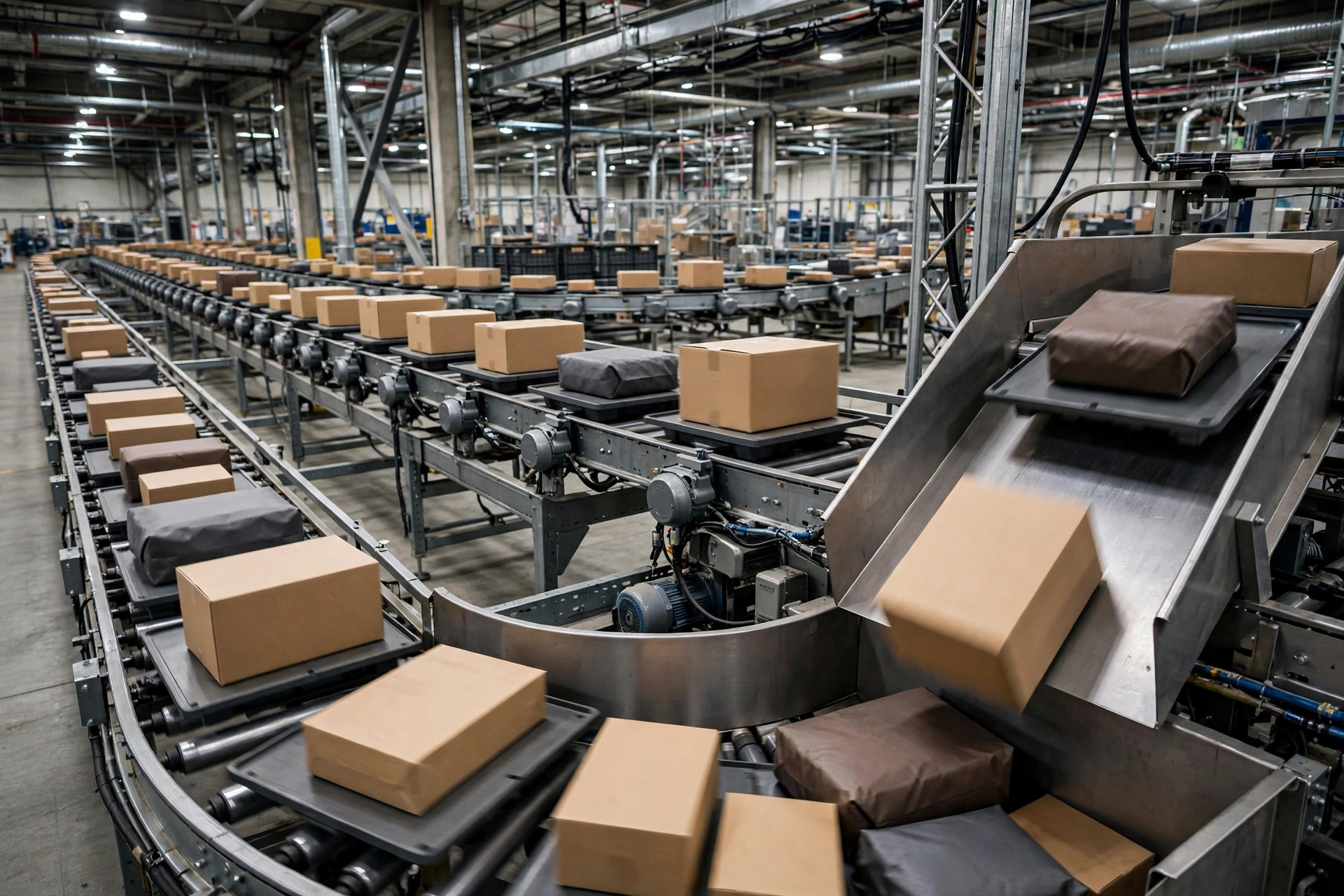
Principle: a loop of small trays, each able to tip left or right. At the divert point the tray tips and product slides by gravity into the chute. No lateral push — the gentlest divert action in the industry.
- Throughput: 6,000–10,000 items/hour — 30–40% slower than shoe.
- Product fit: 0.1–15 kg; handles books, apparel, shoes, fragiles, and irregulars.
- Personality: takes all comers, but tray size caps the maximum item — big goods can't ride.
Head-to-Head
| | Shoe Sorter | Tilt-Tray Sorter | |---|---|---| | Throughput/hour | 12,000–15,000 | 6,000–10,000 | | Weight range | 0.5–30 kg | 0.1–15 kg | | Fragiles | Not recommended — high push force | Recommended — gentle action | | Irregular items | Poor — jams | Good — gravity slide | | Noise | 75–80 dB, on the loud side | 65–70 dB | | Investment (same chutes) | Baseline 100% | ~70–85% | | Maintenance | More wear parts (slats/shoes) | Simpler tip mechanisms | | Typical industries | Books, 3C, footwear cartons | Baby, pharma, apparel, mixed e-commerce |
Three Decision Questions
Q1: Do fragiles or irregulars exceed 20% of volume? Yes → tilt-tray. No → next question.
Q2: Is daily volume at 120,000+? Yes → the shoe sorter's throughput edge starts paying. No → tilt-tray is enough, and cheaper.
Q3: Do you have dedicated equipment maintenance? Shoe slats are consumables needing scheduled replacement — without a maintenance team, tilt-tray is the lower-hassle choice.
The Forgotten Half: Induction
A sort line has two halves: the divert section (shoe/tilt-tray) and induction (singulating items onto the main line). Too many projects pour the budget into diverting and hand-feed induction — then the whole line's throughput chokes at infeed.
- Manual induction: 800–1,200 items/hour/person; fine under 6,000/hour lines; flexible but expensive.
- Automatic induction: singulator plus auto-infeed, 4,000–6,000/hour, $200K–$400K investment.
Rule of thumb: induction capacity should be 1.2x divert capacity to absorb waves. Tilt-tray with manual induction is a common, well-matched combo; a 12,000/hour shoe line needs automatic induction or the divert section idles half the time. The most wasteful project I saw: a 15,000/hour shoe line with 8 manual infeed stations, actually running 7,000 — big money on diverting, bottleneck at induction. When tuning, time the induction cycle with a stopwatch: induction cycle = 3,600 ÷ target throughput. Half a second off, times a full day, is thousands of items lost.
Real Case: Why the Baby Warehouse Chose Tilt-Tray
Back to that baby-products DC: 80,000 orders/day, 3,000+ SKUs, with formula cans (cylinders, 2 kg), glass bottles (fragile), and big diaper packs (soft, irregular) making up 40% of volume. We installed a tilt-tray line, 120 chutes, $2.1M.
The decisive data: in live testing, formula cans hit only 91% divert success on the shoe demo unit (cylinders spun when shoved) versus 99.2% on tilt-tray. After go-live: 99.6% line accuracy at 8,500 items/hour. Slower than shoe — but zero complaints, zero damage claims, which is a lifeline for a baby brand. The owner later calculated: damage rate fell from 1.2% to 0.15%, saving over $800K/year in claims and returns.
One tuning detail: the singulator needed strict spacing — minimum 30 cm between items. Too dense and diverters can't keep up; too sparse and throughput bleeds. Half a second of cycle time, across a day, is thousands of items.
Pitfalls: Four Traps
- Buying throughput, ignoring product: 15,000/hour looks seductive, but if half your SKUs are irregular, effective throughput may trail a tilt-tray.
- No noise planning for shoe lines: 75+ dB means operators nearby need hearing protection — OSHA caps 8-hour exposure at 85 dB; plan for audits and complaints.
- Undersized tilt trays: 600×400 mm trays can't take 700 mm boxes — they'll go manual. Size trays for your largest SKU three years out.
- One chute design for both: shoe sorters push hard, so chutes can be steeper; tilt-trays rely on gravity, so chutes must be gentler. Never reuse one chute drawing for both.
Summary
Shoe vs. tilt-tray has no absolute winner — only fit. Uniform products, big volume, maximum throughput → shoe. Mixed products, fragiles, stability first → tilt-tray. Always run live tests with your hardest SKUs before deciding — test data is 100x more honest than sales talk. Remember: a sorter's first duty isn't speed — it's fast, accurate, and unbroken.