Don't Sign a Multi-Million-Dollar Check on Gut Feel
Last year, a friend running a fashion e-commerce warehouse came to me: 200 sorters on the floor year-round, another 150 temps during peak season, a chronic 3% mis-sort rate, and misships and returns eating hundreds of thousands of dollars in profit every month. "Should I just buy a cross-belt sorter?" he asked.
I didn't answer directly. I asked for three numbers: daily sort volume, peak-to-average ratio, and average parcel weight. After hearing them, I told him: at your volume, a cross-belt is overkill — you'd pay for capacity that sits idle half the time.
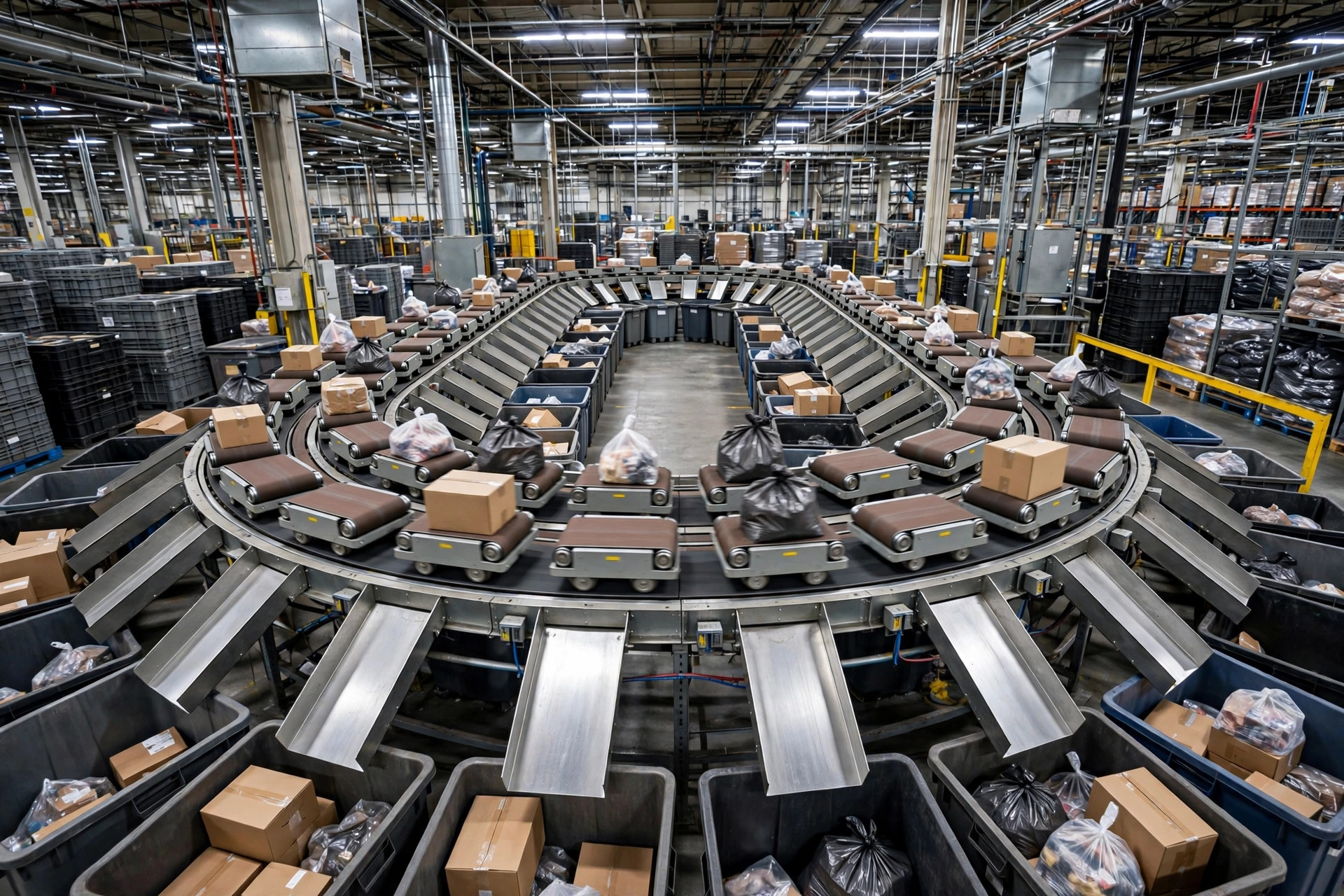
The cross-belt sorter is the heavy artillery of sortation: a single loop handles 8,000 to 15,000 items per hour (fast ones reach 20,000), at 99.99% accuracy. But a full line — equipment, civil work, integration, WCS software — routinely runs $2M to $5M. Done right, it pays back in three years. Done wrong, it becomes the most expensive decoration in your warehouse. Here are the five dimensions I always run through before advising a client.
Five Dimensions to Judge the Investment
1. Volume Threshold: 100,000 Items/Day Is the Dividing Line
Cross-belts are heavy assets, and utilization decides life or death. My rule of thumb: seriously evaluate only above 100,000 items sorted per day; below 50,000/day, don't bother — manual sorting plus a simpler shoe or wheel sorter is more economical.
Then factor in the peak ratio. E-commerce peaks often run 3–5x the daily average, and the equipment must be sized for peak. At a 400,000-item peak day over 16 operating hours, you need 25,000 items/hour — one loop won't cut it; you're looking at dual loops or a cross-belt plus manual backup. Size for average and peak season will bury you; size for peak and the line idles most of the year. The realistic compromise for most mid-size e-commerce operations: one cross-belt plus manual wave support during peaks.
2. Product Fit: Not Everything Rides the Belt
Cross-belts are happiest with items from 0.2 to 30 kg — regular cartons, polybags, apparel pouches. Outside that range, test before you commit:
- Ultra-light items (under 100 g envelopes, small accessories): air currents push them off course; discharge chutes need guards.
- Irregular shapes (cylinders, spheres): they roll on the carrier — run live tests and measure the actual divert success rate.
- Fragiles (glass, ceramics): cross-belt diverting is relatively gentle, friendlier than tilt-trays, but keep chute drops under 1 meter.
One non-negotiable before signing: ship your 20 hardest SKUs to the vendor for live testing. A verbal "it handles everything" is worthless; test videos and data belong in the contract as an appendix.
3. Chute Count: Below ~80 Chutes, the Economics Don't Work
The value of a cross-belt is "one infeed, many outfeeds" — one induction point feeding dozens or hundreds of chutes. Too few chutes and the divert capacity never pays off.
| Daily Volume | Suggested Chutes | Loop Length (ref) | Typical Use | |---|---|---|---| | 100K–200K items | 80–150 | 150–250 m | Regional e-commerce, apparel DCs | | 200K–500K items | 150–300 | 250–400 m | National e-commerce, parcel hubs | | 500K+ items | 300+ / dual loop | 400 m+ | Parcel hubs, large 3PLs |
Plan 20% spare chute capacity for two years of growth — once the loop is built, adding chutes means rebuilding.
4. ROI Math: Three-Year Payback Is the Bar
The formula is straightforward: annual savings = labor replaced + error losses avoided − annualized depreciation − maintenance.
A typical case: a $3M line replacing 120 sorters (at ~$40K/year fully loaded in a US warehouse, that's $4.8M/year), cutting mis-sorts from 3% to 0.01%, saving hundreds of thousands in error costs annually. Maintenance runs 3–5% of equipment cost per year. At healthy utilization, payback lands at 2–3 years. If your model shows more than 4 years, your volume can't carry the line yet — wait.
Watch the hidden costs: WCS licenses, WMS interface development, operator and technician training, spare-parts inventory — budget another 10–15% in year one.
5. Site & Systems: The Loop Is a Space Hog
A 200-meter loop plus induction and discharge chutes easily eats 3,000+ square meters. Ceiling height, column spacing, and fire zones all need checking upfront. More important is systems: a cross-belt needs a WCS for real-time control — whether your WMS has standard interfaces and whether your IT team can handle the integration determines if this is a 6-month project or an 18-month saga.
Real Case: 28-Month Payback at an Apparel 3PL
A Midwest US apparel 3PL: 120,000 orders/day, 450,000 at peak, mostly apparel polybags at 0.3–2 kg. Previously 180 sorters across two shifts, 2.8% mis-sort rate.
The solution: a 220-meter loop, 168 chutes, double-deck induction (6 infeed points), $3.8M invested. After go-live: sorters cut from 180 to 45 (induction + exception handling), mis-sorts below 0.01%, 12,000 items/hour throughput.
The math: ~$5.4M/year in labor savings, ~$600K/year in avoided error losses, minus depreciation and maintenance — payback in 28 months. Two success factors: uniform product profile with full pre-purchase testing, and WCS–WMS interfaces nailed down before contract signing, which got the project live in 7 months.
Pitfalls: Four Classic Ways to Fail
- Signing before product testing: irregular items sort below 90% success, get kicked to manual handling, and the equipment's value collapses.
- Sizing chutes for this year: volume grows 30%, chutes run out, and adding them means rebuilding. The 20% reserve is iron law.
- Budgeting equipment only: $2M for equipment plus $1M for integration, software, and civil work — budget the total package.
- Reporting average as peak: sales reports average daily volume; peak season hits 5x and the loop chokes. Size for peak, staff for average.
Summary
Whether a cross-belt is worth it isn't about how advanced the equipment is — it's about five dimensions: volume over 100K/day, products tested, 80+ chutes, payback within 3 years, and a site plus systems that can take it. If two of the five don't check out, hold off and bridge with wheel or shoe sorters. Equipment exists to make money, not to be admired — run the numbers before you sign. That's my first piece of advice to every client.