Not Every Warehouse Can Afford a Cross-Belt
Two years ago I designed a system for a beauty-samples e-commerce warehouse: 40,000 orders a day, every SKU a small box under 100 grams. The owner opened with: "Lao Mi, quote me a cross-belt." I ran the numbers and talked him out of it — at his volume, cross-belt utilization would sit under 30%, $3.8M invested, 6-year payback. We installed a wheel-diverter sortation line instead: $450K, 14-month payback. He still tells everyone it was the best decision he ever made.
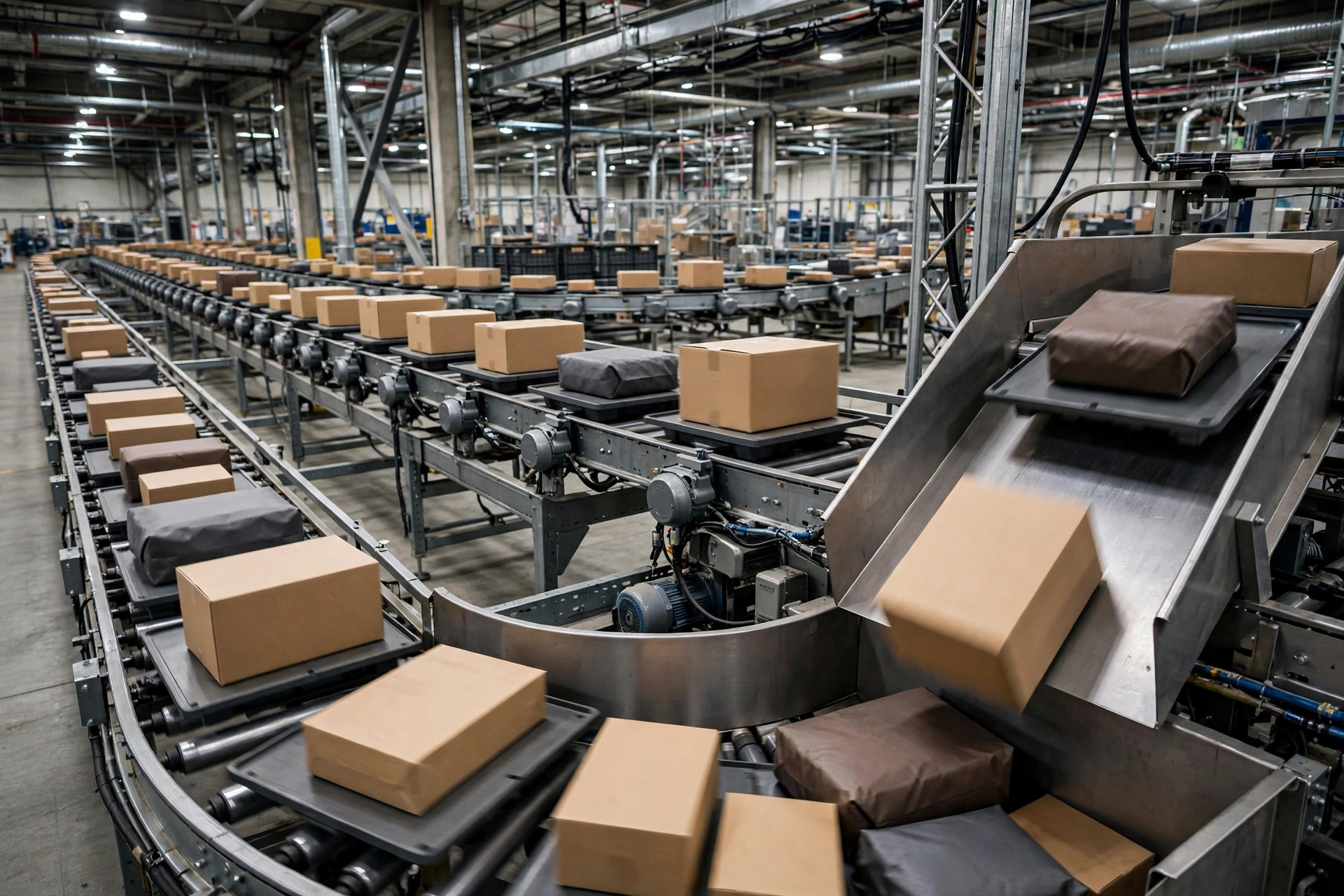
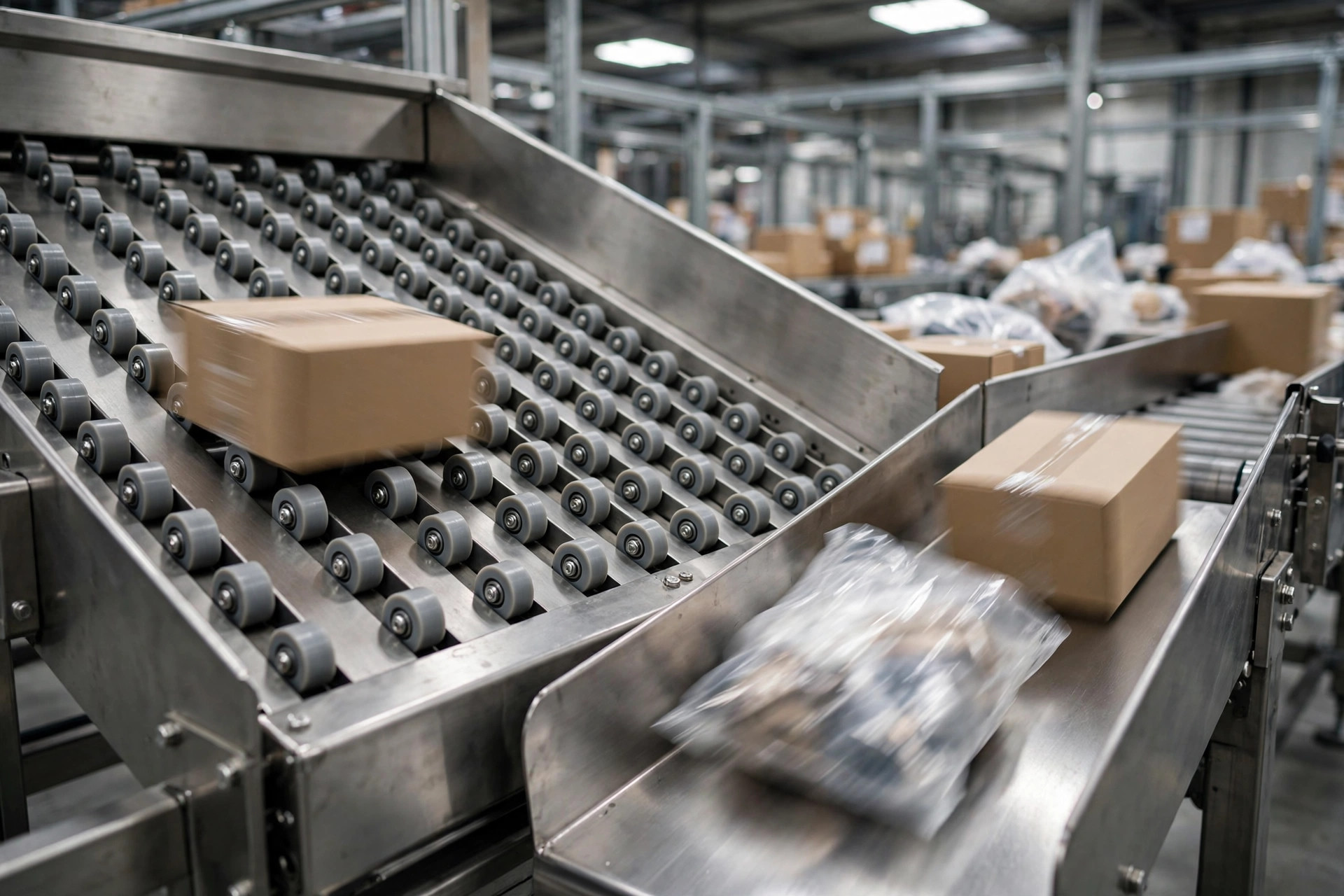
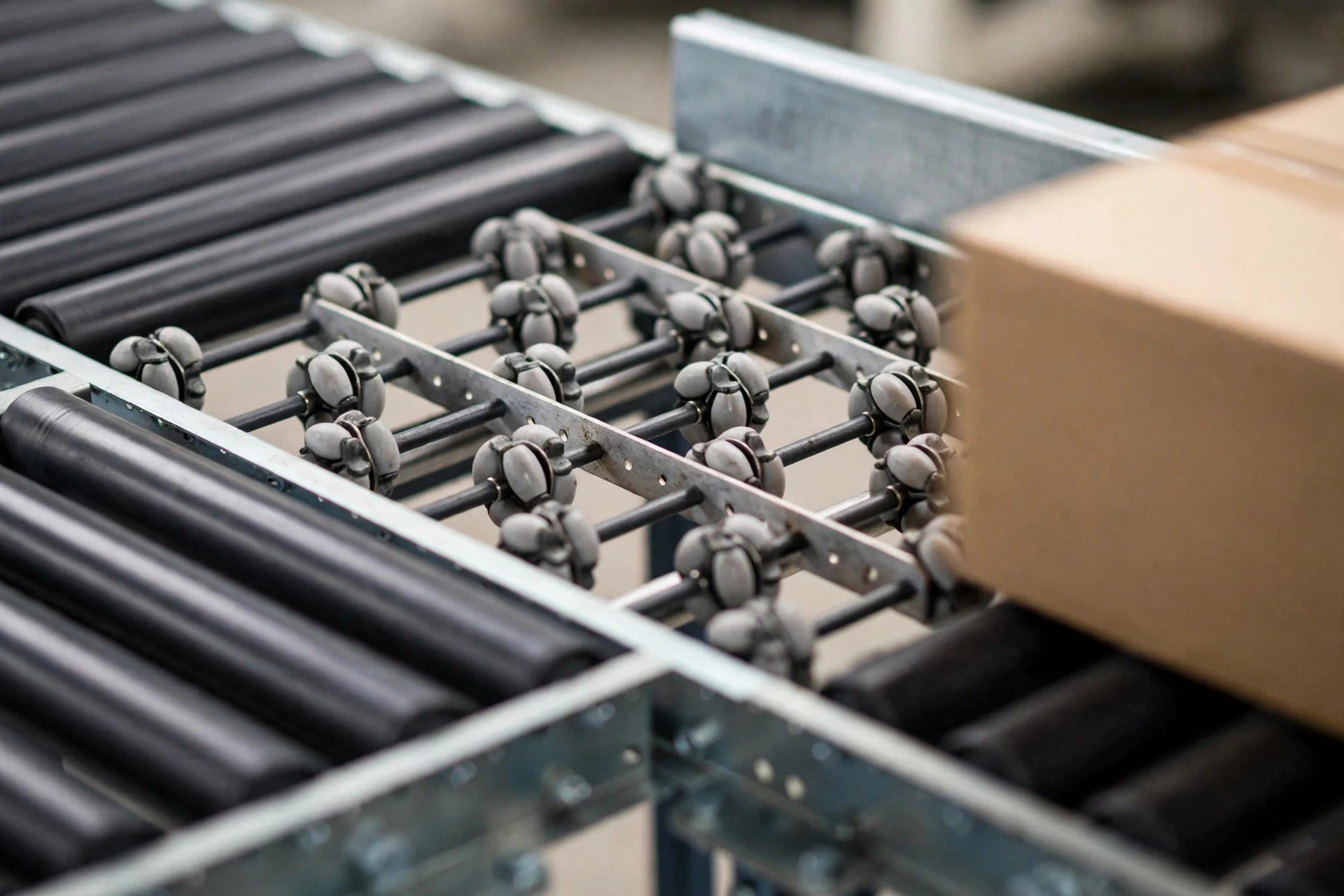
Wheel diverters (also called singulator wheel sorters) work on a beautifully simple principle: the main conveyor keeps running, and at each divert point a set of small wheels swivels to "nudge" parcels into the right chute. Simple construction — and the value champion for small-parcel sortation.
Four Dimensions of the Value Case
1. Cost: One-Third of a Cross-Belt, Far Lower Barrier
A mid-size wheel-diverter line (conveyor, 30–50 divert points, controls) typically runs $300K–$800K — one-third to one-quarter of an equivalent cross-belt. For a mid-size e-commerce or 3PL business doing tens of millions in revenue, this doesn't need board approval, and the cash-flow pressure is an order of magnitude lighter.
2. Throughput: 4,000–8,000 Items/Hour Covers Mainstream Mid-Size DCs
Wheel diverters theoretically divert 60–120 items per minute, for line throughput of 4,000–8,000 items/hour. Note this is small-parcel throughput — items need 30–50 cm spacing, and large items drag the rate down. The sweet spot is 20,000–100,000 items/day with peaks under 150,000. Beyond that, look at cross-belts.
3. Product Fit: Home Turf Is Small Parcels
Wheel diverters love items from 0.05 to 5 kg with flat bottoms — small cartons, courier bags, shoeboxes. Diverting works on friction, so:
- Polybags and bubble mailers: perform great, the wheels flick them right off.
- Tiny items (under 10 cm): can jam in wheel gaps — add anti-jam guides.
- Heavy goods (over 8 kg): the wheels can't push them and wear out fast. Don't force it.
| | Wheel Diverter | Cross-Belt | Manual | |---|---|---|---| | Throughput/hour | 4,000–8,000 | 8,000–20,000 | 150–250/person | | Investment | $300K–$800K | $2M–$5M | Near zero | | Daily volume fit | 20K–100K | 100K+ | Under 20K | | Accuracy | 99.5% | 99.99% | ~97% | | Maintenance | Low — swap wheels | High — specialist crew | None |
4. Maintenance: Swap a Wheel in 30 Minutes
This is the wheel diverter's most underrated advantage. A cross-belt's carriers, drives, and tracks need specialist engineers; a wheel line's consumable is the wheel itself — a few dozen dollars per wheel module, and your own maintenance tech can swap one in half an hour. Noise sits around 65 dB, so no earplugs needed in the sort area. For a mid-size warehouse with no dedicated equipment engineers, the wheel diverter is the only automated sorter you can actually afford to own.
Real Case: 14-Month Payback at a Beauty E-Commerce DC
Back to that beauty warehouse: 40,000 orders/day, 800+ SKUs, all small boxes at 50–200 g. The solution: one main line with 42 divert points, $450K invested.
Before: 60 sorters, 2.5% mis-sort rate, temps every peak. After: 18 sorters (induction + packing), 0.4% mis-sort rate, 6,500 items/hour. At US labor costs, ~$1.7M/year in labor savings — 14-month payback. The owner's words: "If I'd known it was this good, I'd have done it two years earlier."
The WCS: Even a Small System Needs a Brain
Don't assume cheap hardware means you can skimp on controls. A proper wheel-diverter line needs its WCS to do four things: barcode scanning (99.5%+ read rate), chute allocation (dynamically balancing orders across chutes so none overflows), exception handling (no-reads to a reject chute for manual review), and data feedback (per-parcel divert timestamps back to the WMS in real time).
When evaluating vendors, ask: is the WCS developed in-house or outsourced? Has it integrated with my WMS before? Is there a standard API? Hardware barely differs between vendors — WCS maturity is the real dividing line. I've seen projects with fine hardware and a crash-prone WCS that took the whole line down with it. Cheap equipment plus unreliable software equals no equipment at all.
Pitfalls: Three Traps
- Forcing oversized items: one client ran 10 kg boxes on a wheel line — wheels wore flat in three months and maintenance costs doubled. Over 5 kg, look at shoe sorters instead.
- No spacing control: feeding too dense means two parcels divert into one chute and accuracy tanks. The induction end needs an automatic singulator — don't cheap out on it.
- Chutes too steep: light parcels fly off steep chutes. Keep chute angles at 15–20 degrees with cushioned end stops.
Growth Tip: Build the Line Once, Add Chutes in Phases
Plan wheel lines as "main line built once, divert points added in phases." Build the conveyor and controls to full size on day one, install 60% of the divert points, and add more as volume grows. First-phase pressure drops by half, and expansions happen without shutdowns — two weeks to add points. Too many owners try to build everything at once, ending up with idle capacity and strained cash flow. Phasing has another benefit: after phase one runs smoothly, you know your product mix and peaks cold, so phase-two parameters are set with real data.
Summary
The wheel diverter's positioning is crystal clear: for warehouses sorting 20K–100K items/day, mostly small parcels, with no specialist maintenance team, it's the value king. One-third the cost of a cross-belt, 14–20-month payback, maintenance simple enough for your own crew. Don't let "bigger is better" thinking lead you astray — the right fit is what pays. Run your volume and product numbers first, then decide whether wheels get the job.