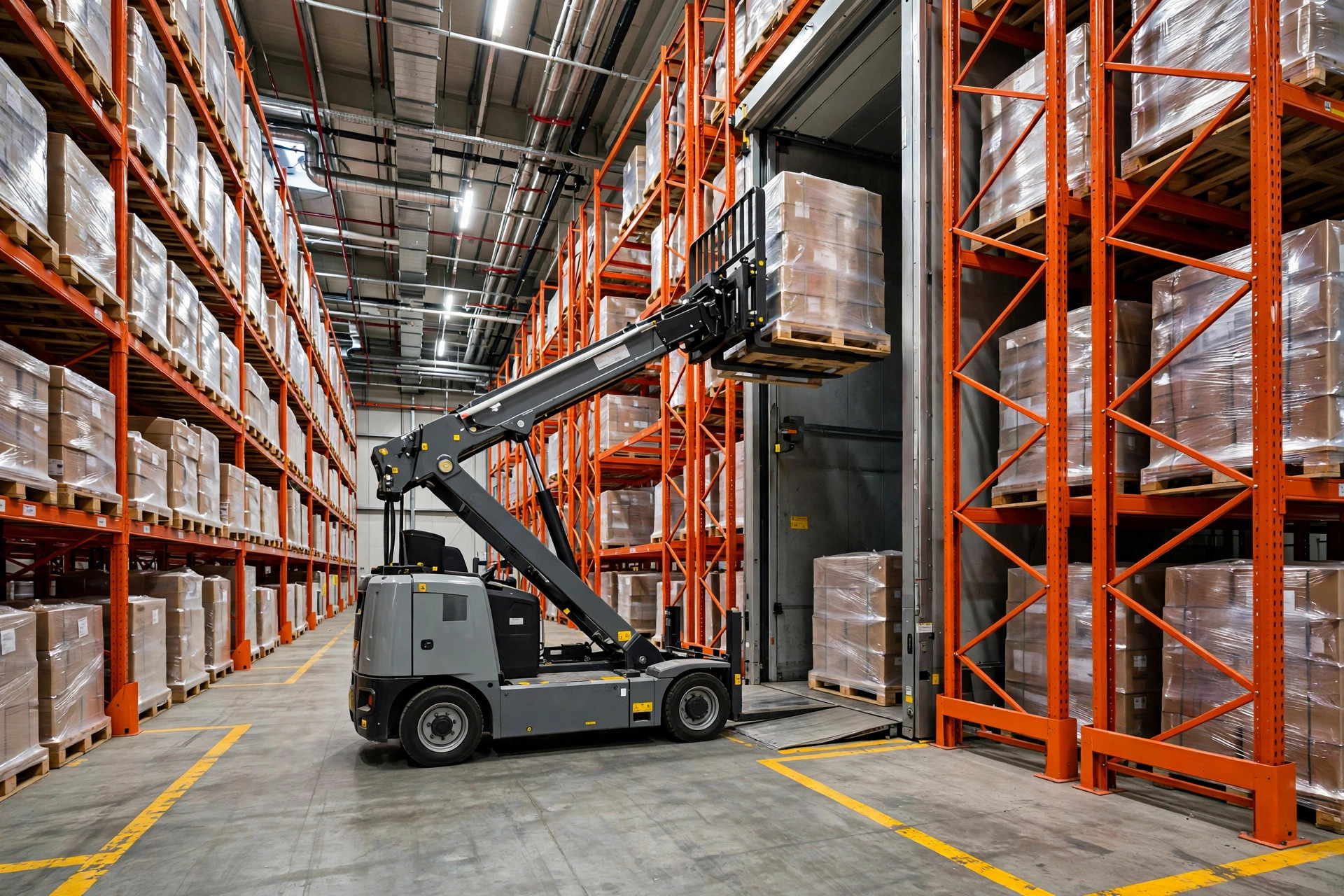
Double-Deep Racking: Will the Rent You Save Cover What It Really Costs?
Last month, a client in Fontana — auto parts distribution, 22,000 pallet positions going into a new building — told me his racking vendor had promised "30% more pallets in the same footprint with double-deep." He asked whether it was worth it. I told him not to sign anything until we ran the math to the decimal point. When we did, he changed the plan: half the building single-deep, half double-deep.
Here is my verdict up front: double-deep is not a magic space-saver. It is a trade — you give up picking flexibility to buy density. If your average SKU sits on 6 or more pallets, turns steadily, and does not need strict first-in-first-out, double-deep pays. If your SKUs are fragmented — two or three pallets each — double-deep will cost you money, not save it.
The rent math: what you are actually saving
The principle is simple. Single-deep: one aisle serves two rows of racking, each row one pallet deep — one pallet position on each side of the aisle. Double-deep: same aisle, same number of rows, but each row is two pallets deep — two positions on each side.
Notice what did not change: the aisle width. Not by an inch. You are saving the footprint of the rack rows, not the aisles.
Run the numbers for a 100,000 sq ft building in the Inland Empire at $0.85 per sq ft per month (use your actual quoted rate):
| Single-deep | Double-deep | |
|---|---|---|
| Pallet positions | 20,000 | 26,000 (about 30% more) |
| Footprint for 20,000 positions | 100,000 sq ft | about 82,000 sq ft |
| Annual rent | about $1.02M | about $836K |
| Annual rent saved | — | about $184K |
Looks great. But two details people miss.
First, that $184K is gross savings — before the costs, which we will get to. Second, what you are saving is "space you would otherwise need to lease." If you already signed a 10-year lease on 100,000 sq ft, the saved footprint only turns into money through subleasing or at your next expansion. For a building already under a long lease, discount the rent benefit over the remaining lease term before it goes into your ROI model — do not plug the full annual figure into a payback calculation.
The cost side: four bills you will pay
First: the racking itself costs more. Double-deep rows are twice as deep — deeper upright frames, longer beams, beefier seismic bracing (in California, seismic rack design is non-negotiable; RMI standards apply). Expect the racking package to run 15–25% more than single-deep. At 20,000 pallet positions, that is a $150K–$300K delta on the purchase order.
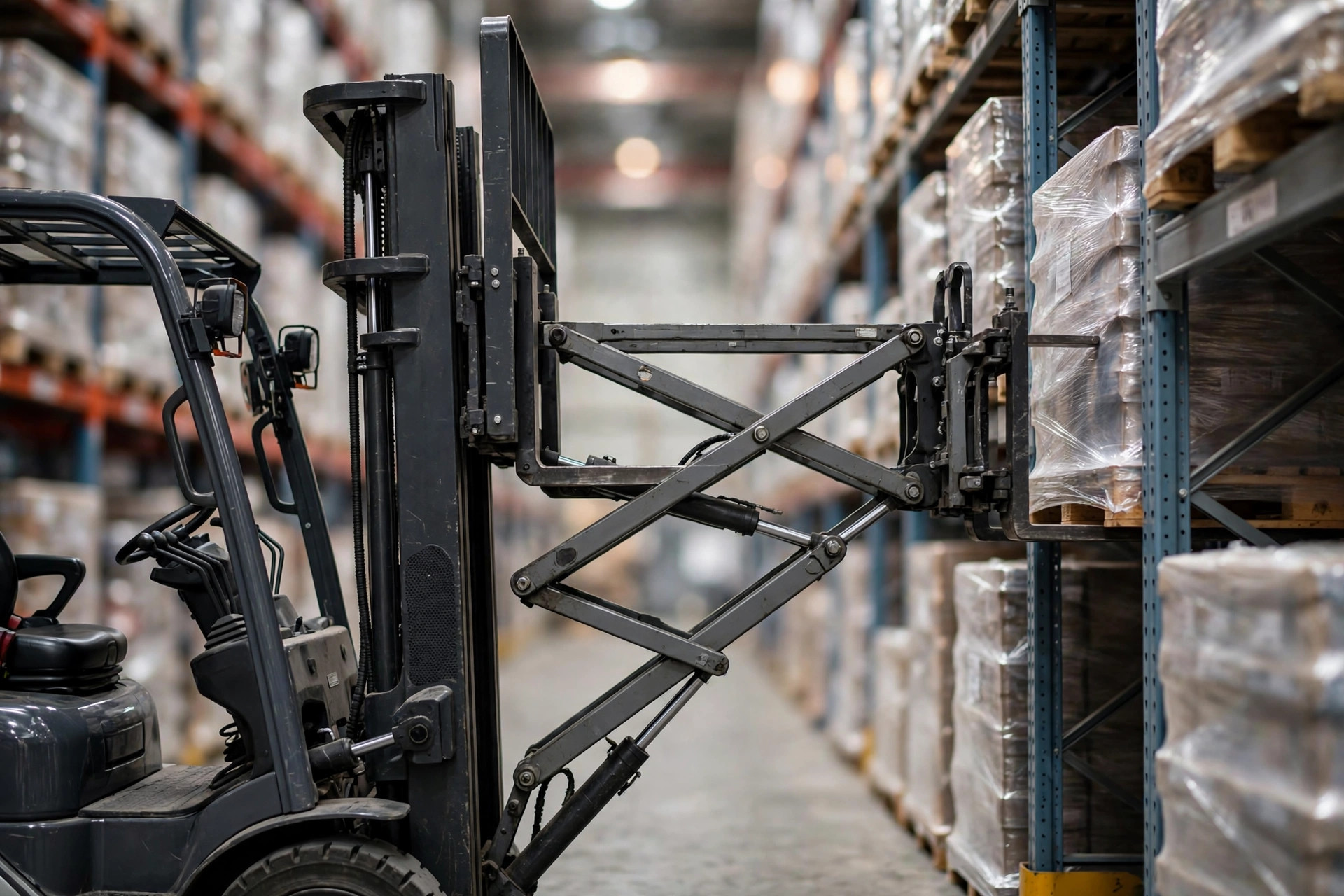
Second: the trucks cost more. A standard reach truck cannot get to the second position. You need double-deep reach trucks with telescopic or pantograph forks — $8,000 to $15,000 more per truck than a standard reach. For a 20,000-position building, that is easily $50K–$80K extra across the fleet. And do not forget training: telescopic forks handle differently, so budget an extra week of operator training before go-live.
Third: the throughput tax. Pulling a rear pallet means moving the front one first (or running special logic), so each putaway and retrieval cycle runs 10–20% slower than single-deep. In a building doing 20,000 pallet moves a day at peak, that tax shows up as overtime and headcount. At roughly $45,000 a year per forklift operator, two extra operators is $90K a year in hidden cost.
Fourth: fire protection and permits. Deeper rows change sprinkler coverage — many jurisdictions require in-rack sprinklers for double-deep, and the ESFR system needs re-engineering. Get the fire marshal's requirements and the approval timeline in writing before you sign; rules vary by jurisdiction, so confirm against the latest local code. I have seen a project where the racking was fully erected and fire sign-off took three months — rent being paid, no freight moving in.
Five traps, all paid in real money
Trap one: FIFO goes out the window. The rear pallet is blocked by the front one — each lane is effectively last-in, first-out. If you handle food, pharma, or anything with expiry dates, that is a dealbreaker unless your WMS can manage expiry at the lane level. Most cannot. Do not touch double-deep until that is solved.
Trap two: honeycombing. The front pallet ships, the rear one is still there — that lane is unusable. Or the rear is empty and the front is occupied — you cannot use the space behind it either. The more fragmented your SKUs, the worse the honeycombing. That 26,000-position building on paper might only give you 85–90% usable in practice. Discount your position count by 15% before running ROI.
Trap three: half the pick faces. The same length of racking gives you half the pick faces of single-deep. For full-pallet operations, nobody cares. For case picking, your pickers walk farther and wait longer.
Trap four: the 30% illusion. The most common bad math I see: treating "30% more pallet positions" as "30% less space." Aisles, receiving, shipping, offices — none of that shrinks. Total footprint savings usually land at 12–18%. If you signed a rent deal betting on 30%, that loss is yours.
Trap five: your WMS does not speak double-deep. Plenty of mid-market WMS products were written on the single-deep assumption — putaway logic, cycle counts, and lane inventory simply do not model a rear position. After go-live you end up tracking rear pallets on a spreadsheet. Before you sign the racking contract, make the WMS vendor demo lane-level inventory management live. If they cannot, upgrade the system before you buy the steel.
The hybrid layout: the answer for most operations
Back to the Fontana client. What did he actually do? His ABC classification was the answer:
| Zone | Racking | What lives there | Logic |
|---|---|---|---|
| Near the dock | Single-deep | A-class fast movers, case picking | Picking efficiency first — maximize pick faces |
| Middle | Single-deep | B-class SKUs | Flexible, adjust with velocity |
| Deep in the building | Double-deep | C-class slow movers, bulk reserve (packaging, seasonal) | Density first — touched a few times a year |
With this layout, his double-deep zone covered only 40% of the floor but held 55% of the pallet positions — and picking productivity never dipped, because everything high-velocity stayed in the single-deep zone. He banked the rent savings and only paid the throughput tax in the low-velocity area. That is how double-deep is supposed to be used — not an all-or-nothing bet.
The sign-off checklist: seven questions before you sign
- Pull your SKU distribution by average pallets per SKU: do SKUs with 6+ pallets account for more than 60% of total pallet volume? If not, stop talking about double-deep — this is the first filter.
- Any strict FIFO or expiry requirements? Solve lane-level expiry management in the WMS first, then talk racking. Order matters.
- Full-pallet or case picking? If case picking dominates, model the cost of halved pick faces — do not count positions alone.
- Your current fleet: can existing trucks take telescopic attachments? If not, are replacement cost and driver training in the ROI model?
- What does your local fire authority require for double-deep sprinkler protection — in-rack sprinklers? How long is the approval cycle? Put it in the project timeline.
- At peak throughput, can your shifts absorb 10–20% slower cycle times? Test it against last peak season's wave data.
- After discounting 10–15% for honeycombing, does the true cost per usable pallet position still pencil out? Re-run it on usable positions, not nameplate positions.
Advice you can use tomorrow: do not let the racking vendor sell you "30% more positions." Pull your own SKU pallet-count distribution first. If SKUs over 6 pallets deep cover more than 60% of your volume, double-deep is worth discussing. Below half — stay single-deep and put the money into slotting and your WMS. The payback is better. Racking is a ten-year asset; seven questions now are cheaper than regret later.