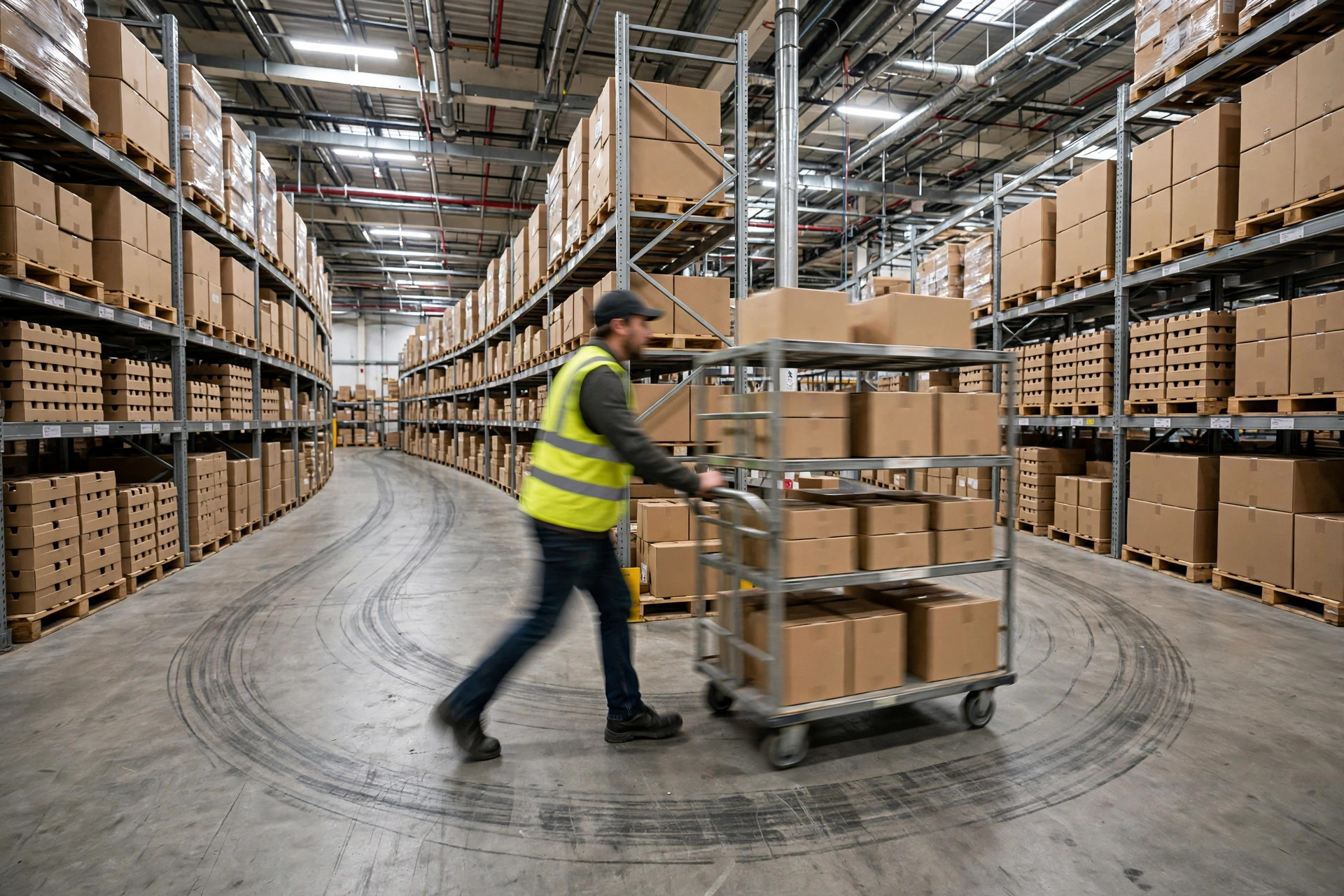
The Problem: Walking Is Eating Your Margin
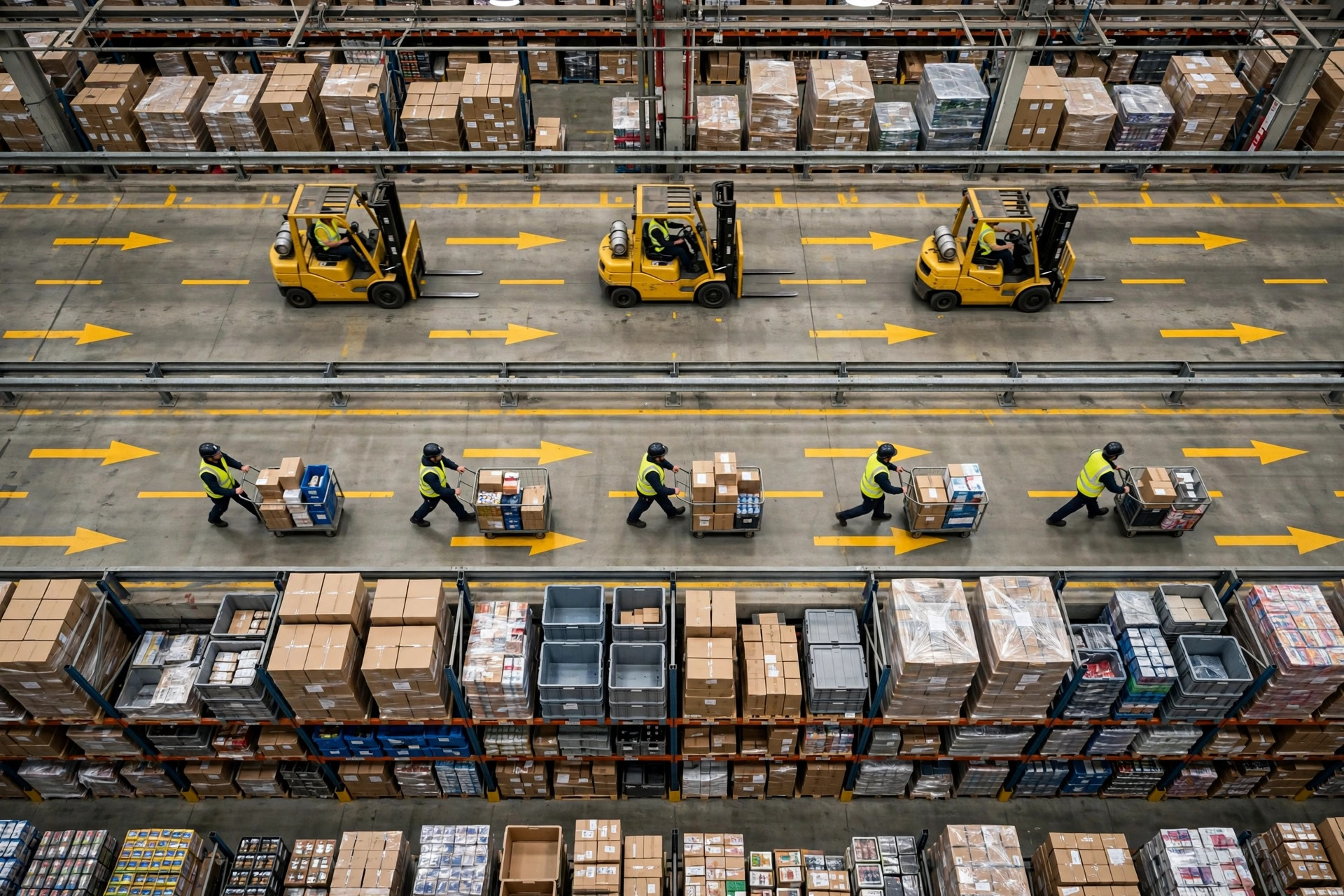
In most distribution warehouses, picking accounts for 55–60% of total labor cost. Yet the actual "value-adding" grab motion takes up less than 20% of a picker's time — more than half is spent walking. A 60-meter aisle walked 40 times a day is nearly 5 kilometers. A slightly worse path design means each picker walks an extra 1–2 km daily, which adds up to hundreds of thousands of dollars in wasted labor per year across the facility.
The two most common routing strategies are S-shape (traverse) and return. Many warehouses pick one by gut feel, use it for years, and never verify whether it was the right choice. We ran a field test in a 3PL e-commerce warehouse with 8 aisles and about 4,500 pick locations: the same 200 orders, the same slotting layout, the same crew, each run under three different routing strategies. The results are worth sharing.
The Method: Four Steps to Your Optimal Path

1. Know the three mainstream strategies
- S-shape (traverse): The picker walks the full length of an aisle and loops back through the next one, tracing the letter S. Strength: almost no backtracking, high aisle utilization. Weakness: with few order lines, pickers are forced to walk entire aisles — much of it empty walking.
- Return: The picker enters an aisle, picks, and walks back out to the main aisle before entering the next one. Strength: shortest travel distance when order lines are few. Weakness: every aisle is walked twice, and opposing foot traffic can jam narrow aisles at peak.
- Midpoint: An imaginary line splits each aisle in half — return on the front half, S-shape on the back half. Best for long aisles with a medium number of order lines; a compromise between the two.
2. The test data: no silver bullet, only fit
Average travel distance per order (meters) across three order profiles:
| Strategy | Small orders (1–3 lines) | Medium (4–10 lines) | Large (10+ lines) | |---|---|---|---| | S-shape | 142 | 118 | 96 | | Return | 88 | 112 | 134 | | Midpoint | 104 | 105 | 108 |
The takeaway is blunt: the fewer the order lines, the better return performs; the more lines, the better S-shape performs; midpoint is "never bad" across all profiles — the safe default. If your warehouse is dominated by small orders (typical in B2C e-commerce), switching to return can cut per-order travel by more than 30%.
3. ABC slotting is the multiplier for any routing strategy
Routing answers "how to walk"; ABC slotting answers "where the goods live." Put A-class SKUs (the top 20% by shipment volume) along the main aisles in the golden pick zone (waist height, closest to packing), B-class in the middle, C-class at the far ends. In our test, ABC slotting alone shortened average pick travel by 18%. Review ABC quarterly — seasonal SKUs drift, and a slotting plan goes stale after about three months.
4. Wave batching: make every trip worth walking
Picking one small order per trip wastes even the best path. Group orders from the same time window and zone into waves so each trip picks multiple orders, spreading travel distance across them. Our test warehouse raised wave size from 20 to 40 orders, and picker UPH (units/lines per hour) rose from 95 to 132. Configure WMS wave templates on two dimensions — zone plus order cutoff time — not time alone.
5. Close the loop with data, not gut feel
After switching strategies, track three metrics for two straight weeks: average travel distance per order, UPH, and pick error rate. If the error rate climbs, the new path is making people rush — roll it back. We once saw a warehouse switch to S-shape, gain 12% UPH, and watch its error rate jump from 0.3% to 0.9%. Not worth it.
Field Case: A 3PL Warehouse's 21-Day Turnaround
Background: an 80,000 sq ft 3PL e-commerce warehouse in California, 3,500 orders/day, 90% of them 1–3 line small orders — all running S-shape. Pickers complained they were "strolling empty aisles all day," and peak-season UPH wouldn't budge.
Three steps: Week 1, switch the small-order zone (85% of volume) to return routing, keep S-shape for the large-order zone. Week 2, ABC slotting — move the top 300 SKUs to the main aisles. Week 3, raise wave size from 25 to 40 orders.
Results: average pick time per order fell from 4.2 to 2.9 minutes (−31%); UPH rose from 88 to 121; error rate held steady at 0.35%. With 22 pickers at $19/hour, that is roughly $140,000 in annual labor savings — for an investment of two weeks of slotting work and a WMS wave-template configuration.
Pitfalls to Avoid
- Don't standardize one strategy across the whole building. Small-order and large-order zones using different strategies is normal. Set routing by zone in the WMS; don't unify for convenience.
- Aisle width sets the ceiling. Return routing jams at peak in narrow aisles (under 2.5 m). Where aisles are narrow and forklifts mix with pickers, the one-way flow of S-shape is safer.
- Order profiles shift seasonally. Peak-season line counts change dramatically — switch strategies with them, and review at least quarterly.
- Don't ignore ergonomics. Return means frequent turning; cart design has to keep up, or injury claims will cost more than the labor you saved.
Summary
There is no standard answer to path optimization — only a matching exercise between order profile, slotting layout, and aisle conditions. Three rules of thumb: small orders → return, large orders → S-shape, unsure → midpoint. ABC slotting multiplies every routing strategy. Validate any change with UPH plus error rate for two weeks. Every 10% cut in travel time cuts picking labor cost by roughly 5% — a calculation every warehouse manager should run by hand.