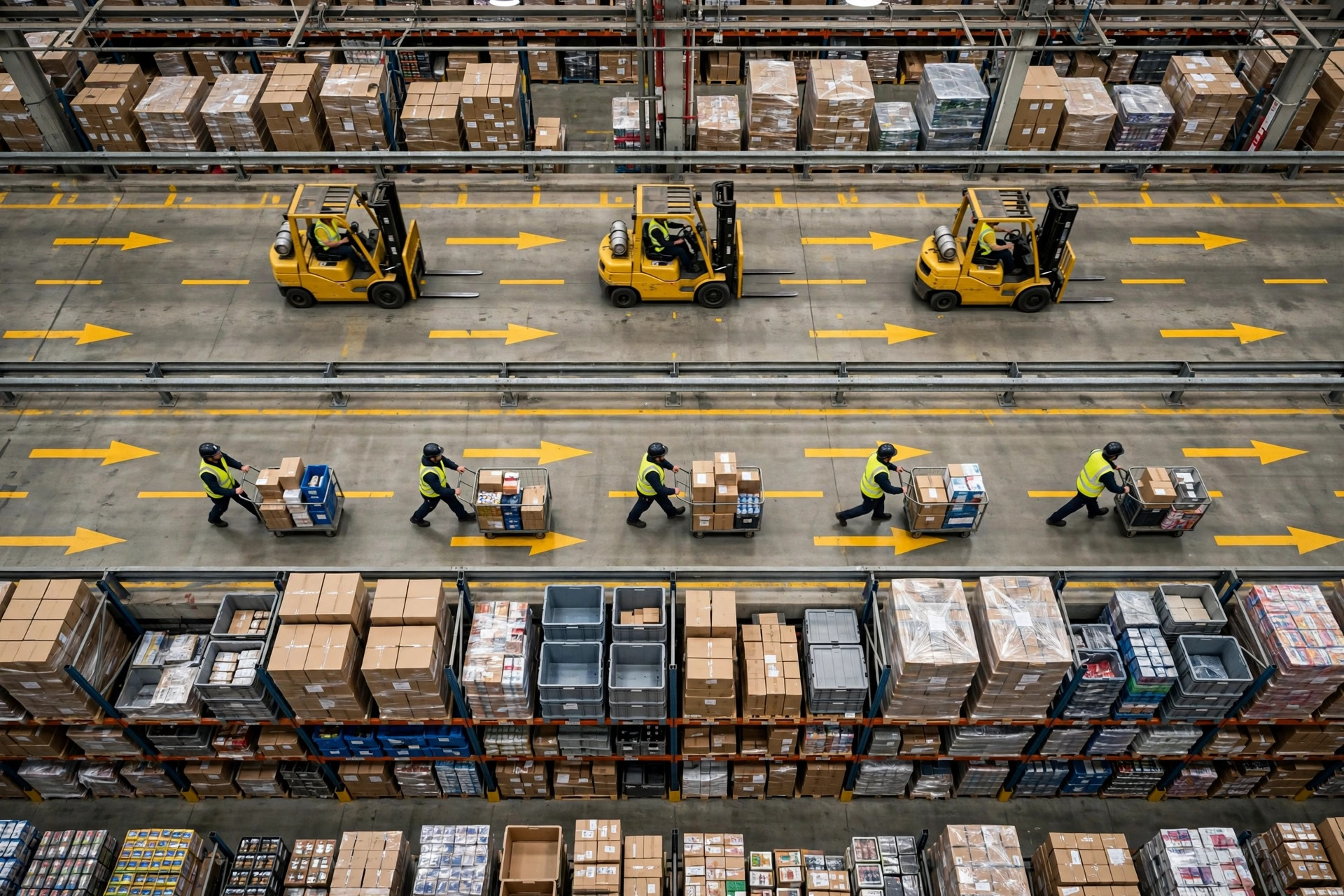
The Setup: "Traffic Paralysis" Inside a Warehouse
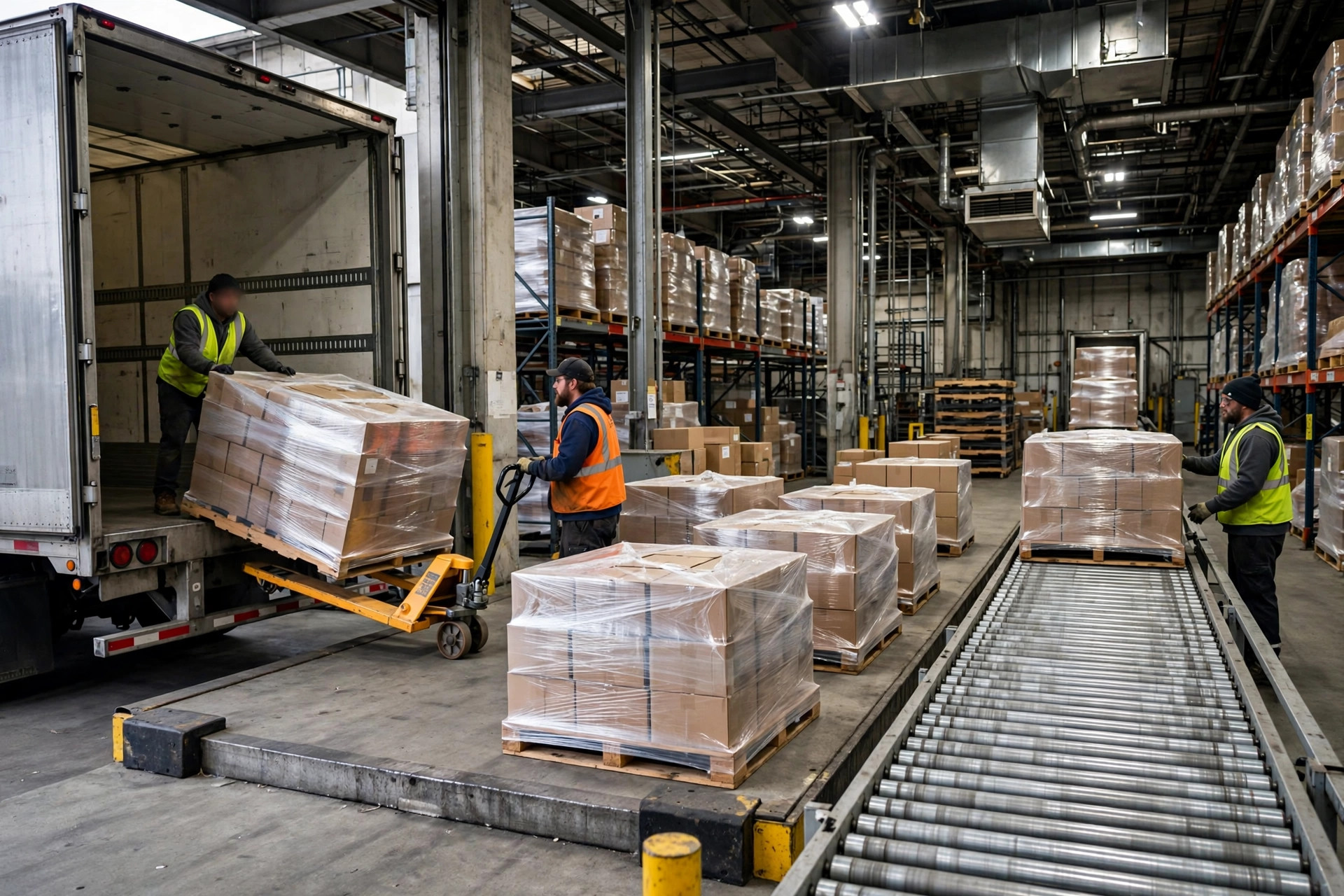
2 AM on Double-11: a major e-commerce warehouse's pack-zone entrance jammed for 40 minutes. Forklifts with replenishment pallets couldn't get in, pickers with loaded carts couldn't get out, packed parcels piled into the aisle, and the pile kept feeding itself. The shift manager's post-mortem: "That night, the warehouse wasn't short of people — it was short of road."
Warehouse flow works like city traffic: with the road network designed wrong, more vehicles and more people change nothing. The five golden rules below are flow design's traffic code.
Rule 1: One-Way Main Flow — Never Backtrack
Goods move in exactly one direction from inbound to outbound. That's flow design's first principle.
- U-flow: receiving and shipping on the same side, goods trace a U through the building. Fits square sites with constrained dock access.
- I-flow (through-flow): inbound at one end, outbound at the other. Fits long buildings; inbound and outbound never interfere.
- Either way, draw the complete goods flow as arrows on the plan — any reversed arrow is a design defect.
The test: pick 10 random SKUs and trace their full receiving-to-shipping paths. If more than 2 show obvious doubling-back, redesign the flow.
Rule 2: Find and Kill "Backtrack Points"
Backtrack points are intestinal blockages in the flow. The four most common:
| Backtrack Point | Symptom | Cure | |---|---|---| | QC far from receiving | Double-handling inbound | Put QC against the dock | | Packing upstream of picking | Picks travel backward to pack | Pack immediately downstream of pick | | Returns crossing the pick zone | Reverse flow disrupts forward | Give returns its own loop | | Replenishment colliding with picking | Two-way traffic in one aisle | Stagger replenishment + one-way aisles |
The universal cure: turn "unavoidable backflow" into "planned loops." Returns must travel back to stock after processing, for example — so give them a dedicated reverse lane instead of letting them fight forward flow for road space.
Rule 3: Tiered Aisles, Separate Vehicles from People
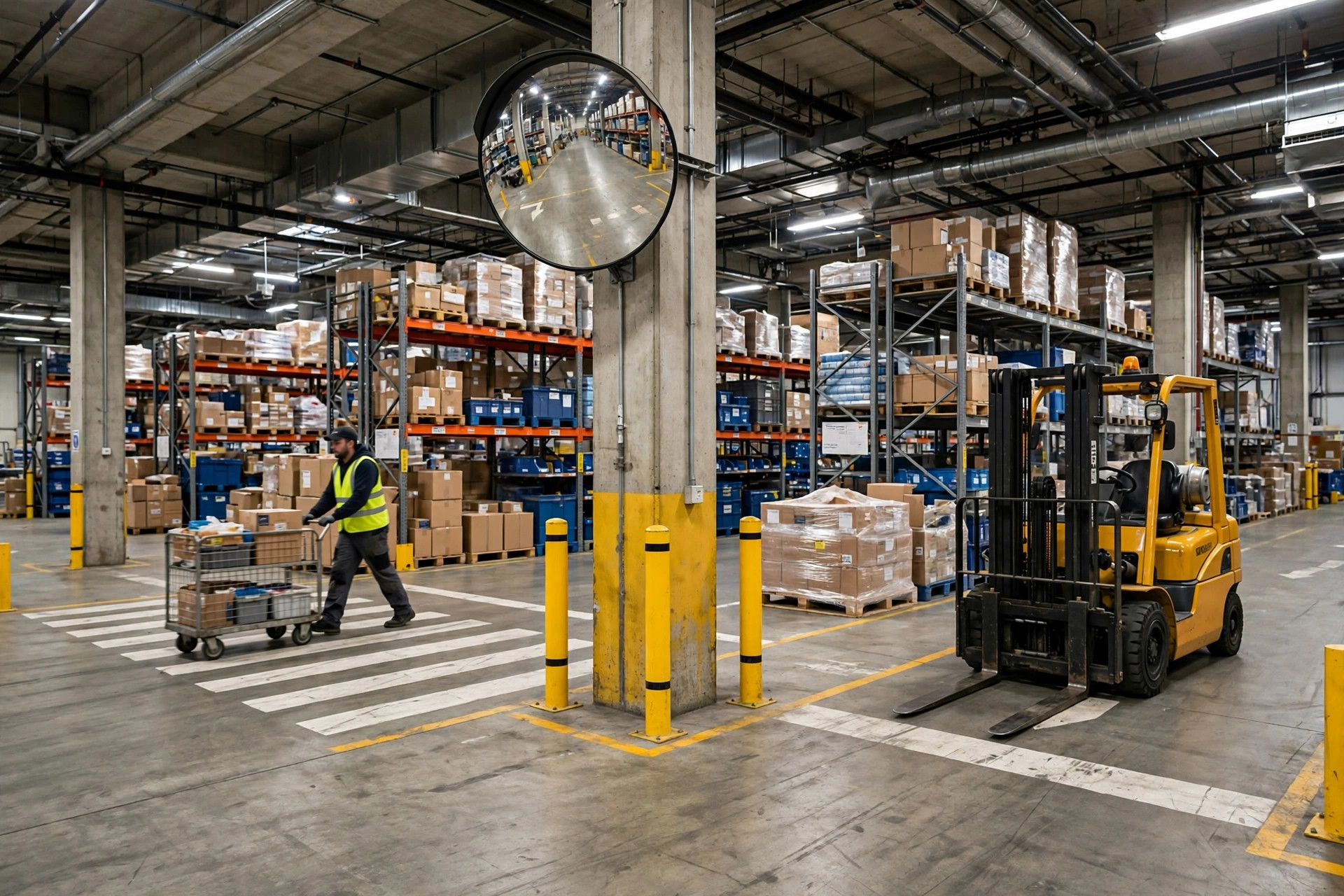
Flow isn't one line — it's a tiered road network:
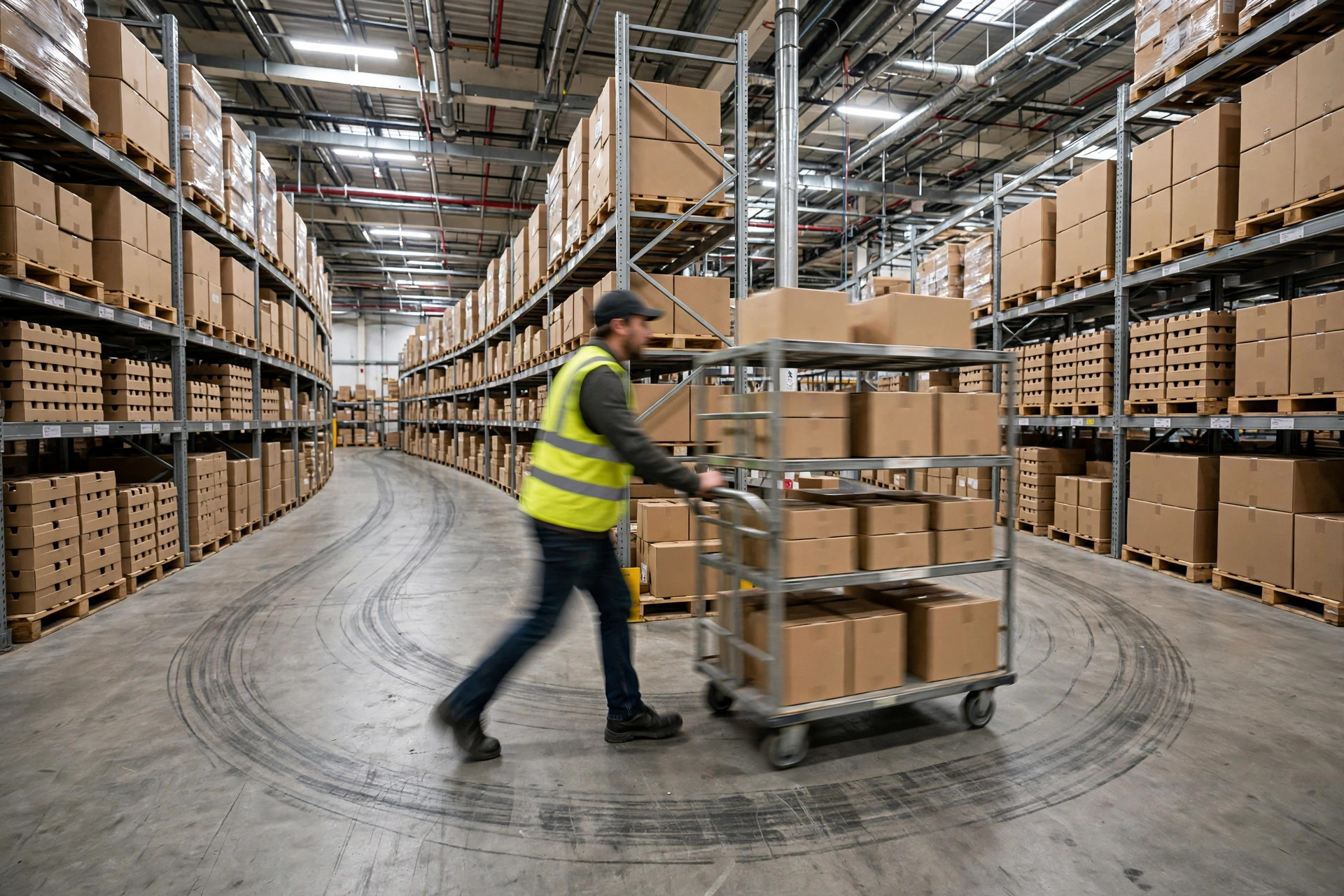
- Arterials: forklift and pallet-jack highways, 3.5–4 m wide, looped through the building so no two points require backtracking.
- Pick aisles: manual-picking only, 1.8–2.5 m wide, forklifts banned (except staggered replenishment windows).
- Pedestrian paths: yellow-marked segregation for clocking in, inspections, and breaks — never borrowing work aisles.
Each tier keeps to its own lanes; the only places forklifts and people meet should be planned intersections, never whole aisles. Mark every intersection with slow-down signage and convex mirrors — 90% of warehouse traffic incidents happen on unplanned mixed-travel stretches.
Rule 4: Feed the Bottleneck — Trade Time for Space
The most expensive thing in a warehouse isn't area — it's bottleneck throughput. Flow design must identify bottlenecks and clear their path:
- Pack stations are e-commerce's classic bottleneck: reserve 1.5× normal staging space ahead of packing as a pre-peak buffer.
- Receiving docks are bottleneck #2: concentrated arrival waves queue trucks back into the building. Use appointment scheduling plus time windows to flatten waves — trading time for space.
- Elevators/lifts bottleneck multi-level sites: one lift's capacity caps the whole mezzanine level; size for 1.3× peak.
The formula: bottleneck flow capacity = 1.2–1.5× peak volume. Designing flow for averages guarantees jams at peak.
Rule 5: Make Flow Verifiable — Review 30 Days After Go-Live
No matter how pretty the drawing, reality gets a vote. After go-live, do three things:
- Map actual travel: shadow 5 workers for a day, record real paths (GPS traces or manual logs), and compare against the design.
- Measure the three numbers: picker daily walking distance, forklift empty-travel rate, bottleneck queue time — they tell the whole story.
- Use the 30-day tune window: floor markings, signage, and staging positions are cheap to adjust. The first month is flow optimization's golden window; after that, change resistance multiplies 10×.
Case Study: A 3C E-Commerce Warehouse — Zero Bottlenecks
A 3C e-commerce warehouse, 8,000 orders/day, ran a through-flow with packing stuck in the middle: picks traveled 60 m backward to pack stations, and outbound staging sat on packing's far side — a classic double backtrack.
The fix: shifted packing downstream of picking, split outbound staging into parcel/LTL zones left and right, looped the arterial, and made pick aisles one-way (in one end, out the other). The investment was floor paint plus 20 m of conveyor.
Results: the pre-cutoff 2-hour jam vanished, picker daily walking fell from 9.8 km to 7.1 km, forklift empty travel dropped from 35% to 12%. The most visible change: on peak night, the shift manager clocked out on time for the first time.
Pitfalls: Four Flow-Design Traps
- Drawing goods flow but not people flow: meal, restroom, and shift-change paths unplanned means people cut corners through work zones — the root of safety incidents.
- Fire lanes occupied by staging: "just for tonight" becomes a month. Paint fire lanes as red grids — occupation equals violation, tied to performance reviews.
- One flow for peak and normal: peak volume runs 3–5× normal; flow needs a "wartime version" — backup aisles activated, one-ways flipped, staging expanded. Rehearse it; don't improvise.
- Bolting automation onto finished flow: AGVs and conveyors added later fight manual traffic. Automation planning must run concurrent with flow design, reserving interfaces and space at minimum.
Takeaway
Flow design is writing the warehouse's traffic code: one-way is iron law, backtracking is a violation, tiering is the road network, bottlenecks get right-of-way, verification closes the loop. Remember the shift manager's words — the warehouse isn't short of people; it's short of road. Build the roads right and people and machines run smoothly on their own.
Warehousing with Mr. Mi · 20 years of US warehousing solutions