New-Hire Training Is a Hidden Cost
Warehouse managers all track labor cost; few track training cost. A new picker takes anywhere from a week to a month to reach solo proficiency — running at half the speed of a veteran while contributing double the errors. Hiring 50 temps before peak season means switching on 50 "slow-and-error-prone" modes at once.
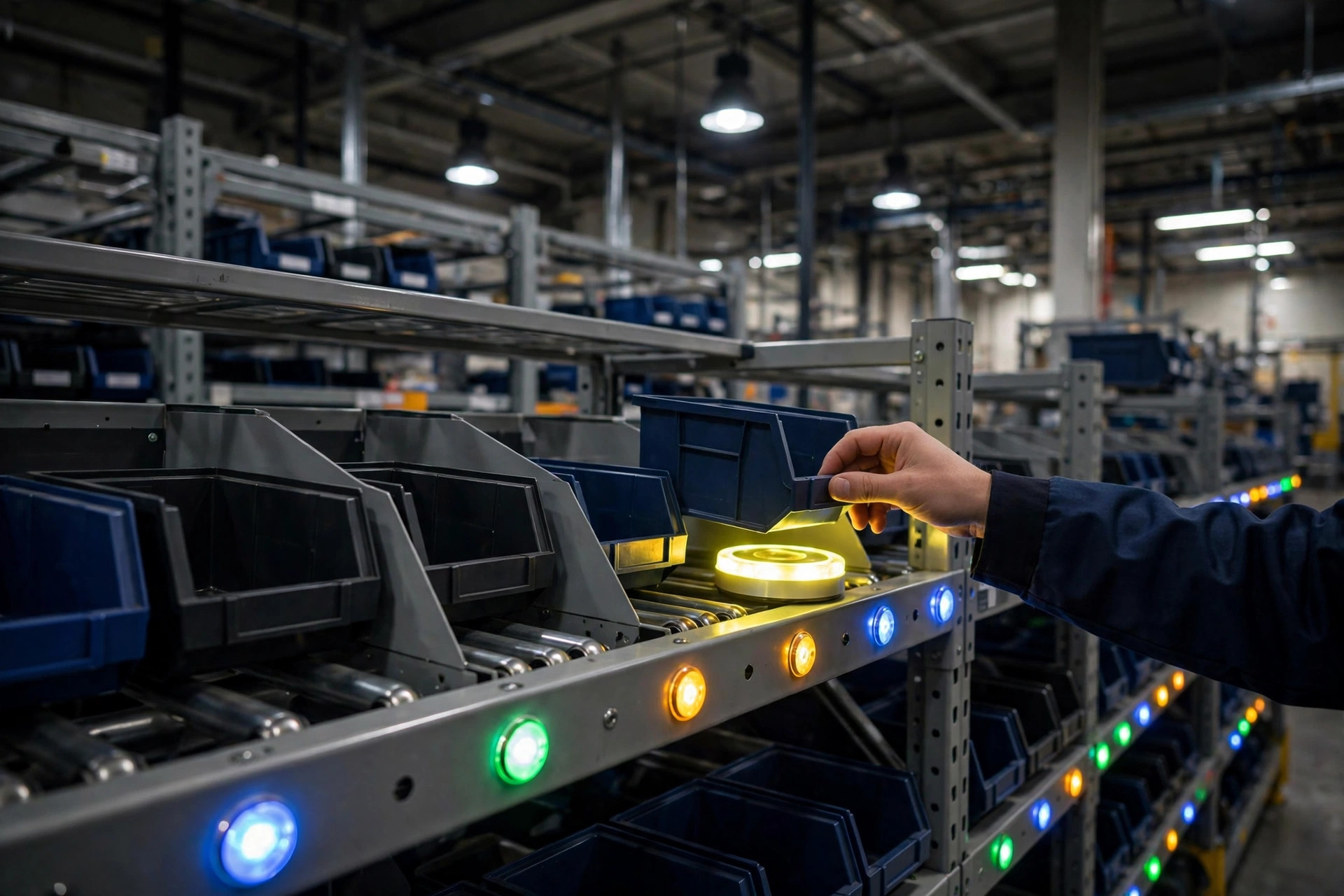
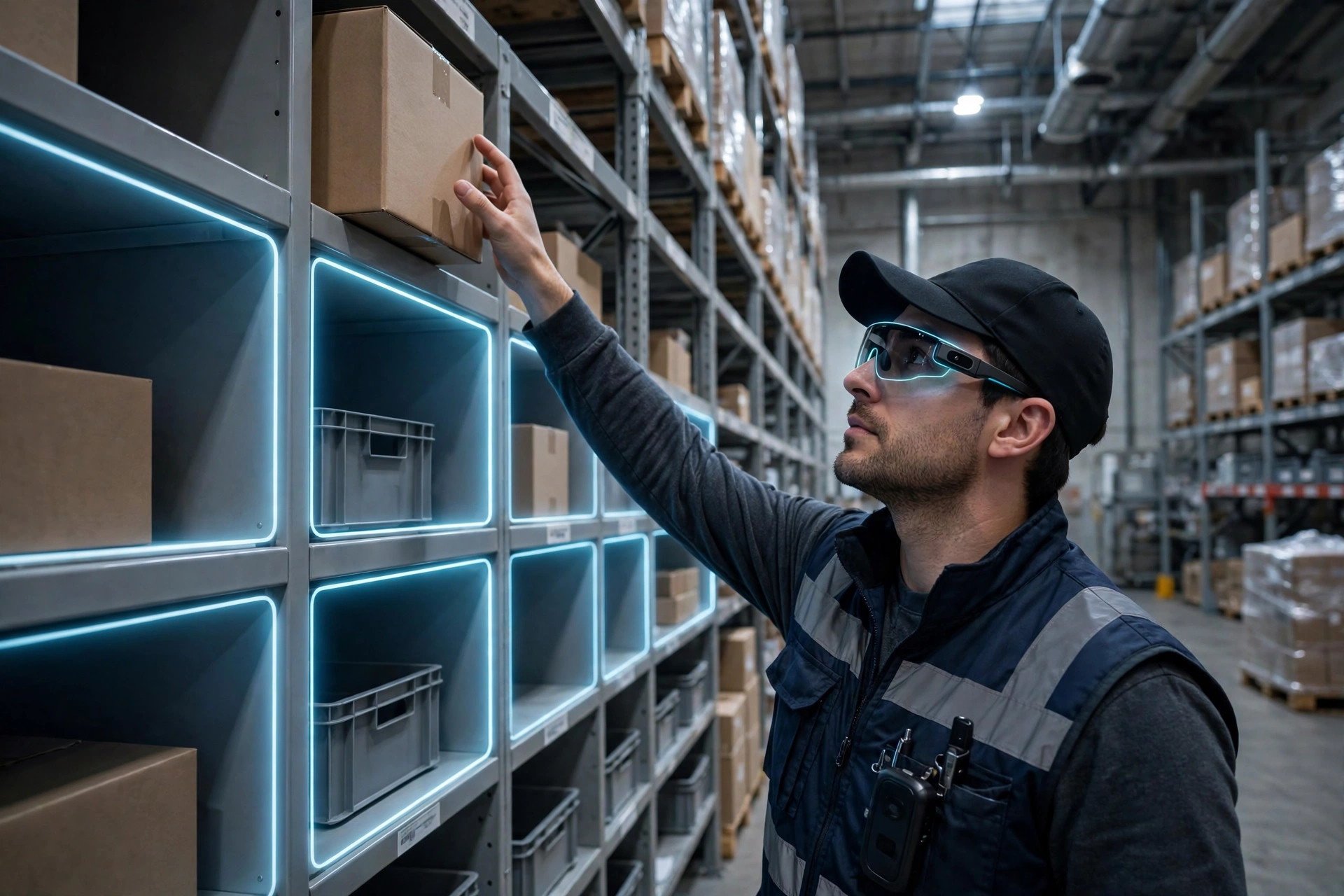
Vision picking attacks exactly this: put on AR glasses, and the system draws "where to go, what to grab, how many" directly onto the reality you see — the target location glows with a highlight box on the actual rack, arrows guide your walking route, quantities float beside the slot. New hires memorize no locations and learn no RF guns; they're productive on day one, following arrows.
1. How It Works: WMS on Your Eyes
A vision-picking system has four parts:
- AR glasses: display + camera + positioning sensors. Mainstream setups use binocular AR glasses — the wider the field of view, the more guidance fits on screen at once.
- Visual positioning: cameras recognize QR codes or image features on the racking, fused with inertial navigation, computing "where you are and where you're looking" in real time — accurate to the slot level.
- WMS integration: order tasks stream to the glasses live; pick paths render as arrows in your field of view, target slots highlight, quantities float in place.
- Hands-free confirmation: after grabbing, say "confirm" by voice or let the glasses' camera scan the product barcode — the task flows on, hands still free.
Compared with PTL's lights or voice picking's headset, AR's unique value is "what you see is what you get": guidance overlaid on real racking, so the brain never context-switches between "screen" and "reality."
2. Four Proven Use Cases
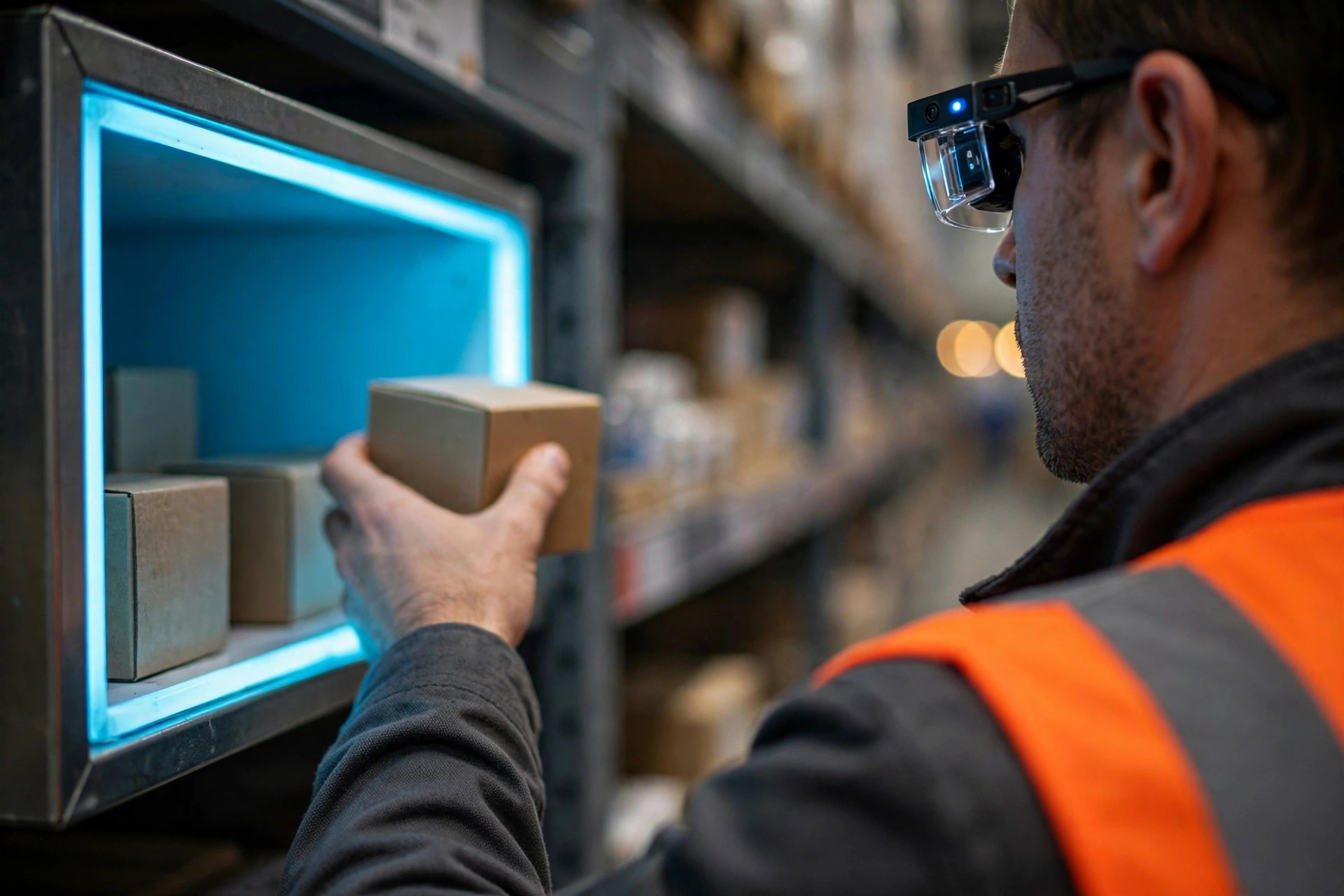
- Pick navigation: the most mature scenario. Arrow routing + slot highlighting + floating quantities. New-hire training compresses from weeks to hours. Ideal for e-commerce DCs with sprawling SKUs and high labor turnover.
- Assisted cycle counting: the glasses scan a slot, the system shows book quantity, variances flag red on the spot. No more clipboard cross-checking — counting productivity up 30%+.
- Putaway guidance: after receiving, the glasses point — "this SKU goes to B-05-3." Rookies can do putaway, ending the era of "only veterans know where things go."
- Maintenance guidance: technicians wear the glasses while repair steps render as 3D animations overlaid on the actual equipment; remote experts see what the technician sees. A killer app for MRO in automated facilities.
| Use case | Maturity | Core value | Best for | |---|---|---|---| | Pick navigation | High (commercial) | Instant onboarding, rookie-ready | E-commerce DCs, high turnover | | Assisted counting | Medium-high | Faster counts, live variances | DCs with broad SKUs | | Putaway guidance | Medium | De-skilled putaway | High-receiving warehouses | | Maintenance guidance | Medium | Remote experts, visual steps | Automation-heavy sites |
3. Cost and Maturity: Can You Buy It Today?
Honestly: vision picking is past the "concept" stage but not yet at the "buy blind" stage.
- Hardware: industrial AR glasses run $2,000–5,500 per unit; retrofitted consumer options are cheaper but compromise on durability and field of view;
- Software: vision-picking platforms charge annual per-user fees of roughly $400–1,100/person/year;
- Implementation: rack feature modeling, WMS integration, process adaptation — implementation for a 5,000 m² warehouse starts around $28K (¥200K).
On maturity, DHL and DB Schenker have piloted since 2017, and pick-navigation scenarios have now scaled to multi-site rollouts. But note: between "successful pilot" and "full-warehouse rollout" stand three hurdles — wearing comfort, battery life, and Wi-Fi coverage. My read for 2026: worth a funded pilot, not yet worth a full-site rollout in one shot.
4. The Numbers: What Early Adopters Measured
Aggregating published pilot data:
- New-hire training: from 2–4 weeks down to 2–4 hours — a 90%+ reduction;
- Pick productivity: 15–25% over paper — on par with voice picking, slightly below PTL;
- Error rate: down into the 0.1–0.2% band;
- Worker acceptance: high among younger workers; workers over 40 need longer adaptation — don't pilot with only the young.
Case Study: What the Early Movers Learned
DHL piloted AR picking across warehouses in the Netherlands and the US: pickers wore smart glasses showing pick lists and navigation arrows in their field of view. Pilots measured ~15% productivity gains and training time collapsing from weeks to hours. DHL then expanded to more sites and to a "vision picking + voice confirmation" combo — eyes on guidance, mouth on confirmation, hands free throughout.
Domestic 3C and pharma DCs are following the same path: start with a 2,000 m² piece-pick zone, run the pilot for 3 months, then decide on expansion. The shared lesson: network first — AR glasses are brutally sensitive to Wi-Fi roaming; optimize warehouse wireless coverage before talking AR.
Pitfalls
- Wearing comfort is gate #1: AR glasses weigh 300–500 g; 8 hours of that strains necks. During pilots, have workers wear them for full shifts and collect honest feedback — not just 1-hour demos.
- Battery reality: heavy use yields 4–6 hours — plan 1:2 device ratios for shift work or mid-shift swaps. Poor charge management turns the devices into paperweights.
- Fix Wi-Fi roaming first: AR is latency-sensitive; AP handoff stutter causes positioning drift. Run roaming tests across the warehouse and drive packet loss down before deploying AR.
- Don't expect it to replace everything: AR excels at guidance, not error-proofing. High-value and error-prone SKUs still need scan or weight verification.
Takeaway
Vision picking is the "next stop" in picking technology: it drives training cost to the floor and makes "rookie-ready on day one" real. But today its best role is "pioneer in pilot," not "workhorse of the whole warehouse." My concrete advice: take one high-turnover piece-pick zone, pilot for 3 months, and do the math on three lines — training savings, productivity gains, error reduction — before expanding. The future is here; it just hasn't been fully delivered yet. Get it running in your warehouse first.