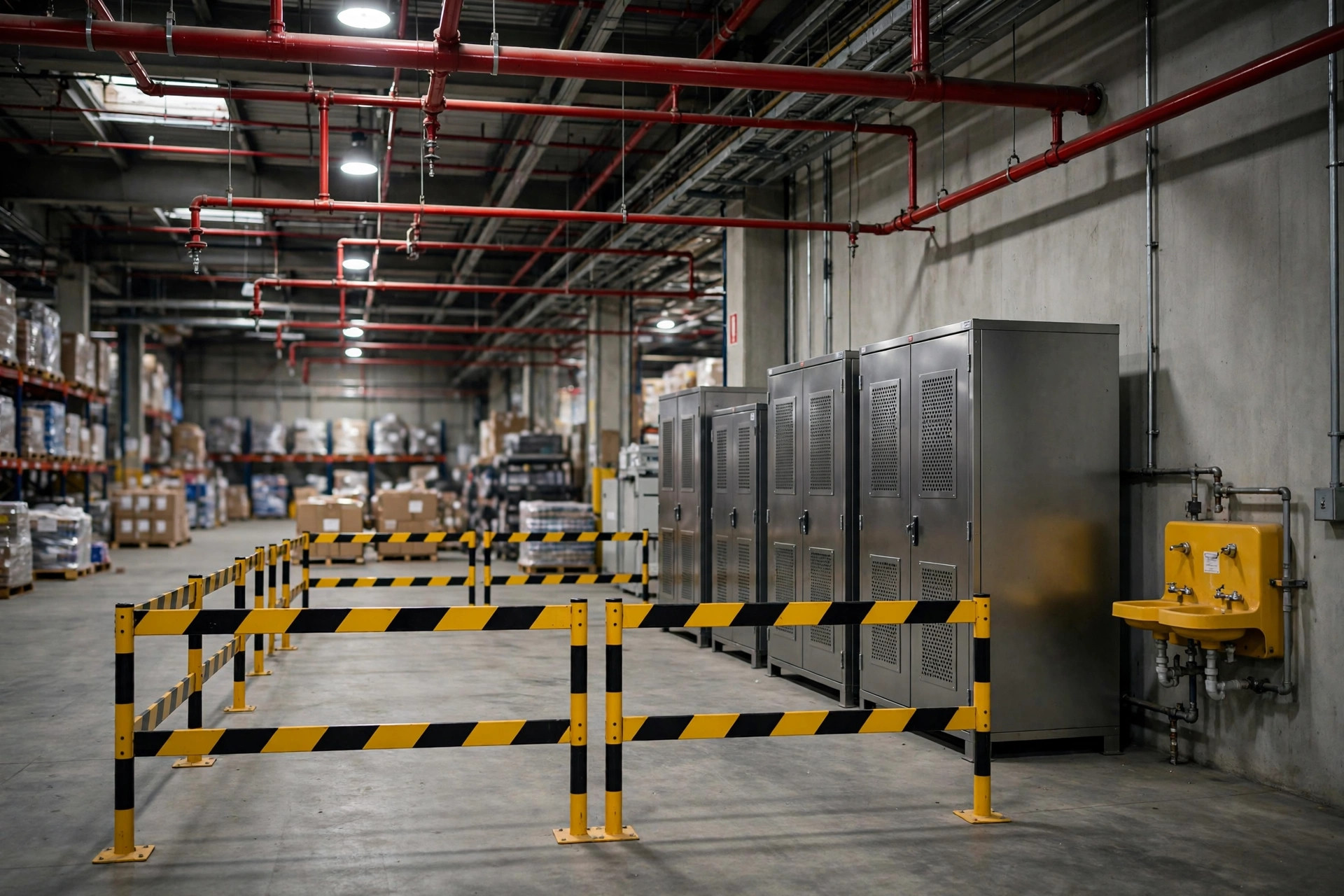
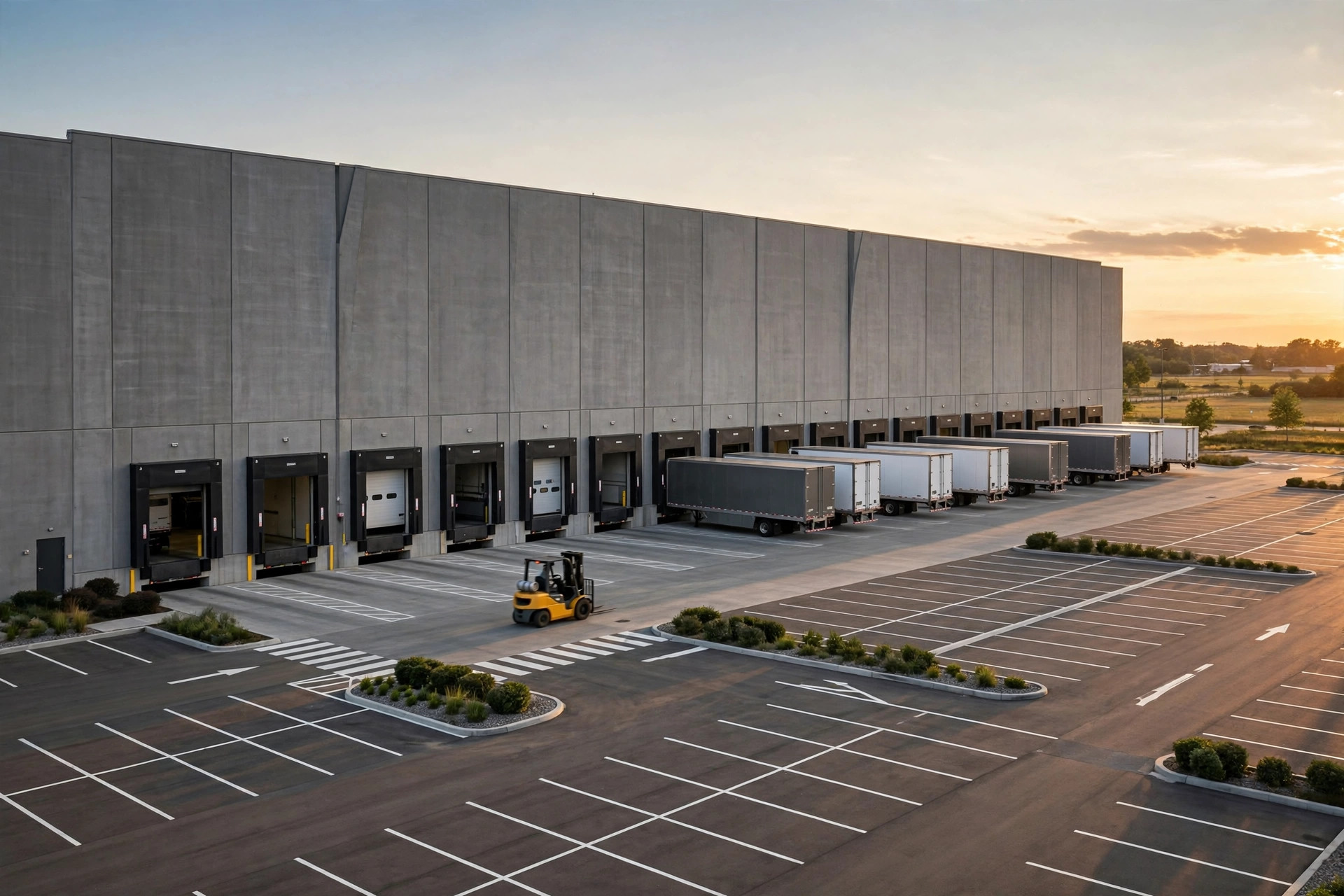
Here's a story that still stings. A 3PL I know in Fontana — 120,000 square feet, apparel — had an electrical fire rip through a third of the building right before the 2023 holiday peak. The owner was calm. "I've got $5 million in property coverage, and the burned inventory was worth maybe $2 million." The claim came back at $1.4 million. He ate the remaining $600,000 himself. The reason came down to one word: coinsurance.
This article is about one thing: how to set warehouse property coverage limits — low enough to avoid wasting premium, high enough to survive a claim. Below is the exact process I run with clients before every renewal. Steal it.
Replacement Cost vs. Actual Cash Value: Pick Wrong and You Overpay All Year
The first decision is what "value" your policy pays on. Two options: replacement cost and actual cash value. Premiums can differ by 30 to 50 percent.
Replacement cost pays what it costs to buy it new again. Actual cash value pays that number minus depreciation. An eight-year-old forklift costs $35,000 new but carries a book value of $8,000 — that's a 4x difference in payout on the same machine.
My verdict is blunt: choose replacement cost for production equipment you actually use — racking, forklifts, conveyors. The logic is simple. If it burns down, you're buying new ones anyway, because the warehouse stops without them. One catch most owners miss: replacement cost only pays at replacement cost if you actually rebuild or repurchase. Take the cash and walk away, and they settle at actual cash value.
Office furniture, computers, and old pallets? Actual cash value is fine. If it burns, you'll replace it cheaper anyway. Inventory and equipment are where the real money sits.
Coinsurance: The Trap That Eats Claims, and the Math You Need
Back to the Fontana story. A coinsurance clause requires your limit to be at least a stated percentage of the "value at risk" — usually 80% or 90%. Fall short, and every claim gets discounted proportionally. The penalty formula:
Payout = Loss × (Your limit ÷ The limit you should have carried)
That apparel 3PL had $8 million at risk (inventory plus equipment) and carried $5 million — 62.5%. Five million divided by 80% of the at-risk value ($6.4 million) equals 78%. So a $2 million loss paid $1.56 million, and after the deductible, the owner netted $1.4 million. He saved a few thousand in premium and lost $600,000 on the claim. Terrible trade.
How to avoid it: carry at least 90% of your value at risk, and pick the 90% coinsurance clause. Better still: buy a coinsurance waiver and eliminate the penalty entirely — roughly 10 to 15 percent more premium. My rule: if your inventory swings more than 2x between slow and peak season, buy the waiver. Don't gamble.
The critical question is what counts as "value at risk." Insurers measure it at the time of loss, not when you bound the policy. Bind in June with $3 million in inventory, sit on $7 million by October, and your coinsurance compliance silently collapses below 50%. Set limits against peak, not average.
Valuing Inventory: Set Limits at Peak, and Give 60 Days' Notice Before You Bulk Up
Inventory is the biggest line in a warehouse property policy and the easiest to get wrong. The standard approach:
First, pull month-end inventory values for the past 12 months and find the peak. Use cost — what you paid or what it cost to make — not selling price. Insurance reimburses your cost, not your margin. A lot of operators get this backwards.
Second, multiply the peak by 1.1 to 1.15 — covering in-transit stock, rented overflow space, and estimation error. Don't skimp on this slice of premium.
Third, notify your insurer 60 days before peak season to bump the limit. Most property policies allow value-reporting adjustments with pro-rata additional premium. The cost of a declared increase is trivial next to a coinsurance penalty on a real claim.
Two more inventory details. First, customers' goods in a 3PL model get a "property of others" provision — scheduled at its own limit, with the customer contract spelling out who buys it. This is where the ugliest disputes start. Second, high-value small items (electronics, luxury goods) carry per-item sublimits, typically $5,000 to $10,000 — schedule anything above individually.

Deductibles: Lower Isn't Better — Run the Numbers
A deductible is what you absorb before insurance pays. Many owners instinctively pick the lowest deductible, assuming "the insurer pays more if something happens." That instinct is wrong.
Run the math: raising the deductible from $5,000 to $25,000 typically cuts an $80,000 premium by 15 to 25% — $12,000 to $20,000 a year saved. Small losses (a few thousand dollars of water damage, a forklift clipping one bay of racking) shouldn't go through insurance anyway. File one small claim and next year's increase can exceed what you recovered, plus you've put a claim on your record.
My verdict: for operations doing $5 million or more in annual revenue, set the deductible at $25,000 to $50,000. Treat insurance as catastrophe protection, not a maintenance wallet. Absorb the small stuff yourself — one year of premium savings covers several small repairs.
Business Interruption: Property Insurance Pays for Things, Not for Time
Property insurance replaces stuff. Business interruption insurance replaces time. Your building burns, rebuild takes three to six months, and meanwhile rent is due, payroll runs, and customers leave. Property insurance covers exactly zero of that.
The limit formula: monthly fixed costs × estimated recovery months × 1.2. Fixed costs include rent, payroll, loan payments, and long-term contract penalties. Don't be optimistic on recovery time — ask a contractor who's done post-fire rebuilds. A partially burned 120,000-square-foot warehouse typically needs four to eight months; I use six.
There's also an "extra expense" provision — temporary space, expedited equipment, overtime — with its own limit. 3PLs need this badly: if you can't find alternate capacity within 48 hours, customers leave.
My call: for 3PLs, business interruption is mandatory, not optional. For private warehouses with fast inventory turns and easy access to alternate space, it's judgment. One thing to remember: business interruption usually carries a 72-hour waiting period — the first three days aren't covered.
Exclusions: Know What's Not Covered Before the Claim
Standard property policies carve out a few things explicitly. Know them now:
Flood and earthquake are essentially never covered. Standard policies exclude both; you buy them separately. In California, take earthquake coverage seriously — it's pricey, but one real SoCal quake is a total loss. For flood, check the FEMA maps; lenders may force-place coverage in flood zones.
Tenant improvements aren't covered. The partitions, racking, and electrical upgrades you paid for in a leased building — the landlord's policy doesn't cover them, and your standard policy might not either. Add a "tenant's improvements and betterments" provision scheduled at what you actually spent.
Gradual damage isn't covered. A 20-year-old roof that slowly leaks and ruins product over months is "gradual deterioration," not a sudden accident. If your roof is past 15 years without replacement, fix the roof first — cheaper than insurance.
Mysterious disappearance isn't covered. A cycle count shows 2% of inventory missing, but nobody can say when or how it vanished — the insurer won't pay. There has to be a defined event: fire, water, a filed theft report. Shrinkage and insurance claims are two different things. Don't mix them up.
The 90-Day Pre-Renewal Checklist
Insurance isn't a buy-once chore. Ninety days before every renewal, walk this list:
- Refresh the inventory peak: pull 12 months of month-end values, recompute the peak and the 1.1 factor.
- Update the equipment schedule: did new forklifts, racking, or automation get added to the policy? Did retired equipment get removed?
- Check coinsurance compliance: current limit divided by current value at risk — still above 90%?
- Reassess the deductible: any small claims filed last year? If yes, consider raising it.
- Review exclusions: any new exposure (like overflow space leased in a flood zone)?
- Update business interruption: have monthly fixed costs changed? Is the recovery estimate still realistic?
- Get two or three competing quotes: don't auto-renew with the same carrier — warehouse insurance pricing moves every year.
- Confirm tenant improvements: any new buildout spending this year? Get it scheduled.
One last honest note: your broker's commission tracks your premium, so they have a built-in incentive to sell you more. Run the checklist yourself, do your own limit math, then negotiate from strength.
When's the last time you checked the coinsurance percentage on your own policy? Most people who look break into a cold sweat.