Beyond UN38.3: What Storing Lithium Batteries in Your Warehouse Really Requires
A complete UN38.3 test report does not mean your warehouse is ready. Transport compliance and warehouse safety follow two entirely different rulebooks. This piece covers what actually matters once batteries are inside your four walls: state-of-charge limits, temperature and humidity monitoring, segregation and fire compartments, suppression and detection, thermal runaway response, and getting your insurance sorted.
Last fall, a 3PL owner in Fontana called me. He'd just landed a power-tool battery account, the customer's UN38.3 paperwork was complete, and he wanted to know if his warehouse needed any special preparation. I asked him one question: "Where are you planning to put the product?" He said, "On the racks, like everything else." I told him to hold off on signing.
I've watched too many operators treat transport compliance as warehouse compliance, as if a UN38.3 report settles everything. UN38.3 is the battery test series in the UN Manual of Tests and Criteria — T1 through T8, from altitude simulation to overcharge and forced discharge. In one sentence: it proves the battery can survive the journey. Freight forwarders ask for it. Customs asks for it. But when the fire marshal walks through your building, that report is not what he's looking at.
Here's the core distinction: transport is about managing risk in motion; warehousing is about managing risk at rest. A lithium battery doesn't need an open flame or an impact to go into thermal runaway. A fully charged, heat-stressed, or internally damaged cell can do it sitting quietly on a rack. The moment the product enters your warehouse, the game changes.
Three things UN38.3 doesn't cover that happen in your building every day
First, state of charge. Transport rules cap state of charge — common industry practice is around 30% or less. But plenty of warehouses never check SoC at receiving — the customer says half charge, and everyone takes their word for it. The worst case I ever saw: a receiving inspection found a full pallet sitting near 100%, and the customer just shrugged and said "that's how it ships from the factory." A fully charged battery carries far more energy into a thermal event. This is not a minor detail.
Put the SoC cap in the contract and spot-check at receiving; at minimum, get written confirmation from the customer. Product arriving fully charged goes back for discharge or into a designated high-risk area — never mixed with general freight.
Second, temperature. A warehouse in the Inland Empire easily tops 40°C (104°F) inside during summer. Heat accelerates self-discharge and slowly degrades cells in long-term storage. Manufacturers generally recommend storing around 15–25°C (59–77°F); most general warehouses can't hold that year-round. That's fine — but at minimum, monitor it: log the zone's temperature daily, set an alarm threshold, and have a response ready when it trips — ventilate, relocate stock, notify the customer. Watch humidity too: condensation corrodes terminals, and corroded terminals can create localized heating.
Third, time. Transport takes days. Warehousing takes weeks or months. A cell with minor internal damage might survive the trip and fail two months into storage. The longer the dwell time, the more you need routine inspections: look for swelling, smell for off-odors, feel for abnormal warmth on the outer cartons. Put those three checks on an inspection sheet. They beat any fancy system.
Where to put it, and how much: slotting in practice
Blunt version: mixing lithium batteries onto general racking is gambling with the whole building.
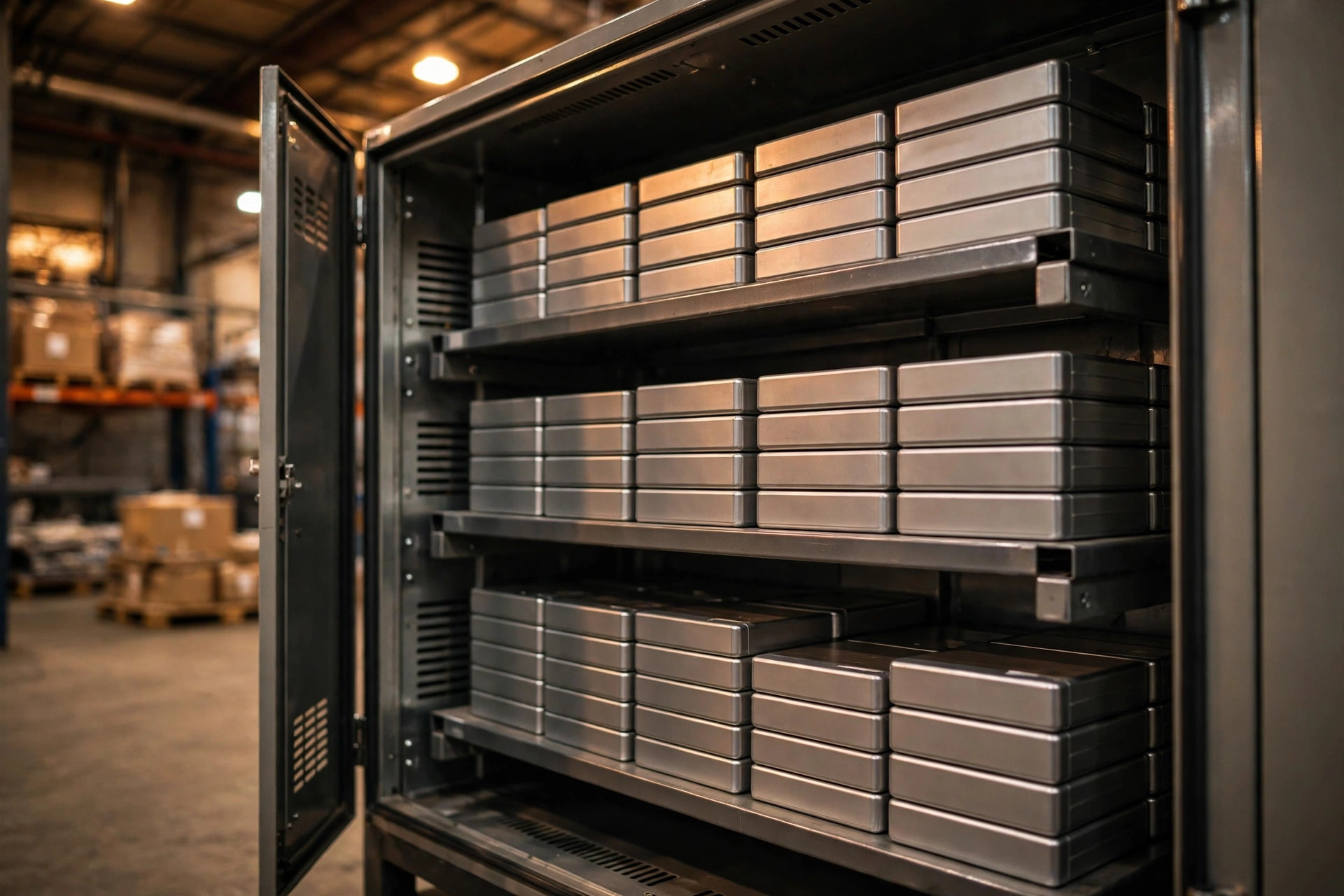
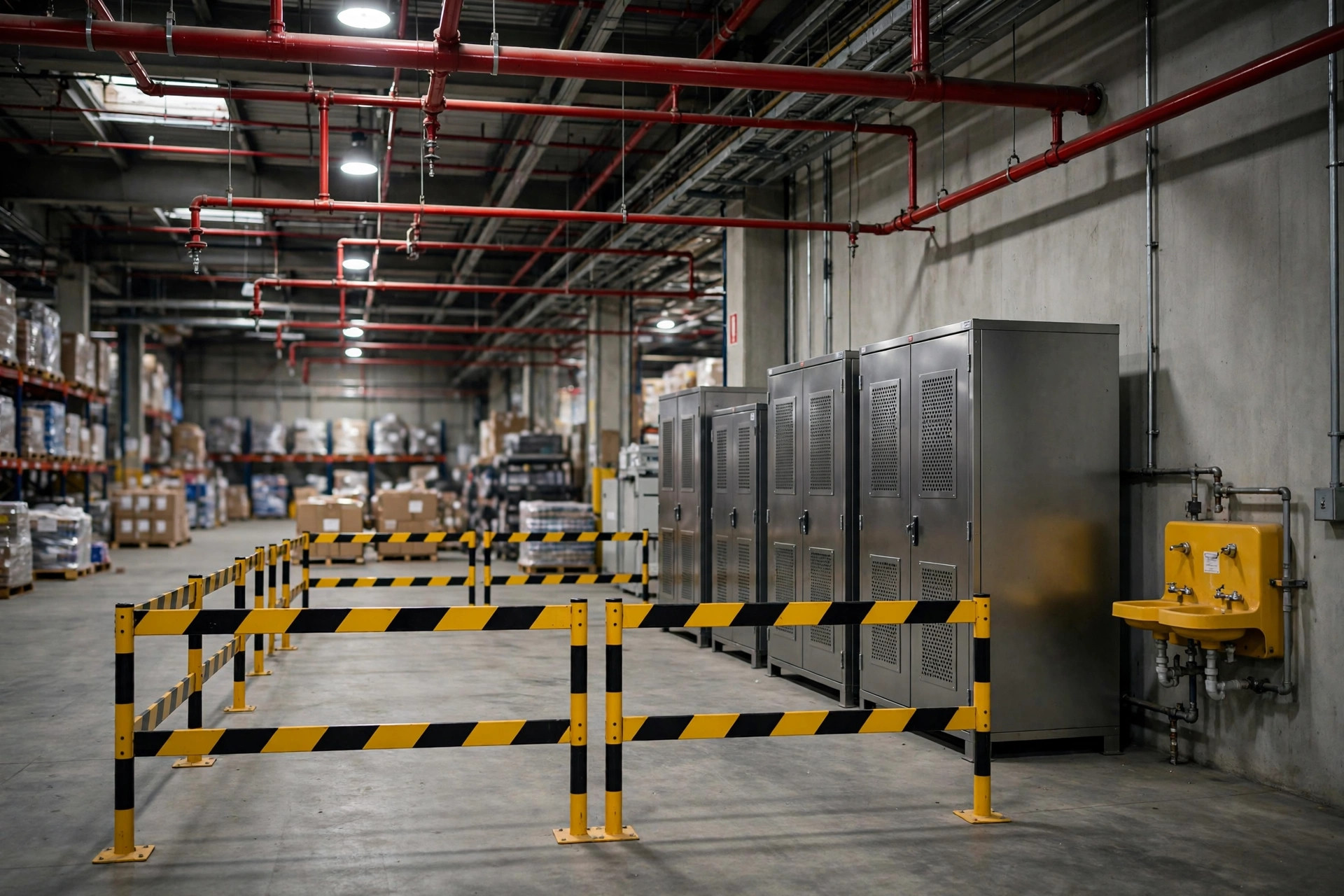
A dedicated zone is the floor, not the ceiling. The battery area should sit away from dock doors, electrical rooms, and evacuation routes, and never share space with cardboard, textiles, chemicals, or other combustibles. If you have the footprint, carve it out with fire-rated walls or compartments. If you don't, use ventilated fire-rated cabinets. A cabinet isn't decoration — its job is to contain heat and flame if one cell goes, buying you time to alarm and evacuate.
Damaged units, customer returns, and recalled lots get their own quarantine. Fence off a caged isolation area with clear signage, managed by designated staff, cleared as fast as possible — never left to accumulate. Returns are the most dangerous inventory you'll handle: you have no idea what the customer did to them. Highest risk deserves the strictest treatment.
Stacking matters too. Don't stack high and tight; leave room for heat dissipation and inspection access. Keep pallets off the walls — wall-adjacent spots run hotter and ventilate worse. In your slotting system, give lithium batteries their own location type so the system itself refuses to co-mingle them with general freight. Build it into process, not memory.
The suppression and detection math — run it before you sign the customer
This is the part most operators underestimate. Plenty of warehouse owners assume their existing sprinklers and smoke detectors are enough. Honestly? Against thermal runaway, standard sprinklers mostly watch it burn. Water cools and can limit spread, but it cannot stop the chain reaction inside the cells. And smoke detectors? By the time they trip, thermal runaway is usually past the point of no return.
The single most worthwhile addition in current practice is off-gas detection. Batteries vent gases before thermal runaway begins, and off-gas detectors can warn you minutes — sometimes tens of minutes — earlier than smoke detection. Those minutes are the golden window for evacuation, alarming, and isolating the zone. The cost of a detection system isn't in the same universe as the cost of half a warehouse.
As for specific sprinkler densities, detector spacing, and compartment sizes — I'm not giving numbers. NFPA and FM Global standards keep evolving, and requirements vary with storage volume and configuration. Always go by the current editions on the NFPA and FM Global websites, and have a qualified fire protection engineer design to your actual situation. Numbers you invent yourself won't survive a fire inspection or an insurance claim.
Price all of this into the customer's quote before you sign — detection, compartments, cabinets, and sprinkler upgrades add up. Run the math first, then decide whether to take the account and at what rate. Don't sign a thin-margin contract and fund the retrofit yourself.
When it actually smokes: what your people should do first
Cold water first: don't expect your staff to extinguish a lithium battery fire with handheld extinguishers. Dry chemical won't stop thermal runaway, and sending people in means toxic smoke exposure. The first principle of the response plan is protecting people, not product.
If someone spots swelling, strange odors, or smoke, the steps are simple: don't touch it, don't gather around, evacuate and alarm immediately. When calling 911, say explicitly that it's a lithium battery fire — the fire department brings different equipment and tactics, and that heads-up saves critical minutes. If conditions allow, cool surrounding batteries with large volumes of water to prevent propagation; isolate what's burning and let it burn out.
The training checklist is short, but every item has to reach every person who touches this product: recognize the warning signs (swelling, odor, abnormal heat); know the alarm and evacuation procedure; know where extinguishers are — and more importantly, when not to use them. Keep the SDS (safety data sheet) for every battery model on file and retrievable on the floor within a minute. That's the first thing the fire department will ask for.
Insurance: don't find out you're uncovered after the fire
Many warehouse property and liability policies either exclude lithium battery storage or require an endorsement with added premium. The worst outcome: a fire happens, and the carrier says this class of goods was never covered. Zero payout.
Before taking on a battery customer, call your insurance broker and ask three things: does the current policy cover lithium battery storage? Is an endorsement needed, and what are the conditions and cost? What level of fire protection will the carrier require? Brokers will typically want your battery types and volumes, SoC controls, fire protection setup (sprinklers, detection, compartments), and your emergency plan and training records. Prepare those upfront and the quote goes through in one round. And if a broker hears "lithium batteries" and immediately shakes their head — take that as a signal. It means even the insurance industry thinks your current fire protection isn't up to the risk.
Three things you can do tomorrow
First, walk your existing battery inventory: is SoC over the 30% cap, are any swollen units mixed in with good stock, are damaged returns properly quarantined? Second, get your broker on the phone and confirm what the policy actually covers. Third, have a fire protection engineer scope what off-gas detection and compartmentation would cost.
UN38.3 is the first half. It covers the product on the road. The second half is played inside your warehouse, under completely different rules. Price the fire protection retrofit before you take this kind of customer, and confirm the insurance before you receive the first pallet. Do those two things first, and you'll sleep a lot better.