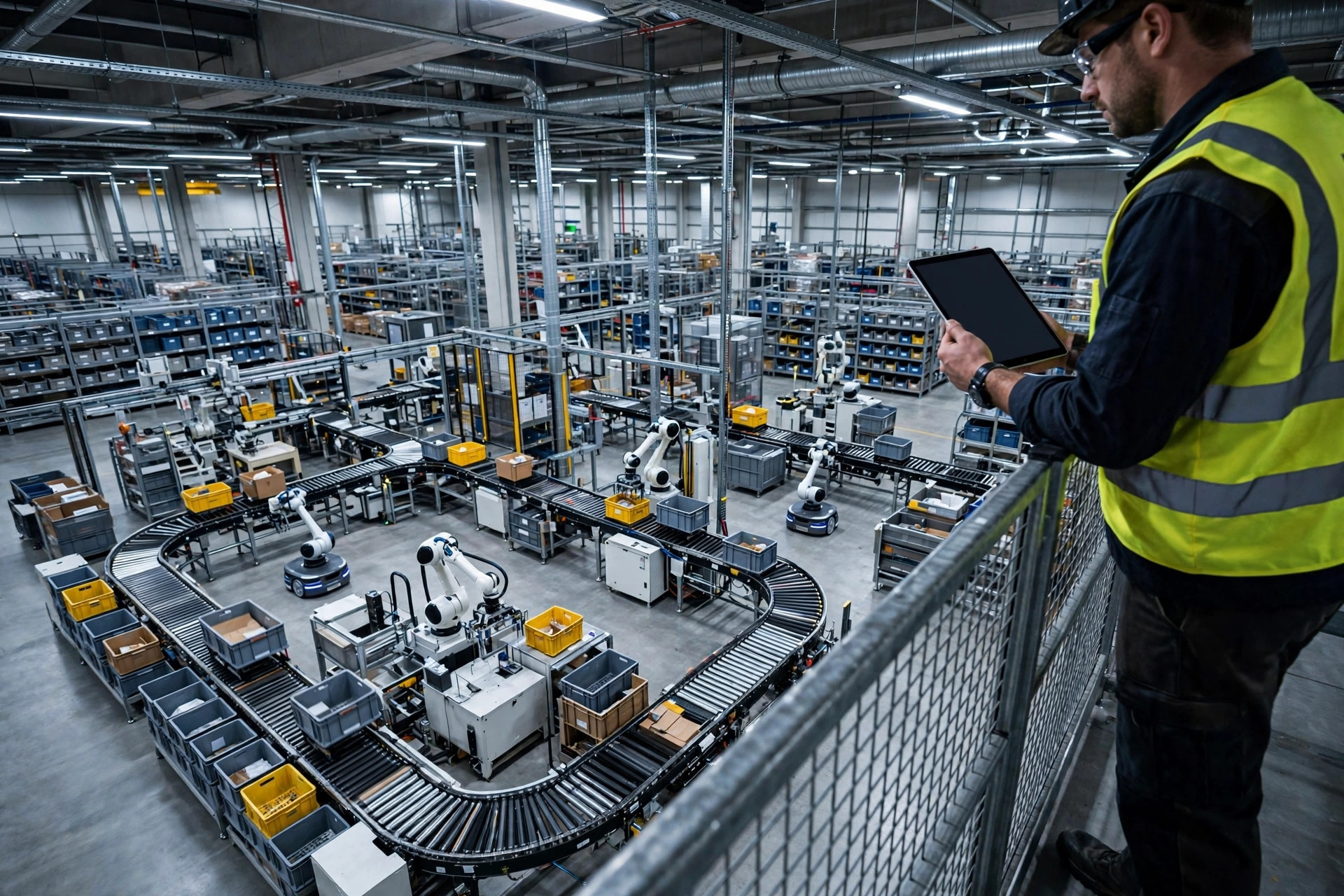
The Opening Question: We Already Have a WMS — Why Add a WES?
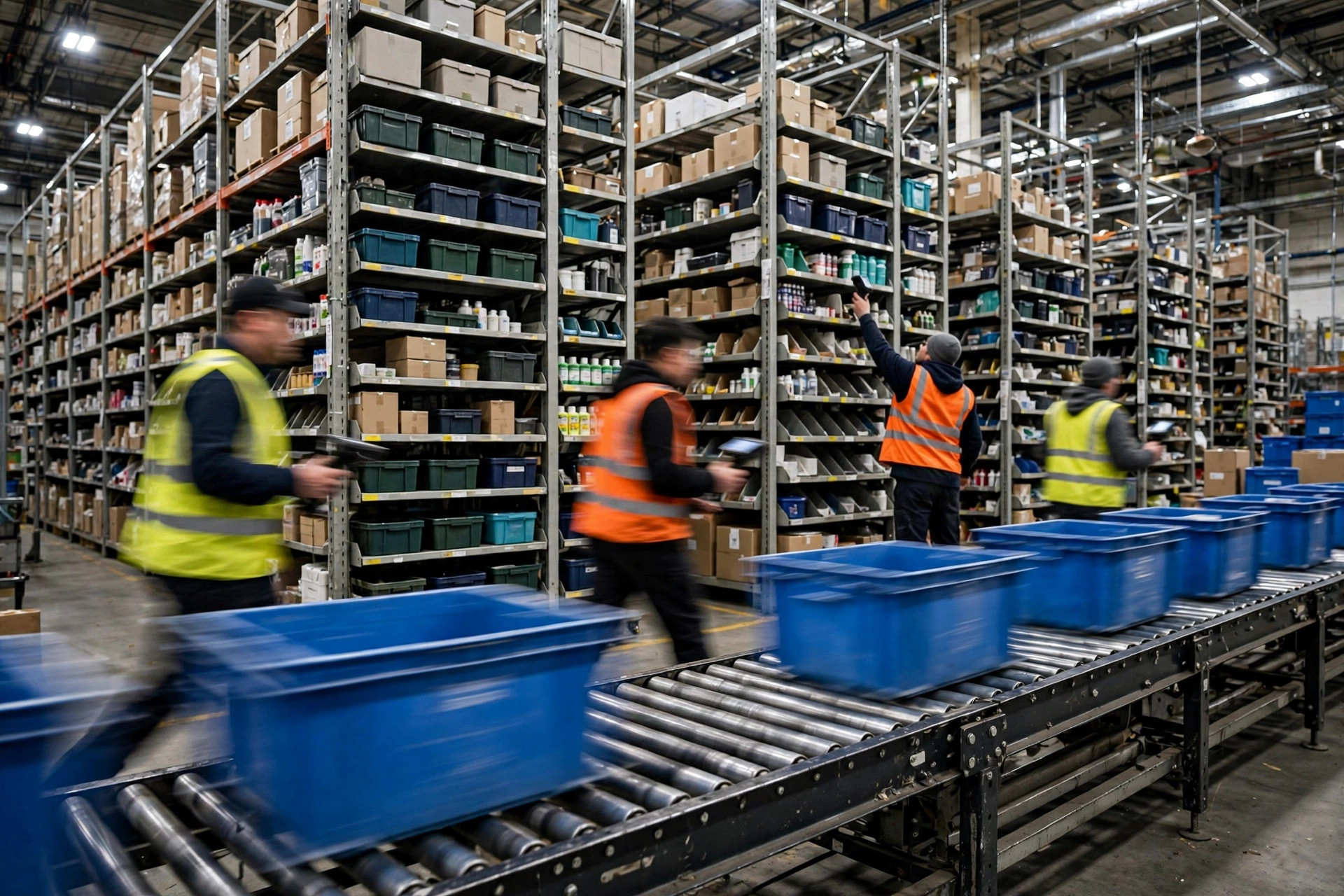
This has been one of the most frequent questions I've heard since 2024. An e-commerce warehouse shipping 3 million orders a year had been running a solid WMS for four years. Then peak season hit: the wave plan looked great on paper, but the floor descended into chaos. Picking Zone A had a long queue while Zone B workers stood idle; a jammed conveyor left AGVs and manual forklifts gridlocked at an aisle intersection. The owner asked me: is our WMS broken? Should we replace it?
My answer: the WMS is fine. What's missing is an execution orchestration layer — that's where WES (Warehouse Execution System) lives. The WMS answers "what do we have, where is it, and by what rules." The WES answers "this very minute, which order goes first, who handles it, and in what sequence so everything flows." One plans; the other conducts the rhythm of execution.
The Core Framework: Four Steps to Draw the Boundary

1. Remember It in One Sentence: WMS Is the Brain, WES Is the Cerebellum
The WMS owns inventory records, slotting strategies, wave planning, and billing — it thinks in hours and shifts. The WES turns plans into floor action: when to release a wave, how much to release, which pick zone goes first, who gets the nearest task — it thinks in minutes and seconds.
An analogy: the WMS is the battle map and the general staff; the WES is the frontline commander. Even the best map can't stop troops from jamming the same intersection without a commander on the ground.
2. The Capability Comparison Table: This One Table Is Enough
| Dimension | WMS | WES | |---|---|---| | Core question | What do we have, where is it, by what rules does it flow | What do we do now, who does it, how do we control the pace | | Time granularity | Hours / shifts | Minutes / seconds | | Typical actions | Wave creation, slotting, cycle counting, billing | Wave release, zone load balancing, task re-sequencing | | With automation | Sends instructions to equipment | Coordinates the takt between equipment and people to avoid gridlock | | Without it | The warehouse can't operate | Congestion at peak, idle hands in valleys — saved only by supervisors' instincts |
3. Three Signals: Does Your Warehouse Need a WES Layer?
- Signal one: more than three types of automation that must work together. Conveyors, AGVs, robotic arms, and shuttles each doing their own thing — the WMS issues instructions but never coordinates their rhythm.
- Signal two: violent wave-volume swings. Peak season at 3x normal volume means fixed-pace wave releases either flood the floor or starve capacity.
- Signal three: chronically unbalanced pick-zone loads. One zone queuing while another idles means you're missing a real-time load-balancing "dispatcher."
If two of the three apply, it's time to seriously evaluate a WES.
4. Deployment Models: Standalone WES vs. Built-in WMS Module
Highly automated mega-warehouses shipping 50,000+ orders a day suit a standalone WES — its neutral orchestration is strongest there. Smaller operations with just conveyors plus manual picking are usually well served by a WES module built into their WMS. Never buy a second system for the sake of a buzzword — first ask your WMS vendor to demonstrate exactly what its task engine can do, then decide.
Field Case: 60,000 sqm 3PL Cuts Travel Distance 22%
A 3PL in eastern China: 60,000 square meters, 40,000 orders a day. Three years on a WMS, the bottleneck was wave release driven entirely by supervisors' gut feel: dump everything at peak and the floor explodes; hold back in valleys and capacity sits idle.
After adding WES-driven dynamic wave release, the system "pull-releases" tasks based on each pick zone's real-time capacity — diverting flow before congestion points form. Three months later: pick-zone travel distance down 22%, order cut-off pushed from 5:00 PM to 7:30 PM — 2.5 extra order-taking hours every day, converting directly into peak-season revenue.
Pitfalls to Avoid
- Don't use a WES as a WMS. A WES doesn't keep inventory records. No WMS, no WES conversation — decorating before the foundation is poured ends in collapse.
- Mind the interface latency trap. If wave-status sync between WMS and WES lags beyond 30 seconds, the execution layer runs "blind" on stale plans. Write the latency SLA into the contract.
- Master data must have a single source. Location, personnel, and equipment masters maintained in one place only — two copies will diverge, and scheduling will send the wrong people to the wrong zones.
A Three-Question Decision Tree
Theory done — at decision time, ask three questions:
| Question | Lean toward built-in module | Lean toward standalone WES | |---|---|---| | Automation level | Conveyors + manual picking only | 2+ automation types (AGV/shuttle/robotics) needing coordination | | Volume peak-to-valley ratio | <1.5, stable wave rhythm | >2.5, promotional explosions | | IT capacity | Team <3, no appetite for another system to maintain | Dedicated team that can own dual-system operations |
Two out of three pointing to standalone WES means start the selection. One more sequencing tip: let the WMS run stable for 6 months first, with inventory accuracy above 98%, before adding WES. A WES is an amplifier — the steadier the WMS, the larger the amplified gain; a messy WMS just gets its chaos executed faster.
The real success metric isn't system sophistication — it's that three months later, supervisors no longer release waves by gut feel. The execution rhythm finally belongs to data.
The Hidden Costs of Standalone WES: Do the Full Math
A standalone WES quote usually shows license plus implementation. The real total has three more lines:
- Dual-system operations. Another system to monitor, patch, and back up — roughly 20% of license cost per year. For a small IT team, that's the straw that breaks the camel's back.
- Master-data sync. Location, personnel, and equipment masters syncing in real time between WMS and WES — the sync pipeline itself needs building, monitoring, and one failure can cause a dispatch incident.
- Organizational cost. With two systems, every incident starts with "which side is it?" — doubling triage time. Write joint vendor troubleshooting SLAs into the contracts.
After the full math, many mid-size warehouses find the built-in module's 80 points good enough versus 95 points at triple the price. Run the 80-point solution for two years; upgrade when automation genuinely outgrows it.
The Takeaway
WMS is the mandatory question; WES is the bonus question. The higher the automation level and the wilder the volume swings, the more a WES pays off. Keep that comparison table in mind: WMS plans, WES conducts the execution rhythm — with the boundary clear, buzzwords can't steer your selection off course.