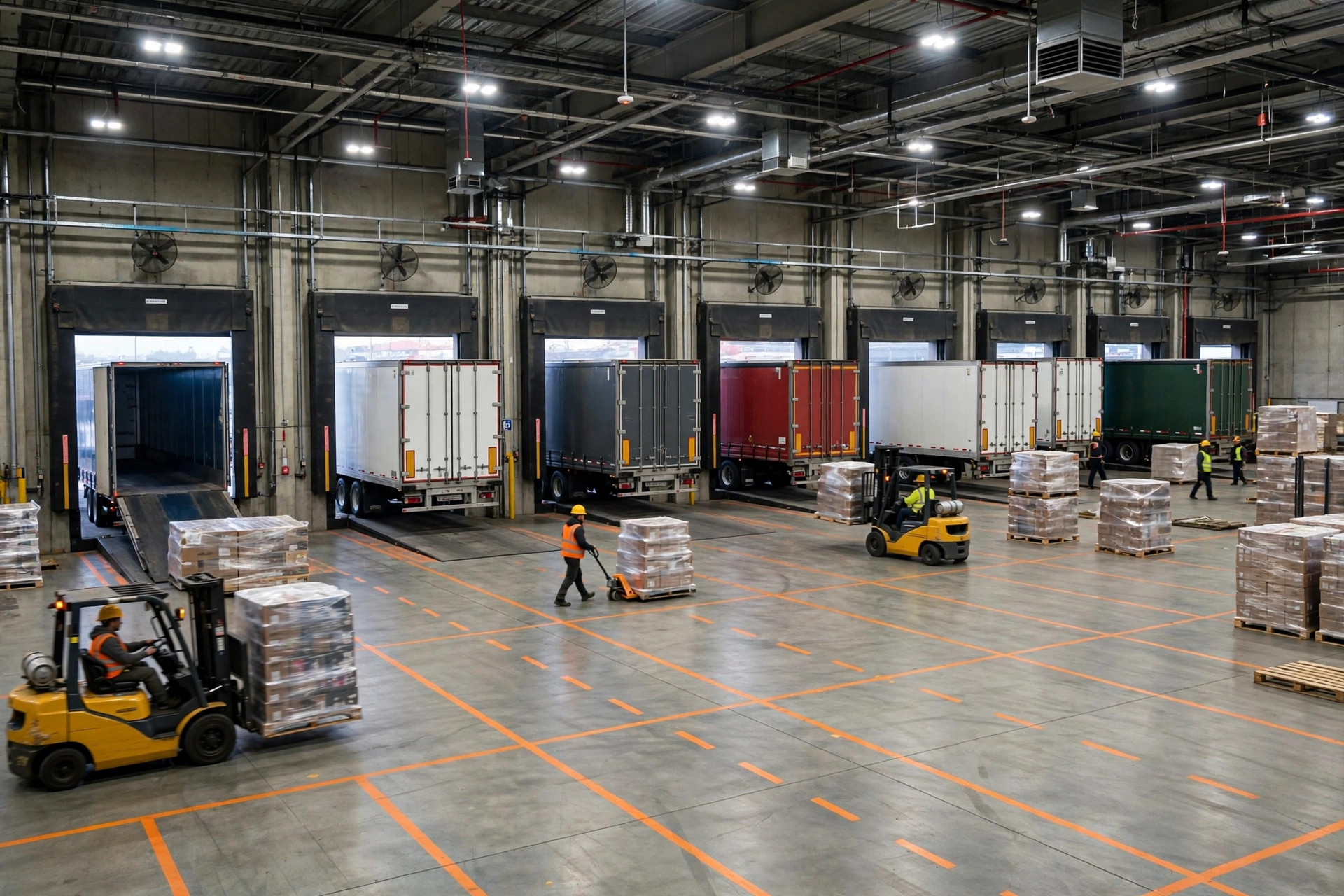
In 2019 I took over an 80,000-square-foot e-commerce warehouse in Rialto, California. The receiving area had four dock doors. Every peak season, five or six trailers sat queued in the yard, and detention fees ran $85 an hour per driver. One month of waiting burned $11,000. The owner asked what adding doors would cost — a full dock door with a leveler runs $25,000 to $30,000 installed, before any structural work. We never added a door. We fixed it with appointments and staggered shifts instead. Dock doors are like that: get the count right during design and you save real money; get it wrong and you burn money every single day.
The Formula
This is the one I have used for years. Ugly, but it works:
Doors = ceil(daily truck arrivals × dock hours per truck ÷ daily operating hours × peak factor)
Four inputs. Here is how to set each one honestly.
Daily truck arrivals: take the average of the last six months of actual check-ins, not the appointment log. In many warehouses those two numbers differ by 20 percent.
Dock hours per truck: not just unloading time. It is unload plus waiting plus clearing the door. A 53-foot dry van unloads in 45 to 60 minutes, but spotting the trailer, checking paperwork, and sweeping the dock routinely eat another 30 to 45 minutes. I use 2 to 3 hours per truck. Counting only the one hour of unloading is the most common underestimate in the business.
Daily operating hours: the hours receiving actually runs. Two shifts means 16 hours. Do not write 24 unless somebody is genuinely unloading at 3 a.m. — inflating this number is lying to yourself.
Peak factor: peak-season arrivals divided by average arrivals. E-commerce buildings usually land between 1.3 and 1.8; I have seen 2.0 in fourth-quarter operations. When in doubt, use 1.5.
A worked example: 14 trucks a day, 2.5 dock hours each, 16 operating hours, peak factor 1.5. That is 14 × 2.5 ÷ 16 × 1.5 = 3.28, rounded up to 4 doors minimum. Note the word minimum — this is the floor, not the comfort line.

The Three Mistakes I See Most
Designing for the average, not the peak. This is the big one. The architect sizes three doors off the annual average, and peak season blows the whole thing up. Dock doors are heavy capital — always design to the peak. The average is just a reference number.
Enough doors, not enough staging. The door count is right, but the staging area behind each door is half a pallet deep. Freight comes off the truck with nowhere to go, so the door becomes a warehouse, the door clogs, and every truck behind it clogs too. My rule of thumb: at least 1.5 to 2 pallet positions of staging depth per receiving door, or work backward from a full truckload — one 53-footer holds 26 pallets, so staging should swallow a full truck plus 50 percent headroom.
Receiving and shipping fight over the same doors. Classic small-warehouse problem: receiving by day, shipping by night, or the same door unloading in the morning and loading in the afternoon. Every switch costs at least 30 minutes of clearing. Two switches a day throws away a full hour of door time. My verdict: once you pass 10 trucks a day, receiving and shipping get separate doors. Do not cheap out on this — switchover losses are bigger than they look.
Cheap Fixes for Older Buildings
Adding doors is expensive. For existing buildings I start with three moves that cost almost nothing:
Appointment scheduling. Force vendors into time windows and turn random arrivals into planned arrivals. The Rialto building cut average truck wait time from 2.7 hours to 40 minutes after going to appointments. A spreadsheet handles it; buy software when the volume demands it.
Night receiving. Many warehouses only receive on day shift while the doors sit idle at night. Push some arrivals to an 8 p.m.–midnight window with a three-to-four-person night crew. That effectively doubles your doors. The extra labor runs about $15,000 a month — an order of magnitude cheaper than building new doors.
Split the day. Give receiving and shipping strictly separate time blocks — say 6 a.m. to 2 p.m. receiving only, 2 p.m. to 10 p.m. shipping only. One switchover per day, minimum clearing loss.
One last thing: the door-count math is grade-school arithmetic, yet I have seen too many warehouses pick their door count by gut feel. Ten minutes, four inputs, one formula — and the number you get may be double what you have today. That gap is exactly what you will pay in detention fees next peak season. Start tomorrow: pull six months of arrival records and run the math.