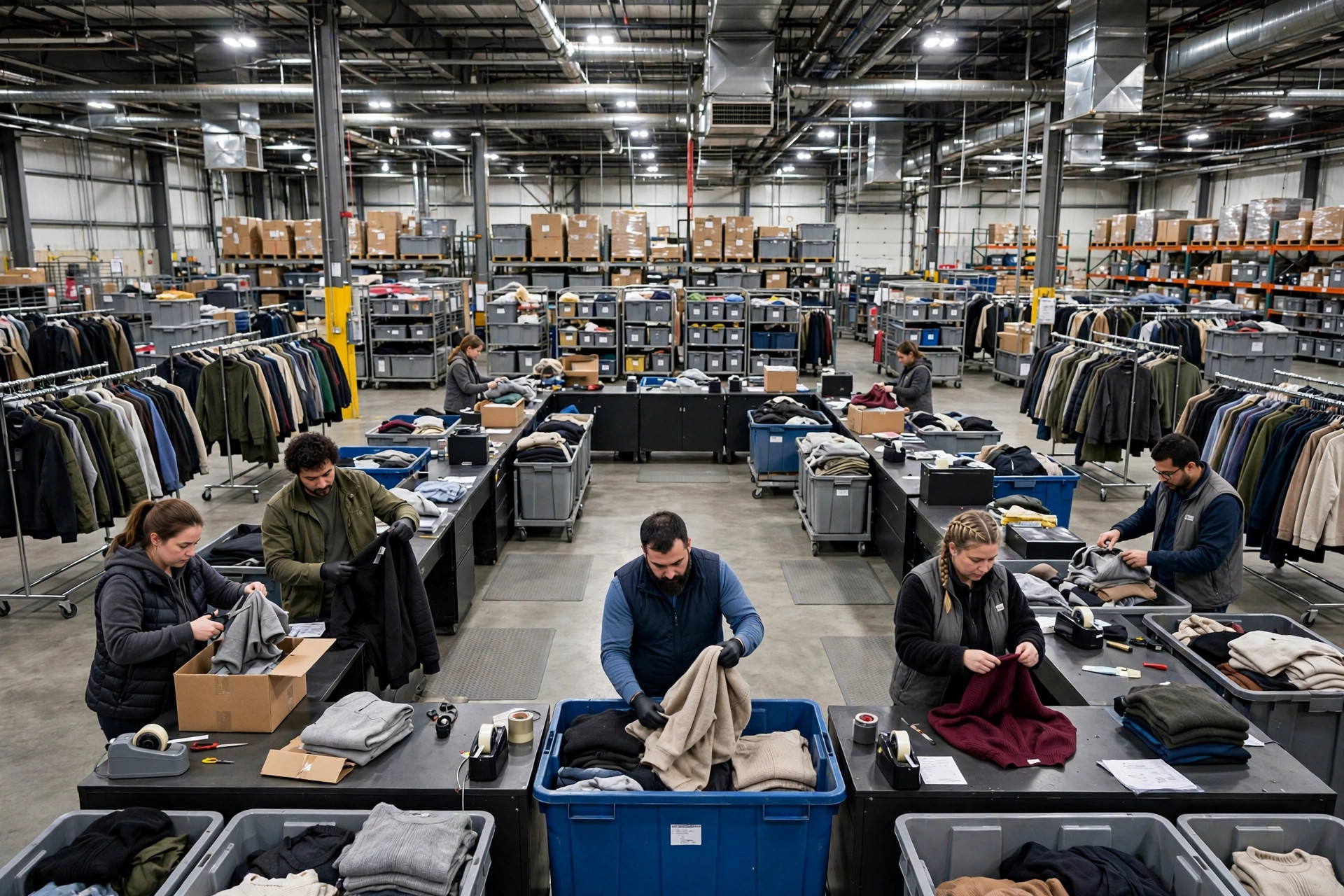
The Setup: Returns Stuffed in a Corner Are Eating Your Margin
In many warehouses the returns area is an afterthought: a taped-off corner of receiving where returns just pile up. Peak season arrives, the pile becomes a mountain, sorters go "archaeology digging" through it, and resalable goods sit two weeks before hitting the shelf — long after their moment passed.
The data stings: every day a resalable return waits to be restocked, its residual value drops roughly 1%–2% (worse for apparel and consumer electronics). Returns processing isn't a cost center — it's a profit recovery center, and done well, one of the highest-ROI zones in the building.
Why Returns Deserve Independence: Three Reasons
Reason 1: The flow runs opposite. Forward logistics moves receiving → storage → picking → shipping in one line; reverse flow goes receiving → sort → (repair/refurbish/scrap) → restock or vendor return, branching repeatedly. Forcing reverse flow into forward aisles is like driving the wrong way on a one-way street.
Reason 2: The work is fundamentally different. Forward work is standardized and batched; reverse work is "unboxing blind boxes" — every return's condition, reason, and disposition differs and demands human judgment. Mixing them means both jobs interfere with each other.
Reason 3: Different skills. Returns sorters need product knowledge and QC judgment, typically earning 15%–20% more than general labor. Mixing high-skill staff into regular picking wastes that premium.
Four Key Design Decisions

1. Location: Hug Receiving, Stay Away from Shipping
Returns enter through the receiving dock (return parcels and inbound freight sharing a dock is simplest), and resalable items go straight back to storage or picking. Keep returns adjacent to receiving and distant from shipping — never let reverse flow cross the whole building. Ideal layout: QC/inbound on the left of the dock, returns processing on the right, forming a tight "reverse loop."
2. Zone Internally by "Verdict," Not by Category
Inside returns, don't sort by "apparel/electronics" — sort by disposition decision across five stations:
| Station | Action | Destination | |---|---|---| | Triage | Unbox, verify, assess condition | Route to stations | | Resalable restock | Clean, re-box | Straight to pick/storage | | Repair & refurbish | Light repair, testing | Repair → re-QC | | Vendor return | Defects, batch quality issues | Vendor-return staging | | Scrap / donate | No residual value | Disposal process |
Arrange the five stations in a U-shape with triage at the mouth to minimize travel.
3. Size from Return Rate, Keep 50% Peak Headroom
Returns area = daily orders × return rate × avg dwell days × footprint per unit × 1.5 (peak factor). Example: 5,000 orders/day, 20% return rate, 3-day dwell, 0.3 m² per unit → at least 5,000 × 0.2 × 3 × 0.3 × 1.5 = 1,350 m². Many warehouses size for the valley and blow up when the post-promo return wave hits — design returns for the peak.
4. System Support: Returns Need Their Own WMS Flow
Physical zoning is only half the job; returns must be "independent" in the system too: dedicated return receipts, per-SKU QC rules preset to resalable/repair/scrap verdicts, and restock priority above normal replenishment. Without system support, even a beautiful returns zone is just a fancy dumping ground.
Case Study: Beauty E-Commerce — Resale Rate from 52% to 81%
A beauty e-commerce warehouse with a 25% return rate used to process returns on two rack rows in a receiving corner. After the retrofit: an 800 m² dedicated returns zone, five verdict stations, plus a small refurbish room (replacing pumps, touching up boxes). The critical change was process: triage SLA compressed from 72 hours to 24, resalable goods flowing back to stock the same day.
Results: resalable rate rose from 52% to 81%, average returns cycle fell from 9 days to 3.2. At 20,000 returns a month, the extra recovered merchandise value exceeded ¥400,000 monthly — the retrofit paid for itself in 3 months.
Pitfalls: Four Returns-Planning Traps
- Mixing returns with inbound flow: return parcels and inbound trucks fighting over one dock will clash at every peak. Split docks once volume justifies it — or at least split time windows.
- "Stack it now, sort it later": the cancer of returns areas. Set SLAs — triage within 24 hours, resalable back in stock within 48. A returns zone without SLAs is a landfill.
- Ignoring hazmat returns: battery- or liquid-containing returns (power banks, perfume) need segregated storage — mixing them is a fire and compliance double risk.
- Vendor returns with no closed loop: vendor-bound goods need their own ledger and aging tracking, or money and merchandise both vanish — many warehouses lose six figures a year to "should-have-returned" leakage.
Takeaway
Dedicated returns planning comes down to one sentence: design reverse logistics as its own production line — its own location, its own flow, its own stations, its own system process, its own SLAs. The faster returns are processed, the faster sleeping inventory turns back into cash. In that sense, the returns area isn't a cost center — it's the most underrated profit center in the warehouse.
Warehousing with Mr. Mi · 20 years of US warehousing solutions