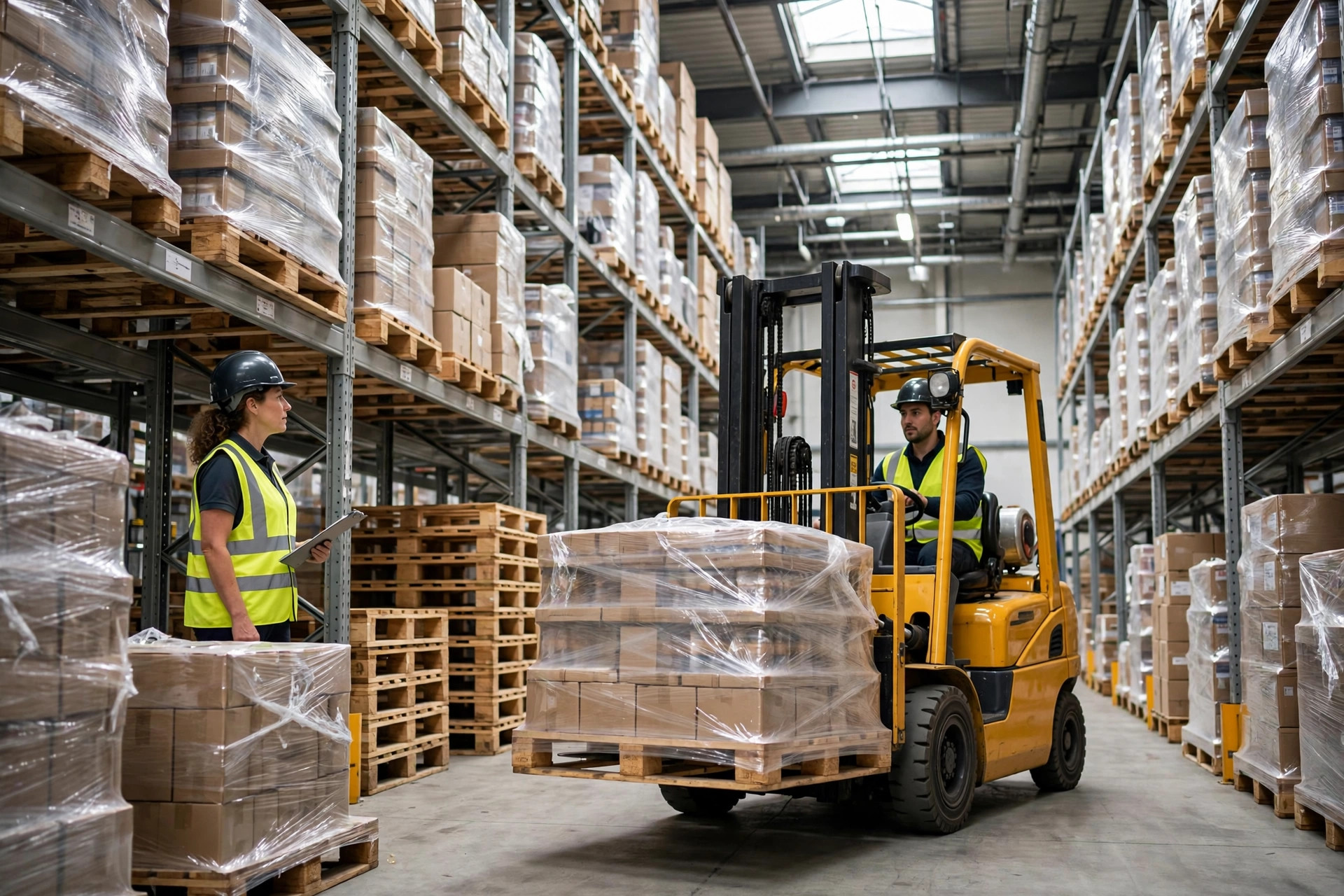
Forklift Certification: Who Needs It and How Often to Recertify
Let me clear up the biggest misunderstanding first: there is no such thing as an "OSHA forklift license." OSHA doesn't issue certifications to operators. What it does — under 29 CFR 1910.178(l) — is hold the employer responsible: every employee who operates a powered industrial truck must complete formal instruction, practical training, and a workplace evaluation before working independently. That card in your driver's wallet? Your employer issued it, not the federal government.
Once you internalize that, everything else falls into place. I learned it the hard way in 2023 at a 3PL warehouse in Riverside, where the owner proudly told me all fourteen of his drivers were "fully certified." The files he showed me were $49 two-hour online course certificates. I told him straight: if OSHA walks in, those are worth nothing — and if someone gets hurt, the insurer will use that file to argue the training was a sham.
Who needs certification: everyone who touches the controls
OSHA's definition of powered industrial truck covers seven classes, and your warehouse probably runs several of them:
- Sit-down counterbalanced trucks (Class I electric, IV and V internal combustion) — the classic forklift
- Reach trucks — the workhorse of narrow-aisle racking
- Order pickers — the ones that lift the operator up with the load
- Rider pallet jacks — many people assume these "don't count." They count.
- Walkie stackers with a mast that elevates loads — also count
The rule is simple: anyone who will operate this equipment in your facility must be trained, evaluated, and certified before touching the steering wheel. Temps, seasonal hires, borrowed drivers — no exceptions. One warehouse I know put a temp driver straight to work because "he's been driving for ten years." The inspector's answer: his ten years are between him and his last employer. Without an evaluation record in your files, he's untrained as far as OSHA is concerned.
The staffing-agency angle trips up a lot of operations. Responsibility follows the work: if an agency driver operates a forklift in your warehouse, the training and evaluation obligation is yours. You can contractually require the agency to send certified drivers, but your files need copies of their training and evaluation records. Otherwise the citation lands on you.
The three steps: instruction, hands-on, evaluation
Compliant training has three parts, and skipping any one of them is what gets people fined.
Formal instruction. Lectures, videos, online courses — all fine. Content must cover truck design and instrumentation, load centers and the stability triangle, daily inspection checklists, pedestrian safety, charging and fueling rules, and accident case studies. Note: an online course only satisfies this step.
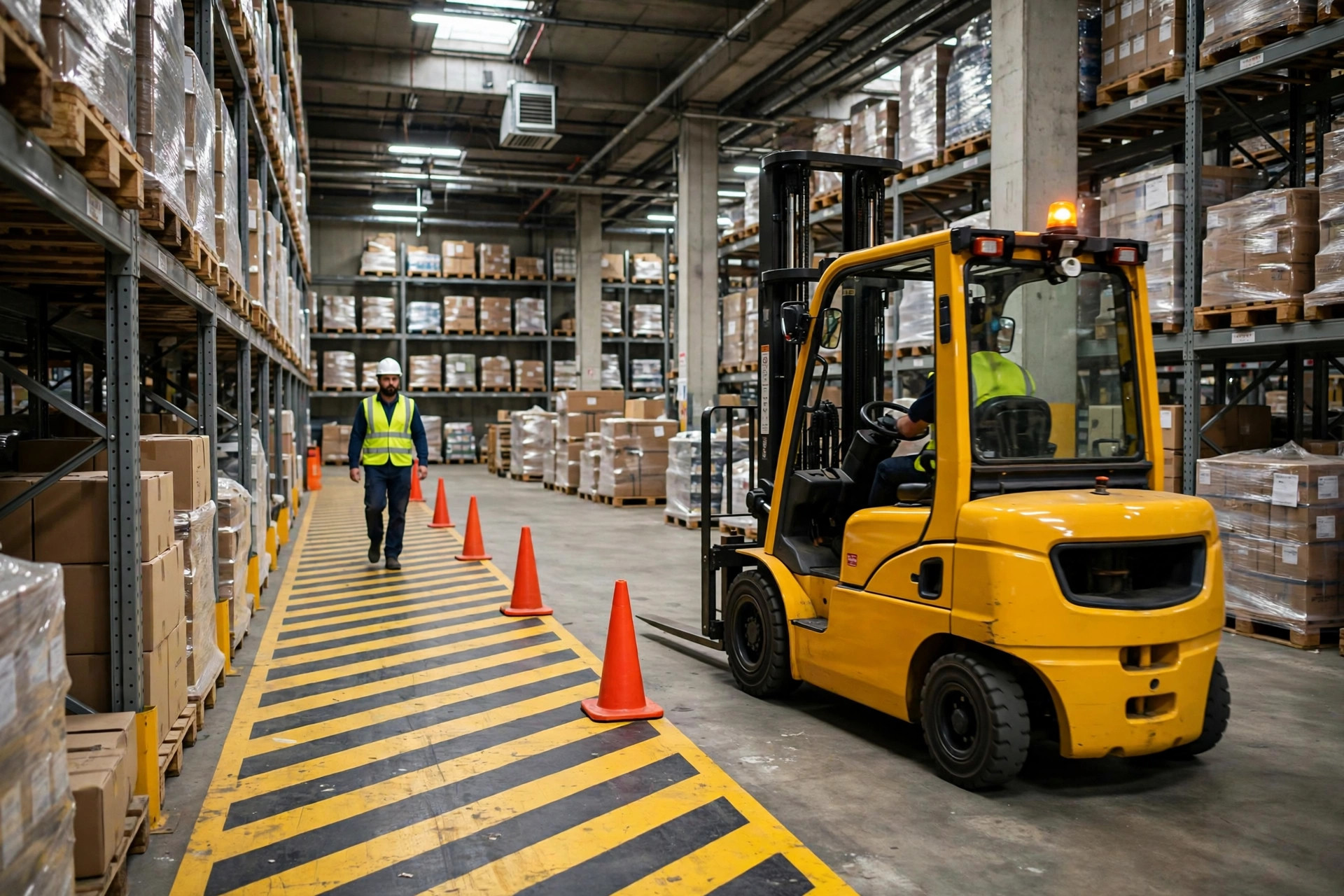
Practical training. Hands-on exercises in the actual work environment, led by someone experienced: maneuvering through cones, entering and exiting racking aisles, high-level picks, ramps, tight turns. Each truck type needs its own session — knowing how to drive a counterbalanced truck does not qualify you on a reach truck. They are fundamentally different machines.
Workplace evaluation. Conducted by someone with sufficient knowledge, training, and experience on the equipment and the job. Pass, and the employer issues the certification — a written record with the trainee's name, training date, evaluation date, and the names of the trainer and evaluator.
The classic trap is treating step one as the whole program. Those $49 two-hour online courses only cover the theory. No practical training, no evaluation. Inspectors spot it instantly: certificate present, evaluation record absent — citation issued, typically in the five-figure range per serious violation. Check OSHA's current penalty schedule for exact numbers.
My recommendation: use a scored checklist for the evaluation, not just a "pass" stamp. Mine has twenty items — daily inspection done, load within load-center rating, looked behind before reversing, slowed in pedestrian zones — each pass or fail, signed at the end. Hand that file to an inspector and they usually stop digging.
Recertification: every three years at minimum, sooner in four situations
The baseline rule: a workplace evaluation at least once every three years. But refresher training is required immediately — regardless of when the last evaluation happened — if any of these occur:
- The operator is observed operating unsafely (speeding, driving with an obstructed view)
- The operator is involved in an accident or near-miss
- The operator is assigned to a different type or model of truck
- Workplace conditions change significantly (new facility, narrower aisles, high-bay racking added)
Items three and four are where most warehouses stumble. Switched to reach trucks, moved from a flat warehouse to high-bay, added a night shift for peak season — all trigger refresher training. My practice: write the triggers into the safety manual, and after any incident, check "was refresher training due?" before assigning blame.

Five things your training file must contain
When OSHA shows up, the first thing they ask for is the files. A defensible forklift training file has:
- The training program outline (what's covered, mapping to the three steps)
- The trainer and evaluator's qualifications (why this person is qualified to evaluate)
- Individual training and evaluation records (name, dates, truck type, result)
- Refresher training records (triggering reason plus content)
- The daily inspection checklist template (proof the inspection habit is real)
With all five in place, the inspector usually flips through a few pages and moves on. Without them, they'll pull drivers off the floor for live evaluations — and that never goes well.
No in-house trainer? Three realistic options
Small operations always ask: we've got five drivers, where do we find a "person with sufficient knowledge and experience" to evaluate? Three answers:
First, bring in a third-party training provider. They come on-site, charge roughly $200–400 per person, and can do a whole shift in a day. Ask one screening question: does the price include hands-on training and on-site evaluation? If they only send a webinar link, walk away.
Second, use your equipment dealer. Whoever sold you the forklifts almost certainly offers training services. Negotiate it into the purchase contract — new truck delivery plus a day of operator training and evaluation is the best deal you'll get.
Third, grow your own trainer. Send your most reliable veteran driver through a train-the-trainer course, and they can run internal training and evaluations going forward. For fleets over fifteen drivers, the math favors this: external training runs thousands per year, while an internal trainer is a one-time investment plus time.
One more detail: training must be truck-type specific. If your warehouse runs both counterbalanced trucks and reach trucks, each operator's record must show evaluations per type. An inspector's favorite question: "Where's his reach-truck evaluation record?" If you can't produce it, he's untrained.
The math
Training one operator through a reputable provider: about $200–400. Doing it internally with a qualified trainer: even less, covering six to eight people a day.
The alternative: a serious OSHA violation runs five figures per item, willful violations higher — check OSHA's current schedule. A single forklift-versus-pedestrian accident routinely costs six figures in medical, settlement, and downtime. I saw a 2024 case where an uncertified temp driver struck a pedestrian; OSHA issued multiple citations, and the insurer dragged its feet on the claim citing failure to train.
My verdict: don't cheap out on forklift training, and don't cut corners. A solid training file is the cheapest insurance you'll ever buy.
Go open your file cabinet this week. If anyone's evaluation is older than three years, or your peak-season agency drivers have empty files, schedule the refresher now. Don't wait for the inspector to find it first.