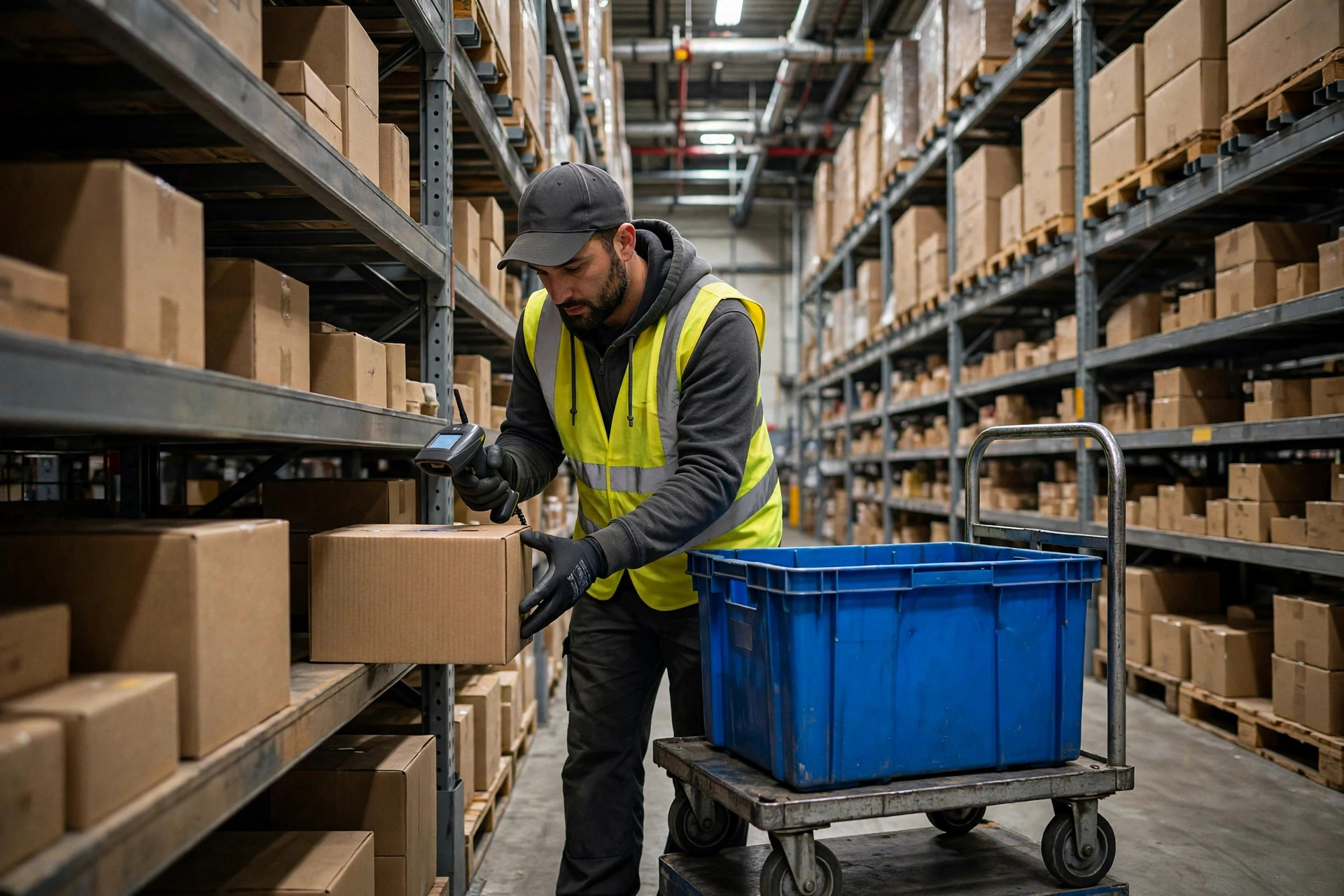
How much does one mispick really cost? Let me give you the number first: $25 to $60. That's a figure twenty years in American warehouses and a mountain of returns taught me — every wrong item you ship costs you return freight, reshipping, labor to process it, customer service time, and the nastiest line item of all: lost customers.
Let me break it down. Back in 2019, I was working with a 3PL in Ontario, California — 120,000 square feet, 23,000 orders a day in peak season, average order value around $30–45. That Q4 we dissected our mispicks and priced out the true cost of a single error.
Return shipping averaged $7–9 round trip via USPS Ground. Reshipping cost another $4–6. Processing the return — receiving, inspection, restocking — took about 12 minutes per order at the then-prevailing California wage of $16.50 an hour, roughly $3.30. Customer service, one email plus one call at a loaded cost of $25 an hour, about $2. Packaging and consumables for the replacement shipment, $1.50. That alone gets you to $18–22.
The real bottomless pit is the bad review and the churn. A single 1-star review on Amazon drags down conversion; from what we measured, a top SKU could lose dozens of sales a day. Even counting direct churn only: a $40 average order at 35% margin, bought six times a year — losing that customer is $84 of margin gone. Never mind what they post on social media.
So the true cost of a mispick, for an ordinary e-commerce order around $40, lands in the $25–60 range. The higher the ticket and the higher the repeat purchase rate, the further up that range you go. Warehouse managers, grab your calculators: 5,000 orders a day at a 2% mispick rate is 100 errors a day. Times $40, over 22 working days — $88,000 a month. Pure loss. Not a cent of revenue in return.
How Speed Incentives Kill Accuracy
A lot of owners do the math and land on piece-rate pay: the more you pick, the more you earn, UPH (units per hour) shoots up, labor cost per order drops. Beautiful. I've watched the other side of it play out. In 2021, an e-commerce warehouse in Dallas raised its pick piece rate from $18 to $22 per hundred lines. UPH jumped from 85 to 112, and monthly labor costs dropped by nearly $24,000. The owner was thrilled.
He forgot to look at the other column. Accuracy fell from 99.5% to 98.1%. That 1.4-point gap, on 6,000 daily orders, meant 84 extra mispicks a day. At $40 apiece, that's $3,360 a day in extra damage — $74,000 a month. He saved $24,000 and lost $74,000. I walked him through the math and he killed the piece-rate plan on the spot.
This isn't an isolated case. A picker's attention is a fixed budget. Push speed up, and the "slow moves" — scan verification, location confirmation, quantity double-checks — are the first things skipped. That half-second RF scan of a barcode is exactly what a rushed picker drops, grabbing by memory instead. Grab wrong, ship wrong. An owner who only measures speed will pay it back double in returns. I've said that for ten years, and nobody has proved me wrong yet.
Speed itself isn't the enemy. It's the sequence that's wrong: lock in an accuracy floor first, then talk about the speed ceiling. My iron rule for clients: 99.5% accuracy is the red line, and no incentive plan gets to touch it. Below that line, the faster you go, the faster you lose money.
Three Cheap Error-Proofing Moves
There are plenty of ways to error-proof a pick operation, but expensive doesn't beat right. For warehouses on a budget, these three are the fastest payback I've ever deployed, and they work in basically any operation doing 2,000+ orders a day:
Move one: RF scan verification on every line. Every SKU gets barcode-scanned at pick, and the system matches it against the order line. This alone kills more than 70% of "wrong item" mispicks. The hardware is just RF guns — $300–500 each, ten pickers, ten guns, $3,000–5,000 one time. Some owners complain it's slow — two extra seconds per scan. Do the math: 5,000 orders a day, 3 lines average, that's 8.3 extra labor hours a day, $150 at $18 an hour. But the mispick rate drops from 2% to 0.6% — 70 fewer errors a day, $2,800 saved. Those two seconds are the best two seconds in warehousing.
Move two: check digits on location labels. Add a check digit to every location barcode so the system validates the position on scan. This one specifically kills the "right SKU, wrong slot" error — lookalike SKUs in adjacent slots, the most common and hardest-to-catch mistake. The investment is near zero: print new labels, flip a config in the WMS, half a day. I rolled this out at an apparel warehouse in 2020, and pure "wrong location" errors dropped from 300+ a month to under 40.
Move three: weight verification sampling at pack-out. Put a scale on the pack bench, keep each SKU's weight in the order data, and have the system flag any parcel whose actual weight deviates past the threshold. Full weighing slows down packing, so I sample: rookies get 100% weighing, experienced pickers 20%, veterans with three straight months above target drop to 10%. An industrial scale runs $200–400, and weight checks cut "wrong quantity" mispicks roughly in half.
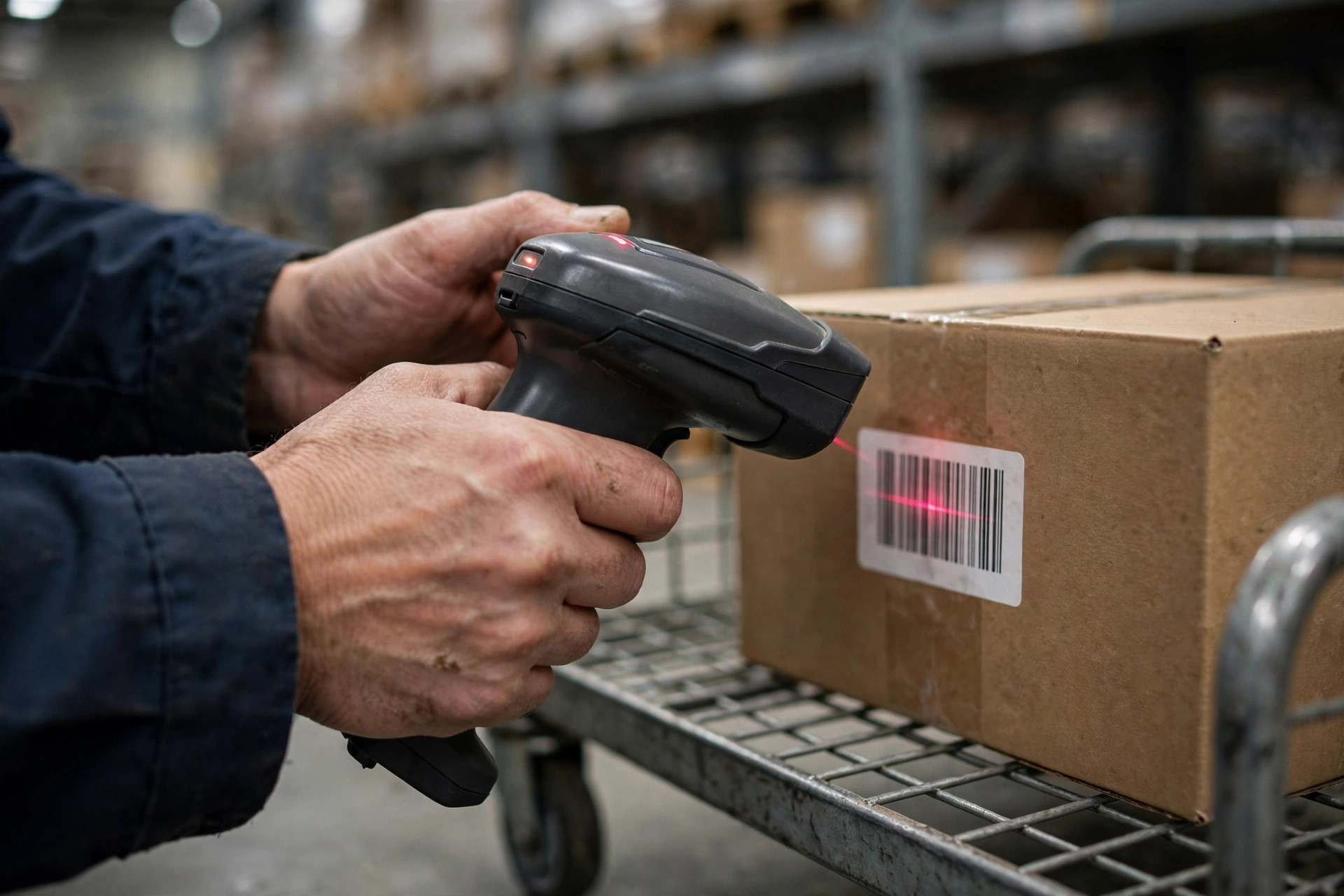
Add all three up: a mid-size warehouse spends under $10,000 one time and under $3,000 a month in extra labor, and saves tens of thousands in mispick costs. The ROI speaks for itself.
A Real 3PL Turnaround
In 2022, a 3PL in Chino, California came to me. Mid-size — 80,000 square feet, fulfilling for 30-plus e-commerce brands, about 7,000 orders a day. Their pain was textbook: performance reviews were 100% tied to UPH, pickers averaged a handsome 108 UPH, but accuracy sat at 98.2%. Customer complaints were burying the service team, and two big clients were already talking about leaving.
I changed three things. First, reweighted the scorecard: 60% accuracy, 40% UPH, with a hard rule — accuracy below 99.3% zeroes out the month's bonus, no exceptions. Second, tiered standards: rookies (under 3 months) at 99.0% accuracy and 70 UPH; experienced pickers at 99.5% and 95 UPH; star pickers above 99.8% at 110+ UPH earning a $2/hour premium. Third, the three error-proofing moves above: full RF line verification, location check digits, and weight sampling at pack-out.
The first month looked ugly. UPH dropped from 108 to 92, and the pick supervisor nearly lost it with me. But accuracy climbed from 98.2% to 99.1%. Month two: UPH back to 99, accuracy 99.4%. Month three: UPH 105, accuracy 99.6%. Target hit.
The three-month numbers: mispick rate from 1.8% to 0.4%. At 7,000 orders a day over 22 days, that's 2,156 fewer errors a month. At $40 each — $86,000 a month in mispick costs avoided. The price was three extra pickers during the UPH dip, about $16,000 a month in labor. Net savings: $70,000 a month. The big client that was about to walk stayed — a $4M+ annual contract.
I tell this story a lot, and it comes down to one line: your scorecard is your steering wheel — people give you whatever you measure. Measure only speed, and they'll give you speed, with accuracy thrown in the trash.
Three Things You Can Do Tomorrow
No system upgrade needed, no budget approval — put these on tomorrow's morning huddle. First, pull your last three months of mispick rates, multiply by $40, and post the real monthly loss on the warehouse bulletin board so everyone sees it. Second, add an accuracy red line to the scorecard — start at 99.3%, and anyone below it loses the month's bonus no matter how fast they picked. Third, audit 20 locations for lookalike SKUs sitting in adjacent slots; if you find any, move them apart this week. That one's free.
Accuracy and speed aren't enemies. Get the sequence wrong, and they are. Lock in the 99.5% floor first, and speed will grow on top of that foundation. Trade accuracy for speed, and every dollar you gain will be collected back — with interest — by returns.