
Workplace Injury Reporting in Warehouses: The 3 Most Common Injuries and How to Prevent Them
Last November, a 3PL warehouse in Riverside that handles e-commerce fulfillment showed me their problem: an injury rate well above peers, and the insurer threatening a 30% premium hike. Ten minutes with a year's incident records told the story: 11 recordable injuries — 8 back strains and sprains, 3 slips and falls — the same old problems on repeat. Not one properly investigated; the "corrective action" column on nearly every report was blank.
Here's my verdict up front: most warehouse injuries aren't bad luck — they're the same hole you keep stepping into. Reporting and recordkeeping aren't just about surviving an OSHA inspection. They're the cheapest accident-prevention tool you have — but only if you record by the rules, report on time, and actually read what you wrote.
The 3 injuries I see over and over in warehouses
Overexertion and strains from manual handling. This is the undisputed number-one cause of warehouse injuries, year after year. The classic scene: a picker handling 400 to 500 cartons per shift, lifting 20-to-35-pound boxes from the floor to waist-high racking, hundreds of repetitions a day. During peak season, on day nine of overtime, a young worker bent down for a carton of returns and felt something snap in his lower back — a herniated disc, six weeks out. Prevention isn't complicated, but it has to be real: heavy items go in the waist-high "golden zone," floor and top levels stay light; add hydraulic lift tables and turntables in pick areas; rotate stations every two hours; train new hires on lifting posture in their first two weeks and keep them off the floor until they pass. The math is simple: a lift table costs a little over $800, while one back injury easily tops $40,000 in direct and indirect costs.
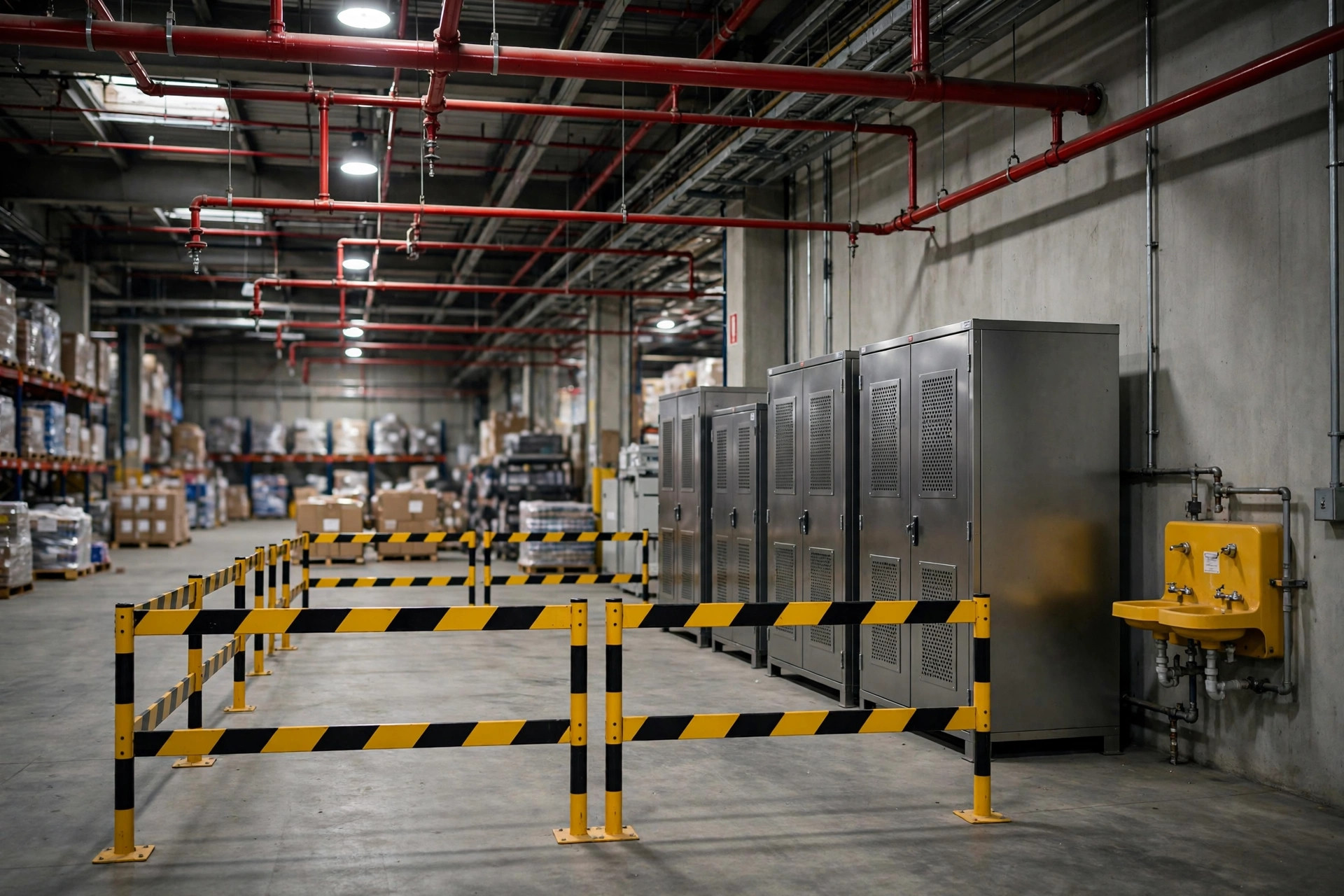
Forklift-related struck-by incidents. The forklift is the most dangerous piece of equipment in any warehouse, full stop. Two scenarios keep recurring: a forklift clipping a pedestrian picker at a blind aisle corner, and a forklift driving off the edge of a loading dock — which is almost always a severe injury when it happens. Prevention comes down to three hard rules: separate people from machines, with pedestrian walkways marked in yellow and convex mirrors plus speed bumps at every crossing; horn-and-slow at every turn, with blue spotlights fitted so pedestrians see an approaching forklift's beam 10 to 12 feet early; certify every operator and retrain at least every three years as OSHA requires — one unsafe act and the keys come back until retraining is done, no exceptions. On the dock, wheel chocks and trailer restraints are the bare minimum, and no forklift enters a trailer until the driver gives the all-clear signal.
Slips, trips, and falls. The most underestimated category, and the easiest to dismiss as "the worker wasn't careful." Real scenes: pallet splinters on the aisle, stretch-wrap tails on the floor, a small puddle of hydraulic fluid from a leaking forklift, rainwater tracked into the dock area. I handled one case where a night-shift worker stepped on a broken pallet board and fractured an ankle — three weeks lost. Prevention is about daily habits, not big spending: build a "see it, pick it up" 5S culture where floor debris gets cleared within five minutes; put anti-slip mats at dock entrances and "wet floor" signs out during rainy season; pull damaged pallets the same day and never let them back into circulation; report a forklift oil leak the day it appears, not next week.

My recommendation: fold these three categories into a monthly safety walkthrough — lifting posture, forklift aisles, floor debris, fifteen minutes, write down what you find. The walkthrough log is your best prevention evidence: if something happens, it proves due diligence; if nothing happens, it closes gaps before they bite.
OSHA recordkeeping, decoded: the 300, 301, and 300A
Many warehouse managers confuse "reporting" with "recordkeeping." They're two separate tracks: recordkeeping goes on your own OSHA forms; reporting means notifying OSHA by phone or online. Here's how the rules work — when in doubt, check the latest policy on OSHA's official site:
OSHA 300 Log: Every recordable injury or illness goes on the 300 Log within 7 calendar days of learning about it. Calendar days, not business days — weekends count. What counts as "recordable"? The bright line: medical treatment beyond first aid, days away from work, restricted work or job transfer, loss of consciousness, or a significant injury diagnosed by a physician. A Band-Aid and an ice pack — first aid only — doesn't get recorded.
OSHA 301 Incident Report: Every case on the 300 Log needs a detailed 301 report, also within 7 days. The 301 captures what happened, how it happened, the body parts affected, the objects or substances involved, and the medical outcome. This is the document OSHA inspectors read first, so make it specific — "employee injured" tells them nothing.
OSHA 300A Summary: Once a year, summarize the 300 Log into the 300A, have a company executive certify it, and post it where employees can see it from February 1 through April 30 — a full three months. Keep all records for five years. Some employers must also electronically submit 300A data to OSHA by March 2 each year; whether that applies to you depends on your establishment size and industry code, so verify on OSHA's site.
Severe-injury reporting (this is reporting, not recordkeeping): A work-related fatality must be reported to OSHA within 8 hours; an in-patient hospitalization, amputation, or loss of an eye within 24 hours. Call 1-800-321-6742 or report online. No exceptions — this applies to every employer regardless of size.
What late reporting actually costs you
I've watched too many warehouses learn this the hard way. The real price list:
- Fines stack per violation. OSHA's 2026 penalty levels: up to $16,550 per serious violation, up to $165,514 per willful or repeated violation. Each unrecorded case on your 300 Log can be its own violation — the numbers add up fast.
- Missing the severe-injury window hands OSHA a loaded citation. Failing to report a fatality or hospitalization on time is its own violation, and it can be classified as willful if OSHA decides you knew the obligation and ignored it.
- It invites a full inspection. One late-reported serious injury can trigger a comprehensive OSHA visit — and once inspectors are in the building, they don't limit themselves to that one incident.
- Workers' comp gets messy too. Drag your feet on the claim and the insurer may question whether the injury is really work-related, delaying or denying benefits. You'll pay for the dispute either way.
- Broken trust is the hardest to repair. When an injured worker discovers the company didn't even record the incident promptly, the first thought is to call a lawyer. I've seen minor injuries turn into major lawsuits, and it always starts with "the company didn't care."
The workers' comp filing process is straightforward, but timing is everything: the employee reports the injury to a supervisor and gets medical care immediately (state reporting deadlines vary — some states allow up to 30 days — but sooner is always better); the employer promptly provides the claim form and helps complete it; medical records, the incident account, and witness information get documented; the insurer investigates and decides on benefits. Remember: workers' comp is the insurance track, OSHA recordkeeping is the compliance track. Run both — filing a comp claim doesn't replace your 300 Log.
An injury-reporting checklist you can use tomorrow
Print this and pin it in the office. When something happens, work the list:
- Within 1 hour: People first — call for medical help. Secure the scene, take photos, note witness names.
- Within 24 hours: Complete the internal incident report. Decide whether OSHA severe-injury reporting is triggered (fatality: 8 hours; hospitalization, amputation, eye loss: 24 hours) — make the call if it is.
- Within 7 days: Log it on the 300 and finish the 301 report. Unsure whether it's recordable? Record it first — you can line it out later if it turns out not to be. The fine for a missed record dwarfs the cost of an extra line.
- Ongoing: Track treatment and return-to-work status; keep the days-away count current.
- Every year by February 1: Summarize the prior year's 300 Log, get executive certification on the 300A, and post it February 1 through April 30.
- Long term: Retain everything for five years. Employees have the right to review the records — don't hide them.
One thing you can do Monday morning: spend 20 minutes counting last 12 months of 300 Log entries by injury type. (If you don't have a 300 Log yet, start one today.) If back strains dominate, your rack height zoning and lifting training aren't working. If slips and trips keep recurring, your 5S walkthroughs are theater. The numbers don't lie — they'll tell you exactly where next month's safety budget should go. In injury management, prevention is always cheaper than reporting, and reporting is always cheaper than the fine.
(This article is general practical guidance, not legal advice. Verify specific regulatory requirements against the latest policy on OSHA's official website.)