
Here's an underappreciated number: Kohl's does roughly $3 billion in annual online revenue, and its third-party marketplace only graduated from pilot to full launch in late 2024. A freshly opened marketplace, categories not yet crowded, armed with the Kohl's Cash conversion machine — competing here costs a fraction of competing on Amazon. If you sell to middle-American households, ignoring Kohl's now means paying triple to squeeze in later.
What this platform actually is
Kohl's is a legacy American department-store chain whose strengths are apparel, home, baby, and toys — household essentials. Its marketplace runs on the same Mirakl foundation as Macy's, with the same curated logic: hand-picked sellers, third-party listings blended into the main site behind a small badge. Launch categories span men's and women's apparel, sports and fitness, pet supplies, home, toys, baby gear, and electronics, already at thousands of SKUs and expanding fast.
Kohl's holds two weapons other platforms don't. First, Kohl's Cash: shoppers earn and redeem Kohl's Cash on marketplace purchases — a "the more you buy, the more you get back" mechanism that locks in price-sensitive households. Third-party orders participate fully. Second, in-store returns: marketplace items can be returned at any Kohl's store nationwide. For buyers that's convenience; for sellers it's conversion — "I can return it down the street" cuts purchase hesitation in half.
One more detail: shoppers can pay with the Kohl's credit card and accumulate loyalty rewards on marketplace orders. The full membership machinery is open to third-party transactions, which isn't a given on curated marketplaces.
Where the bar sits
Like Macy's, Kohl's is curated — brand fit is the first filter. Its customer is the American middle-class household, shopping "affordable quality of life." Luxury positioning doesn't fit; neither does rock-bottom white label.
Hard requirements mirror the department-store set: US business entity, tax documentation, brand authorization chain, product catalog. Kids and baby categories need CPSIA compliance; electronics need FCC certification. Teams that have done Macy's onboarding can largely reuse the same dossier.
The hidden bar is price architecture. Kohl's shoppers are extremely price-sensitive and trained to wait for Kohl's Cash events. Your pricing must leave room for promotions: everyday price, event price, clearance price — all three tiers, no exceptions.
Getting in, step by step
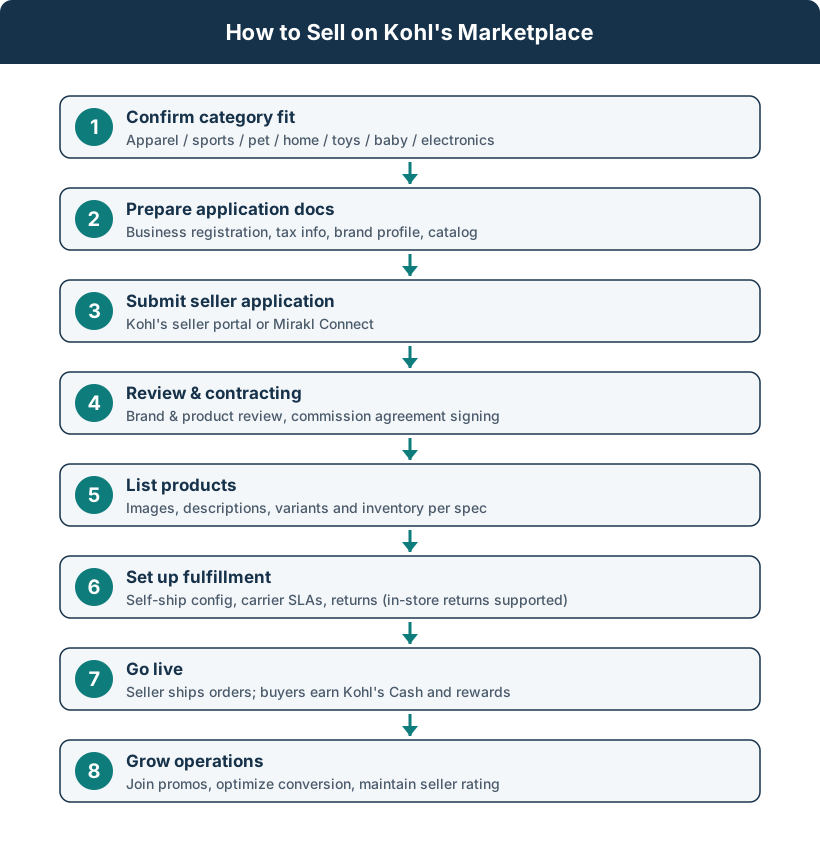
Apply through Kohl's seller recruitment entry or Mirakl Connect. Already selling on Macy's, Nordstrom, or other Mirakl platforms? Same portal, same product data — migration cost is minimal. That's the friendliest part of the Mirakl ecosystem for sellers.
In review, Kohl's cares deeply about category planning. It's in growth-hunting mode and has said publicly it's recruiting across apparel, sports, pet, home, and toys. If you sit in one of its target categories, approval odds run higher than in mature ones. Write your category growth plan into the application — it carries more weight than brand storytelling.
At listing, mind the variant structure. Apparel and footwear size-color variants must hang under one parent; split variants get bounced in review. Launch with 30–50 core SKUs, prove out the full order-logistics-returns loop, then scale.
Running the numbers
Kohl's doesn't publish commission rates — they're set by category at contracting, so confirm the latest official policy before signing. The model below uses typical curated-marketplace levels.
Say you sell women's casual apparel at $38 average order, 2,500 orders a month, $95,000 in monthly sales. Assume 15% commission: $14,250. Cost lines: fulfillment (self-ship, ~$6 per order: $15,000), returns (apparel at 18%: ~$8,000 in return freight and damage), Kohl's Cash cost-share (sellers typically share the cost of Kohl's Cash events — budget 3% of sales: $2,850), onsite ads (4%: $3,800).
Monthly contribution: roughly 95,000 − 14,250 − 15,000 − 8,000 − 2,850 − 3,800 = $51,100 before product cost. With COGS at 35%, true net margin lands near 19%. Notice the two lines rookies most often forget: the Kohl's Cash share and returns. Both must be baked into pricing.
Tactics that work
First, dance to the Kohl's Cash calendar. Kohl's runs fixed Kohl's Cash issuance cycles all year; conversion can double during events. Have event pricing and inventory ready ahead of time, and don't be shy about pushing volume during events — that's lesson number one in the Kohl's playbook.
Second, treat in-store returns as a conversion tool, not a cost center. The "returnable in store" badge on your listing measurably reduces purchase hesitation. Price the return cost in; never put return friction on the page.
Third, family packs and multi-packs sell. Kohl's shoppers buy for the whole household in one trip — multi-packs carry better average order values and conversion than single units.
Fourth, perfect your size charts. Wrong fit is the number-one driver of apparel returns. Model height and weight, measured dimensions, "runs large/small" guidance — getting this right can shave 3–5 points off your return rate, which is pure profit.
Fifth, reuse the Mirakl ecosystem. One portal managing multiple platforms — product data, inventory, and orders unified. SKUs already listed on Macy's port to Kohl's with only content adaptation; marginal cost is low.
Pitfalls to avoid
Pitfall one: the Kohl's Cash cost-share. When joining platform events, nail down the cost-sharing ratio at contracting. Every year, rookies discover post-event that Kohl's Cash ate half their margin.
Pitfall two: promo dependency. Kohl's shoppers are trained to wait for events — if your everyday price is too honest, there's no room to discount during events. Price with a promo buffer built in; Amazon's everyday-low-price logic doesn't apply here.
Pitfall three: returns routing. In-store returns don't mean returns aren't your problem — store-collected returns flow back to your returns warehouse for processing. Confirm the full reverse-logistics path with Kohl's before launch, not after returns pile up.
Pitfall four: the category-expansion trap. Kohl's is hungry for growth and your recruiter may encourage more categories. But each new category means new supply chain, new content, new support costs. Win one category outright before expanding.
Fulfillment and warehousing: how to set it up
Kohl's Marketplace is seller-fulfilled — fulfillment is your battleground.
Kohl's customer base is heavily "middle America" — not concentrated on the coasts like some platforms. A single LA warehouse shipping to the Midwest takes 4–5 days and fails the experience bar. Go three-node, or at minimum two: West (LA/Phoenix), Central (Chicago/Dallas), East (Pennsylvania/New Jersey) for 3-day national coverage. On a budget, start with two and let Dallas cover the central and southern states.
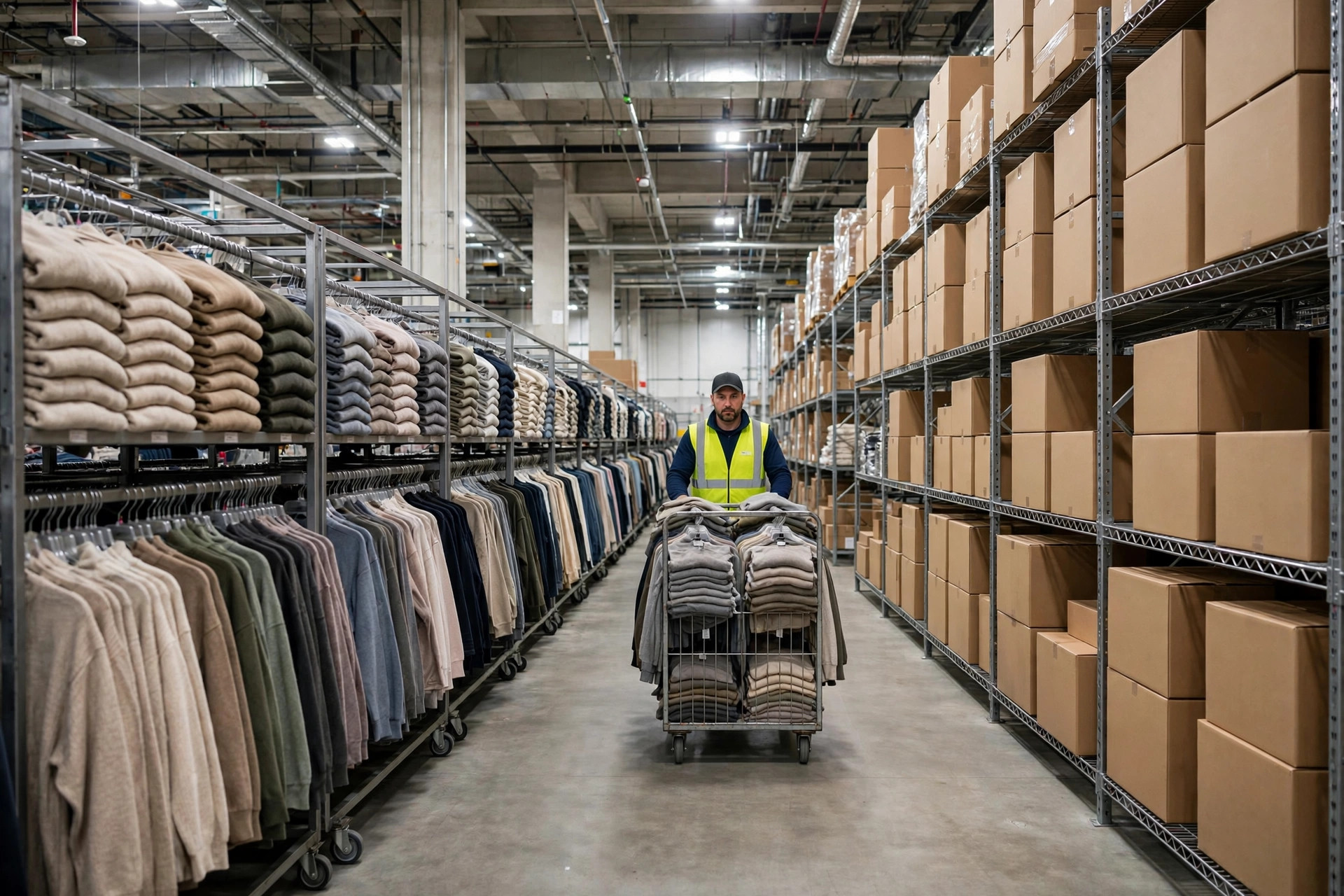
Apparel warehousing has special demands: hanging-garment zones, QC stations, hangtag swapping, steaming — value-added services generic e-commerce warehouses don't offer. When vetting a 3PL, ask directly about apparel-category experience; a blank stare means walk away. Returns processing is the core competency for apparel: A-grade restocked within 48 hours, B-grade to discount channels, C-grade written off — grading standards belong in the 3PL contract.
For overseas inventory, run the classic model: full-container ocean to LA, deconsolidate, then allocate by regional sales forecast. Kohl's promo calendar is fixed, so inventory can follow the Kohl's Cash schedule: ocean freight 75 days ahead of major events, air top-ups 45 days ahead of smaller ones. In your WMS, build dedicated waves for Kohl's — its pack requirements (branded tissue, thank-you cards) stay segregated from other platforms.
One action for tomorrow: search your category on kohls.com and count third-party sellers and their review volumes. If a sub-category has fewer than 20 third-party sellers, congratulations — you've found a traffic pocket. Windows like that typically last 12–18 months. And before you move, get Kohl's full-year promo calendar; planning inventory around its rhythm is the highest-leverage move you can make.