

In September 2022, 164-year-old Macy's did something few expected: it opened a third-party seller marketplace on macys.com, launching with 400+ brands across 20+ categories. A legacy department store started playing Amazon's game. Three years on, that curated marketplace has become one of the smoothest on-ramps for brands targeting America's middle-class shoppers — provided your brand can pass the buying team's taste test.
What this platform actually is
Macy's Marketplace runs on Mirakl's technology, and at its core it's a curated marketplace — admission by selection, not by payment. That's the opposite of Amazon's open-bazaar logic: Macy's team hand-picks brands and categories one by one. Apparel, beauty, home, baby, toys, pets, and small appliances are all in scope; launch brands included names like Sony and L'Occitane.
For shoppers, third-party products sit seamlessly alongside Macy's own assortment, marked only by a small "shipped by seller" badge. Buyers still earn Star Rewards points and get easy returns. That seamless experience is what Macy's guards most fiercely — and it's the price sellers pay: your fulfillment and service standards must live up to a century-old department store's reputation.
One telling fact: Macy's 10-Q filings state that commissions from licensed departments and the digital marketplace remain immaterial to net sales. Translation: the platform is still in investment mode, which makes this a window for early sellers — categories aren't crowded yet, and traffic allocation is relatively generous.
Where the bar sits
Macy's reviews brand fit first. It doesn't care about your Amazon monthly revenue; it cares whether your brand belongs in front of its customer base. Fast-fashion white labels and price-chasing me-too products have no oxygen here.
The hard requirements: a US business entity, tax documentation (W-9 or W-8), a clean brand authorization chain (you're the brand or an authorized distributor), and a complete product catalog. Beauty and personal care need FDA-relevant compliance; children's products need CPSIA certification.
The hidden bar is content capability. Macy's demands department-store-grade product content — not Amazon white-background basics. Model shots, lifestyle imagery, detail close-ups are all table stakes. Budget for photography before you apply.
Getting in, step by step
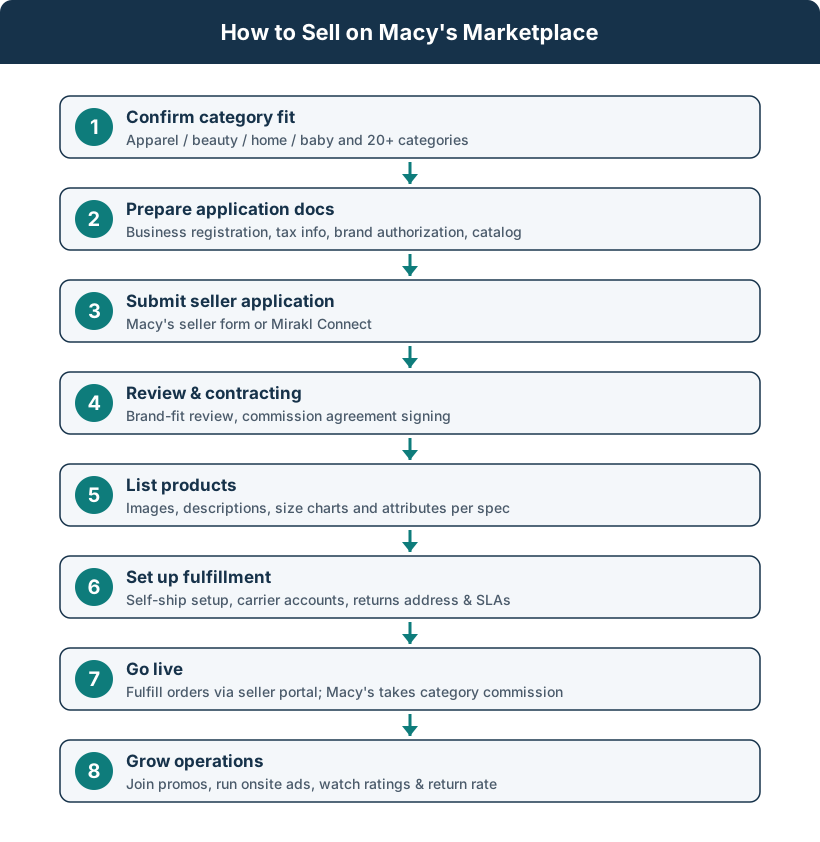
Apply through the seller page on Macy's website, or via Mirakl Connect — if you already sell on other Mirakl-powered platforms like Nordstrom or Best Buy, the same portal cuts your setup work dramatically. Mirakl cites an average of 23 days from onboarding to first sale across its network.
Brand fit dominates the review. From experience: a crisp two-page brand brief — target customer, price positioning, performance in other channels — beats a 100-SKU dump. Macy's wants brands that make its shelves look better.
After signing, don't rush to list everything. Study the content specs first — Macy's product review is meticulous about image dimensions, description formats, and attribute completeness, and non-compliant listings get bounced. Launch with 20–50 hero SKUs and get the full flow working before scaling to hundreds.
Running the numbers
Macy's publishes no commission table — rates are set by category at contracting, so confirm against the latest official policy before signing. The model below uses typical curated-marketplace levels for illustration.
Say you sell mid-tier home fragrance at $45 average order value, moving 1,500 orders a month for $67,500 in monthly sales. Assume a 15% commission: $10,125 to the platform. Then deduct fulfillment (self-ship at roughly $7 per order: $10,500), returns (department-store shoppers return a lot — budget 12%, about $4,000 in return freight and damage), and content plus onsite advertising (5% of sales: $3,375).
Monthly contribution comes to roughly 67,500 − 10,125 − 10,500 − 4,000 − 3,375 = $39,500 before product cost — about 58% (pre-COGS). With COGS at 40%, true net margin lands near 18%. This model only holds if returns stay controlled — the department-store return habit is the biggest variable in this business.

Tactics that work
First, ride Macy's promotional calendar. Its anniversary sales, Black Friday, and holiday season drive national-level traffic. Get promo submissions and inventory locked 60 days ahead. Third-party sellers can participate in site-wide events — that's the most tangible early-seller perk of a curated marketplace.
Second, treat Star Rewards as a conversion lever. Macy's loyalty program is sticky, and whether your listing accrues points directly affects click-to-buy. After launch, verify the rewards badge displays correctly — it's not automatic everywhere.
Third, don't skimp on content. Department-store shoppers buy "texture and feel" — lifestyle hero images and usage-scenario detail pages convert far better than plain white-background shots. This money is well spent.
Fourth, staff customer service to department-store standards. Macy's buyers expect department-store service; response times beyond 24 hours visibly lift negative review rates. Hire a dedicated rep or outsource to a team that knows this customer.
Fifth, write a generous returns policy. Macy's is famous for easy returns — if your policy is stricter than the platform's, conversion suffers. Price the return cost in instead of betting customers won't return.
Pitfalls to avoid
Pitfall one: the commission and "initial fees." Macy's has referenced an initial cost to start selling; confirm the exact figure at contracting. Any broker asking for tens of thousands in "deposit" upfront is a scam — walk away.
Pitfall two: category mismatch. This is a curated platform — great products in the wrong category don't get in. Before applying, search your category on macys.com and check whether third-party sellers already operate there. It's the fastest validation available.
Pitfall three: the content-rejection loop. The classic rookie death is listings bounced repeatedly in product review, burning two to three months before going live. After signing, get the full content spec document from your onboarding manager and check every line before submitting.
Pitfall four: underestimating returns. "Buy many, return some" is normal for department-store shoppers — apparel return rates can push past 20%. Returns must be priced into your retail price, or the more you sell, the more you lose.
Fulfillment and warehousing: how to set it up
Macy's Marketplace is seller-fulfilled — the platform doesn't touch your inventory. That makes fulfillment entirely your battlefield, and it's where sellers separate from each other.
Speed is requirement number one. Macy's shoppers expect department-store delivery; parcels taking 5–7 days get buried in bad reviews. Go bi-coastal at minimum: New Jersey or Pennsylvania covering the dense East Coast, LA covering the West, with 2–4 day delivery as the passing grade. On 3PL selection, prioritize apparel-category experience — hanging-garment handling, QC, hangtag swapping, and other value-added services that generic e-commerce warehouses can't do.
Returns are requirement number two. Macy's buyers return to you directly, so your returns warehouse must work in lockstep with outbound: inspection, restock, defective disposition. Returns processing can run 3–5% of sales. My recommendation: write restock SLAs into your 3PL contract — A-grade back on sale within 48 hours, B-grade to clearance channels, and never let returns sleep in the warehouse.
For overseas inventory, run the classic playbook: full-container ocean freight with West Coast deconsolidation and regional allocation. Apparel and home goods cube out fast, so ocean's cost advantage is massive. Plan 60-day replenishment cycles, 90 days ahead of major promos. In your WMS, build dedicated waves for Macy's orders — department-store pack standards (tissue paper, brand stickers) stay segregated from other channels so pack materials never get mixed up.
One action for tomorrow: search your core category on macys.com and count third-party sellers, note their price bands and review counts. Those three numbers tell you whether Macy's is worth your effort. If third-party sellers in your niche number under 30, the category is still early — and early movers get the best shelf positions.