
Nordstrom's third-party marketplace has something no other platform does: no public seller application at all. To get in, you first pass the buying team. If the buyers say you're in, you're in. It sounds old school, and it is — but it's also Nordstrom's most valuable asset. Its customers are America's pickiest, highest-spending shoppers. A brand carried by Nordstrom earns a luxury-retail credential no ad budget can buy.
What this platform actually is
Nordstrom is the benchmark American luxury department store — designer labels, accessible luxury, premium beauty. Its marketplace is also Mirakl-powered, but more buyer-driven than Macy's: Nordstrom's own buying team hand-selects participating brands and styles. Launch participants included AdoreMe, Cynthia Rowley, Natori, and Mulberry. The CEO has said publicly the goal is to double or triple online assortment over the coming years — "not to become an everything store," but to go deeper in the categories customers already come for.
The operating split is distinctively Nordstrom: sellers own product content, pricing, and shipping; Nordstrom owns customer care — yes, Nordstrom itself handles service for third-party orders. Buyers can return in store, earn loyalty rewards, and access styling and alterations. In other words, Nordstrom extends its strongest capability — service — over third-party sellers. That's a double-edged sword: conversion runs high, but your shipping and packaging must be worthy of the service wrapped around them.
Where the bar sits
Gate one is the buyers. There's no self-serve application — you reach the buying team through trade shows, brand agents, or the business contact on nordstrom.com. Buyers evaluate brand positioning, design language, price tier, and existing channel performance. A white label doing $100K a month on Amazon may be worthless in a Nordstrom buyer's eyes; a niche designer label with boutique credibility might get invited in.
Gate two is the quality system. This customer has zero tolerance for defects. Fabric, construction, packaging — every step of the unboxing must meet counter standards. Buyers will ask for your QC process and inspection standards.
Gate three is fulfillment capability. Sellers ship themselves, but Nordstrom sets the speed and packaging bar. Ship wrong, ship slow, or ship cheap-looking, and you don't just lose the order — you lose credibility in the luxury channel.
Getting in, step by step
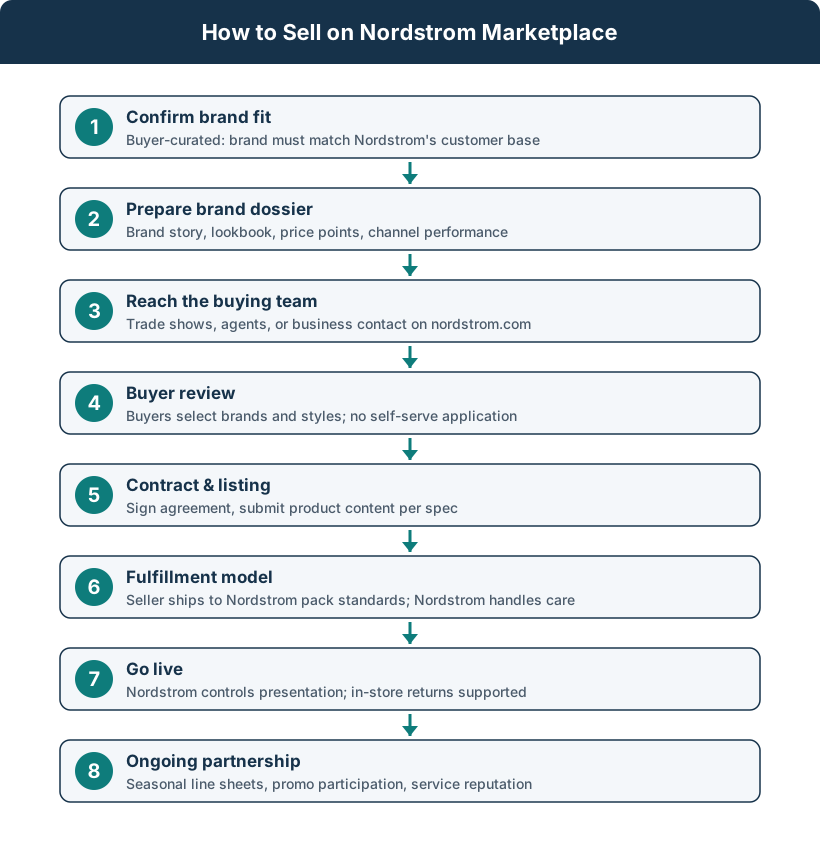
This chart looks different from the others because step one isn't "submit application" — it's "reach the buyers."
Three practical routes: attend US apparel and beauty trade shows (buying teams scout there); get introduced through a brand agent or showroom with Nordstrom relationships; or send brand materials and a lookbook through the business contact on the site. Cold emails convert poorly; warm introductions convert an order of magnitude better.
Once buyers approve, contracting, listing, and shipping follow the standard flow. Nordstrom dictates content specs and presentation — sellers trade content control for Nordstrom-grade page quality and traffic. It's a trade worth making.
Running the numbers
Nordstrom publishes no commission rates — they're negotiated per brand and category, so confirm the latest official policy before signing. The model below uses typical luxury-marketplace levels.
Say you sell accessible-luxury womenswear at $180 average order, 600 orders a month, $108,000 in monthly sales. Assume 20% commission (luxury marketplaces typically charge above mass platforms): $21,600. Cost lines: premium packaging and fulfillment (white-glove pack-out, branded boxes, ~$12 per order: $7,200), returns (luxury apparel at 15%: ~$6,000 in return freight and inspection), content and lookbook investment (5% of sales: $5,400).
Monthly contribution: roughly 108,000 − 21,600 − 7,200 − 6,000 − 5,400 = $67,800 before product cost. With COGS at 30%, true net margin lands near 33%. See the point? $180 average order versus $38 on a mass platform — five extra commission points, but absolute profit in a different universe. Luxury channels sell brand premium, not units.

Tactics that work
First, the lookbook is your foot in the door. Buyers review dozens of brands; a tight, visually coherent lookbook under ten pages — brand story, price tier — beats a fifty-page product manual ten times over. Hire a real photographer; phone snapshots won't cut it.
Second, nail your price-tier positioning. Nordstrom's core sits at accessible luxury to premium — your pricing must land in its shelf comfort zone. Price too low and buyers think you cheapen the floor; too high and nothing moves. Map your category's price distribution on nordstrom.com before you price.
Third, deliver counter-grade unboxing. Tissue paper, brand stickers, thank-you cards, dust bags — on Nordstrom these aren't bonuses, they're the passing grade. Buyers paying premium prices are buying the whole experience.
Fourth, let Nordstrom run service, but feed it properly. Nordstrom-handled service means sky-high complaint standards — your tracking data, carrier scans, and inventory accuracy must sync in real time. Integrate via EDI or API from day one; manual spreadsheet uploads won't survive.
Fifth, submit newness quarterly. Buyer-driven platforms allocate traffic to "new" — send buyers fresh styles and colorways every season to stay top of mind. Brands that go dark for two seasons watch their traffic quietly slip away.
Pitfalls to avoid
Pitfall one: running Nordstrom like Amazon. Assortment dumping, price racing, volume chasing — all dead ends here. Buyer-curated platforms reward "few but excellent." SKU count doesn't matter; every style being a winner does.
Pitfall two: packaging downgrades. Some sellers swap to plain poly mailers after launch to save cost. When Nordstrom buyers unbox cheap packaging, bad reviews and returns arrive together. Price packaging in; never cut it.
Pitfall three: inaccurate inventory. Luxury styles run shallow — dozens of units per SKU. Sync lag causing oversells puts Nordstrom's own service team in front of angry buyers, and your brand equity pays the bill. WMS inventory accuracy must clear 99.5%.
Pitfall four: ignoring alterations and styling. Nordstrom offers alterations and styling services; your product data (fabric composition, care instructions, fit measurements) must be complete and accurate, or store associates can't serve your buyers and return rates spike.
Fulfillment and warehousing: how to set it up
Nordstrom is seller-fulfilled, but the standard is "counter grade." That's the single most important sentence in this guide.
Build a separate pack-out line. Tissue folding, sticker placement, dust-bag technique, thank-you cards with a handwritten feel (printed faux-handwriting works) — every motion needs an SOP. Carve out a dedicated Nordstrom packing zone in your 3PL with dedicated packers; never co-mingle with other platforms' orders. The cost of one wrong pack material: months of buyer trust.
On warehouse placement, Nordstrom's customers cluster in coastal metros and affluent suburbs. Two nodes is the starting config: LA for the West Coast, New Jersey for the East, 2–3 day delivery. Apparel needs hanging-garment zones and climate control (silk and cashmere are unforgiving) — your 3PL needs luxury-apparel experience. Returns QC matters even more: luxury resale demands pristine condition, so every return gets individual inspection, steam pressing, and repacking; only A-grade flows back to full-price sale.
For overseas inventory, luxury apparel is light and high-value, so air freight's cost share is tolerable. Go "small batch, high frequency": ocean container for the opening buy, weekly air top-ups for winners. That keeps cash free without stockouts. In your WMS, build Nordstrom as an independent wave with its own pack SOPs, QC standards, and returns flow — run it as a standalone luxury business line, not "just another channel."
One action for tomorrow: pick three comparable brands already on Nordstrom, order their cheapest items, and dissect every detail of the unboxing. Only when your unboxing scores 90 against theirs should you knock on the buyer's door.